All dishes / 西欧
Fish and chips Period AOrigin theory BVerified
Some fields (dish name, region and gates) are shown from the Japanese-edition data.
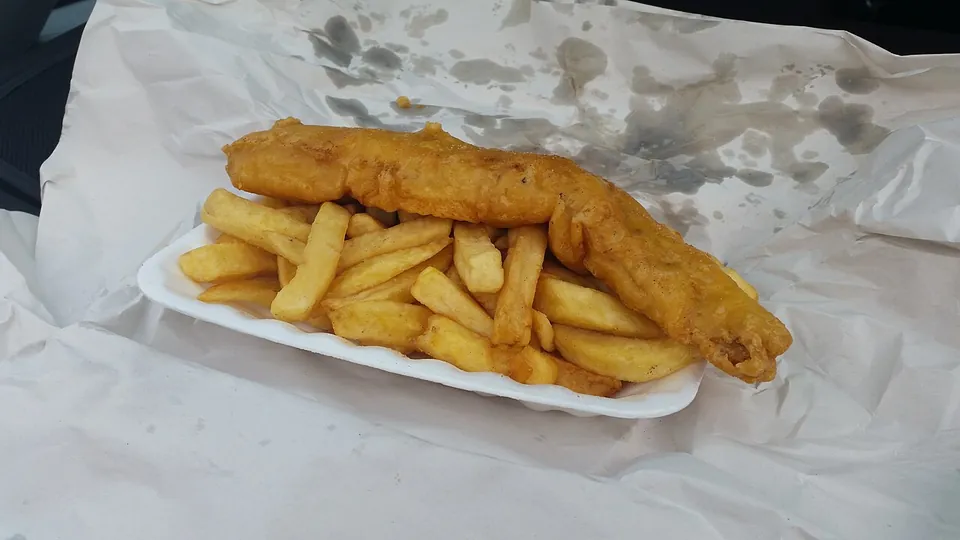
Britain's national dish: fried fish and fried potatoes wrapped in paper. Which shop first sold the two side by side—Malin's in London or Lees's in Mossley—is a question that, for want of contemporary records, has never been settled.
Verification highlight popular claim → verdict → evidence
The mid-19th-century emergence of fish and chips is solidly dated. The critical enabler was neither the fish (already local) nor the potato (already established) but the distribution network -- railways and steam trawling that carried cheap fresh cod and haddock inland (Britain, roughly 1840-1870, coastal regions first). The leading, near-consensus account traces the dish to the fusion of Jewish-style fried fish (pescado frito) with British-style chips. The specific shop that first combined the two -- Malin's in London (c.1860) or Lees's in Mossley (c.1863) -- remains an open, unresolved dispute even in scholarly accounts (Walton, 1992).
The three gates
- Ingredient-supply gate
- Cod and similar whitefish, plus potatoes (both already well established in Britain by the 18th-19th centuries)
- Cooking-technique gate
- Railways plus steam trawling, and cheap frying oil
- Venue gate
- eating houses / working class / coastal and port towns / Jewish immigrant
Overview
Fish and chips took shape in Britain around the middle of the nineteenth century, roughly between 1840 and 1870. That this pairing of fried fish and fried potato could not have appeared in Britain much earlier is a firm point of history.
The starring cod and haddock were native to British waters, long a fixture on tables around the fishing ports. The potatoes served alongside them, though New World in origin, had settled into British eating by the close of the eighteenth century. The ingredients themselves were already at hand.
What changed was that the fish could now reach inland cities cheaply. Railways linked the coastal ports to the industrial towns, and steam-powered trawling drove catches sharply upward. Cod and haddock landed that morning could travel the rails packed in ice and reach an inland worker in under a day. The records show the dish spreading first in the port towns and seeping inland along the lines from there.
To this were added cheap frying oil and shops that sold fried food by weight to working people. In the smoke-filled cities, the crowds wanting a hot, cheap supper met the rails that carried in the sea's fish—and at that meeting point, fish and chips arose.
How we know
Two questions run through the history of fish and chips: where the technique of frying fish came from, and which shop sold it first.
On the pedigree of the fried fish, recent scholarship has gone a good way toward an answer. Sephardic Jews brought pescado frito—fish fried in advance for the Sabbath, meant to be eaten cold—and this technique, carried to Britain, joined with the French-derived fried potato, the chip. Panikos Panayi, a historian of European history, in his 'Fish and Chips: A History' (2014), grounds the dish in exactly this confluence of two streams: the fried fish Jewish, the chips French. The Royal Museums Greenwich and Historic UK trace the same line. The original pescado frito, however, was a separate dish that came without chips; something can be called fish and chips only from the moment fried fish and fried potato are joined on one plate. The phrase 'fish and chips' itself, so far as can be traced in print, first turns up in an 1879 Manchester Evening News advertisement for 'Fried Fish and Chipped Potato,' followed by an 1886 Burnley Express and an 1887 Sheffield Daily Telegraph. The 1879 and 1886 originals sit behind a paywalled newspaper archive and have not been examined firsthand; only the 1887 instance has actually been seen. Either way, the phrase surfaces some time after the dish was already abroad in the world.
The other question—which shop first sold fried fish and chips side by side—remains in the fog. From the south, Joseph Malin (Bow, London, around 1860, recognized by the National Federation of Fish Friers as the world's oldest shop); from the north, John Lees (Mossley, Lancashire, around 1863, whose shop bears a sign proclaiming it 'the world's first fish and chip shop'). John K. Walton, a historian of working-class culture, writes plainly that no contemporary record survives to show which came first, and that the point cannot be settled. The founding shop still cannot be identified.
The dish spread out from the towns where fish, packed in ice, ran the rails to inland tables. The founding shop may sit in the fog, but the thick thread of it—the line that carried the sea's fish inland—can still be followed clearly.
The full set of origin theories and the detailed verification log — traceable all the way to their sources — are available on the Japanese edition.
See the full origin theories and verification log (Japanese) →