All dishes / 東アジア
Japanese curry rice Period BOrigin theory BVerified
Some fields (dish name, region and gates) are shown from the Japanese-edition data.
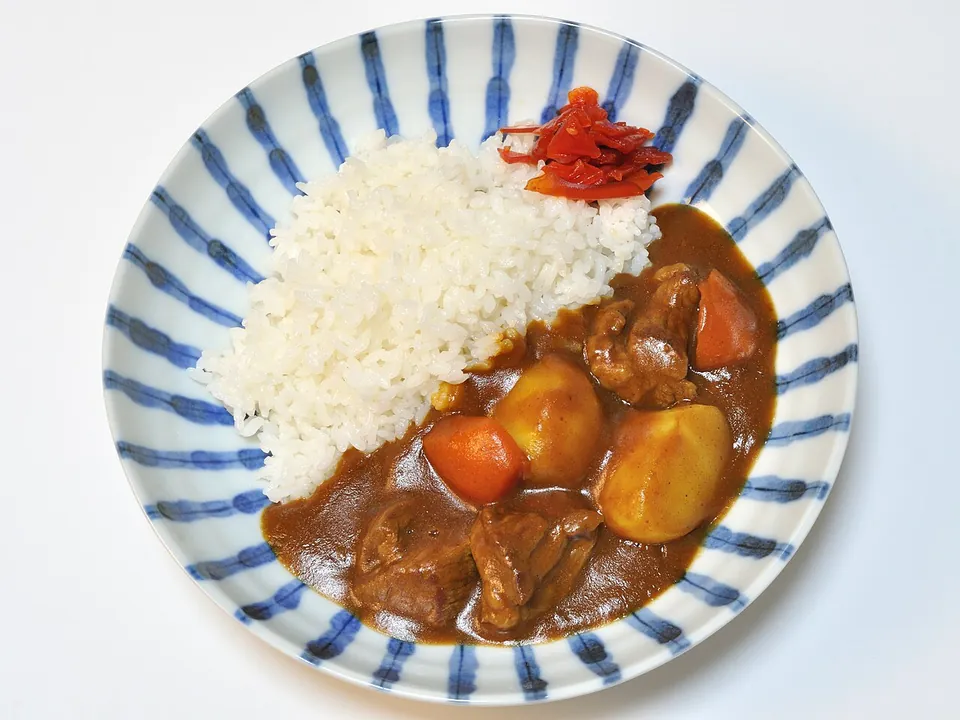
Japanese curry rice did not come straight from India. It descends from "curry" as Britain had already reworked its Indian colonial cooking into a Western-style stew, and it was the Meiji-era Japanese Imperial Navy that carried it across the country as a shipboard meal. The tale that the naval surgeon Takaki Kanehiro introduced curry to the navy to fight beriberi is a later story that the records do not bear out.
Verification highlight popular claim → verdict → evidence
Curry reached Japan by way of Britain (India to Britain to Japan). It first appears in print in two 1872 cookbooks, and the earliest documented naval curry dates to 1908. British curry powder was adapted by the Japanese Navy into a flour-thickened roux served over rice. The widely repeated story that naval surgeon Takagi Kanehiro personally introduced curry as a cure for beriberi is not well supported by primary sources -- his beriberi dietary reforms are historical fact, but crediting him individually with curry's introduction appears to be a later embellishment.
The three gates
- Ingredient-supply gate
- Curry powder (British brands such as Crosse & Blackwell and similar)
- Cooking-technique gate
- Spread nationwide through military food, adopted by the Japanese Navy in imitation of the British Royal Navy
- Venue gate
- military / common people
Overview
Curry rice took its settled shape in Japan in the late Meiji period, toward the end of the nineteenth century. But the road the dish traveled did not run straight from India to Japan. The spices that had been blended together in India were standardized by British firms such as Crosse & Blackwell into bottled "curry powder," a product anyone could handle. What reached Japan was not the Indian article but this curry by way of Britain. In the written record it first appears in 1872 (Meiji 5), when cookbooks such as the Seiyo Ryori Shinan (by Keigakudo Shujin) and the Seiyo Ryori Tsu (by Kanagaki Robun) carry entries for curry; the former describes a frog curry made with scallion, ginger, garlic, butter, wheat flour, and curry powder. That Japanese curry today is a thick brown stew, leaning more toward sweetness and body than toward heat, follows from its being modeled on a Western stew by way of Britain rather than on Indian cooking.
What carried this curry across the country was the setting of the military. The Japanese navy, taking the British Royal Navy as its model, adopted a curry thickened with wheat flour to suit rice as a shipboard meal. The oldest text to record navy curry is the Kaigun Kappojutsu Sankosho (Naval Cookery Reference), compiled in 1908 (Meiji 41) by the Maizuru naval corps; it already sets down the form unchanged today—beef or chicken, carrot, onion, potato, salt, curry powder, and wheat flour, thickened with a flour roux and poured over rice. Men who finished their service carried the dish home to their villages, and from the military and Western-style restaurants curry spread to ordinary tables. By 1905 (Meiji 38) curry powder was being produced domestically, so that households could make it without relying on imports, and its place as an everyday food was sealed.
How we know
People still tend to think "curry means straight from India," but Japanese curry rice did not arrive directly from there. Even though the spices originate in India, what set the shape of the dish as we know it was the detour: Britain, which ruled colonial India, standardized those spices into bottled "curry powder" and reworked them into the base of a Western-style stew. What crossed to Japan was this British curry, and the reason the thick brown stew leans toward sweetness and body rather than heat is that its model was the British Western stew, not the Indian table. From the first appearance recorded in an 1872 cookbook to the shipboard form conveyed by the 1908 Naval Cookery Reference, the route—India to Britain, Britain to the navy, the navy to the home—can be traced one step at a time in the primary sources.
There is another story often told. Navy curry, it is said, was devised by the naval surgeon Takaki Kanehiro to prevent beriberi and introduced by him to the navy. It is true that Takaki reformed the sailors' diet from white rice toward barley rice and Western food and reduced beriberi, and that achievement is historical fact. But no contemporary record supports the particular claim that curry was a pillar of that dietary reform, or that Takaki personally brought curry into the navy. Even Japanese reference works note that they can offer no basis for saying Takaki adopted curry and cannot tell whether it is fact. That the navy served curry is confirmed in writing by the Naval Cookery Reference, but tying its adoption to Takaki and to fighting beriberi has the strong color of a tradition added afterward.
So this dish carries no grand fabrication, but it does carry two assumptions: the association of "curry, therefore straight from India," and the personal legend that "Takaki Kanehiro brought curry into the navy for beriberi." The first falls apart once the several-stage route is traced; in the second, only the parts about the person and the motive have been handed down without support in the sources. That the setting of the military carried curry across the country is certain, but who began it and why remains, in the record, unsettled.
The full set of origin theories and the detailed verification log — traceable all the way to their sources — are available on the Japanese edition.
See the full origin theories and verification log (Japanese) →