All dishes / 西欧
Fasolada Period BOrigin theory CVerified
Some fields (dish name, region and gates) are shown from the Japanese-edition data.
Fasolada, the white-bean soup often called Greece's national dish, is regularly traced to an ancient festival. But its central bean was born in the New World and had no place on an ancient Greek table.
Verification highlight popular claim → verdict → evidence
Popular claim: fasolada descends directly from an ancient Greek bean soup offered to Apollo at the Pyanopsia festival, tied to the Theseus legend. Verdict: refuted for the dish in its current form -- ancient Greek bean soups used fava and other Old World legumes, since the white bean (Phaseolus vulgaris) that defines fasolada is a New World crop that only reached the Mediterranean in the 16th-17th century (Bitocchi et al., 2023, Nature Communications). Fasolada's status as Greece's "national dish" is also a relatively recent narrative reinforced during the 20th-century occupation and postwar years, not an ancient tradition.
The three gates
- Ingredient-supply gate
- Olive oil was already available; the white beans that define the modern dish are New World in origin, and their arrival in the Mediterranean in the 16th century set the limiting date.
- Cooking-technique gate
- Beans and vegetables simmered together in olive oil, a simple stew.
- Venue gate
- Everyday household food and a Lenten fasting dish; regarded as Greece's national dish.
Overview
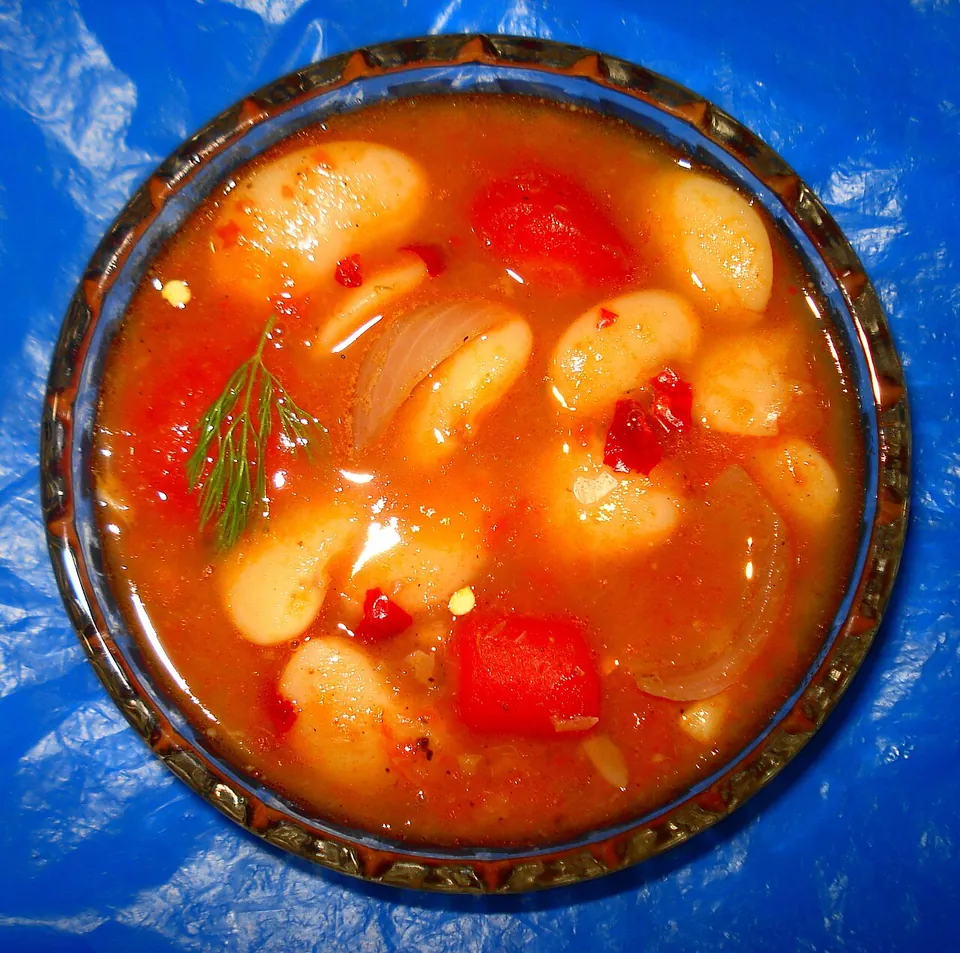
Fasolada is a plain soup of white beans simmered in olive oil with vegetables. In Greece it is everyday home cooking and a Lenten fasting dish, and it is often spoken of as a national dish.
Its central ingredient, the white bean (Phaseolus vulgaris), is a New World crop, and it did not spread across the Atlantic into Europe until the sixteenth and seventeenth centuries. Olive oil and vegetables were long at hand around the Mediterranean, but until this white bean crossed the sea and took root in Greek kitchens, the fasolada we know today had no way of coming into being. Once the bean arrived, the soup as it is now known took shape.
The cooking itself is simple. The beans and vegetables are quietly simmered in olive oil, with no special technique and no costly ingredient. A soup that filled the stomach cheaply, it settled easily into daily meals.
How we know
Fasolada is often given an ancient pedigree. It is said to begin with the bean dish offered to Apollo at the Pyanopsia, the festival known as the 'day of the bean soup,' and even to reach back to the legend of Theseus.
But this pedigree cannot stand as the origin of the fasolada eaten today. Its present central ingredient, the white bean, is a New World crop and was not present in ancient Greece. As archaeologists have pointed out, the bean dishes offered at the ancient festival were soups of other legumes, such as fava beans, different in their very main ingredient from a white-bean fasolada. An origin story that binds the ancient dish and the present one as one and the same does not hold.
None of this denies the antiquity of bean soup as a kind of dish. Boiling and eating beans is an old custom. But that was a different dish with a different bean, better understood as an early layer that lies behind, rather than a direct ancestor of, the white-bean fasolada. Even the language of a national dish was strengthened only in the twentieth century. During the German occupation and the hardship of the postwar years, the soup was eaten widely as a cheap source of nourishment, and it was in that period that its standing as a national dish took hold. For all the old pedigree it wears, the soup loved today is a comparatively recent tradition.
The full set of origin theories and the detailed verification log — traceable all the way to their sources — are available on the Japanese edition.
See the full origin theories and verification log (Japanese) →