All dishes / 中東・北アフリカ
Ghormeh sabzi Period COrigin theory BVerified
Some fields (dish name, region and gates) are shown from the Japanese-edition data.
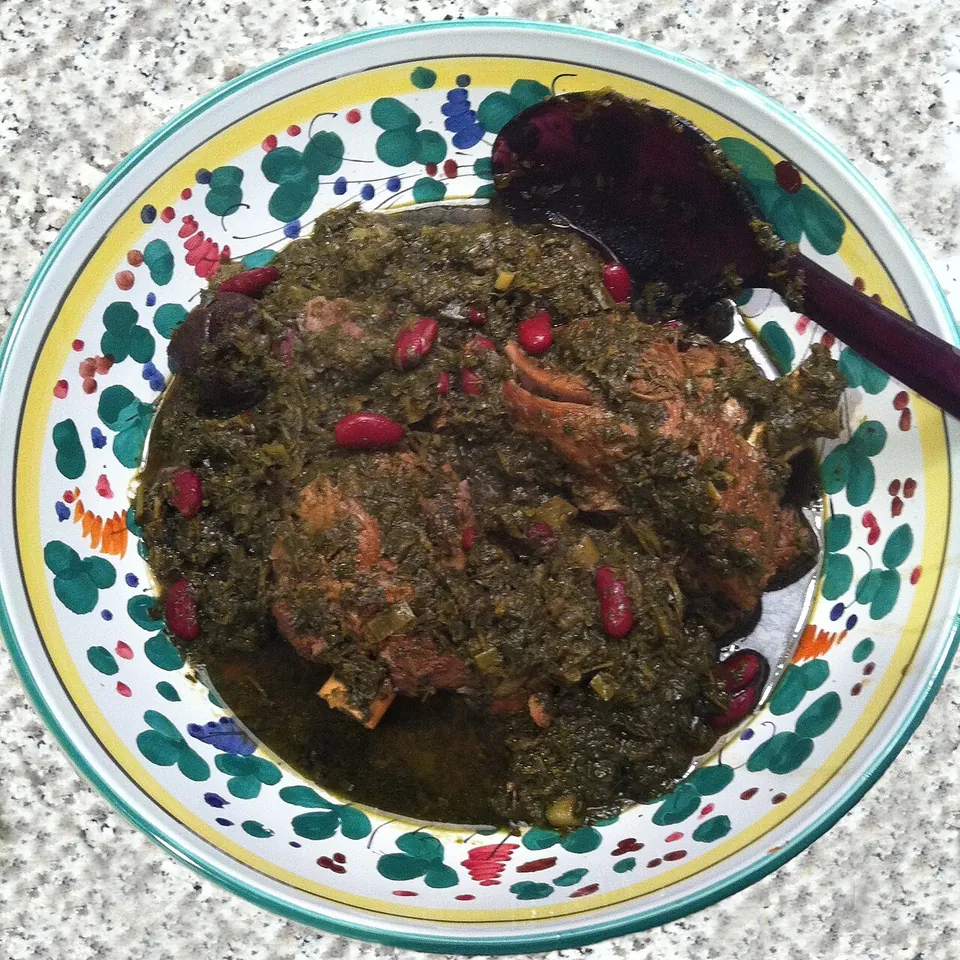
Ghormeh sabzi, a deep-green stew built on great handfuls of fried herbs, is one of the defining dishes of the Iranian table. It is sometimes told as an inheritance from ancient dynasties thousands of years old, yet the version everyone now knows only took shape after kidney beans crossed the ocean from the Americas.
Verification highlight popular claim → verdict → evidence
Ghormeh sabzi is often called an inheritance of two and a half to five thousand years, handed down from the Pishdadian or Kayanian kings. The beans forbid that reading: the kidney bean (Phaseolus vulgaris) came from the Americas and reached Safavid Persia only from the 1590s, along Armenian trading routes (Bitocchi et al., Nature Communications, 2023). Stewing herbs with lamb is genuinely old, and sharply sour khoresh dishes are already there in the Karnama, the Persian manual of about 1521, while the word ghormeh comes from the Turkic qavurma, to fry, a borrowing of the medieval centuries. The dish as it is cooked now, though, cannot do without the bean, and so belongs to the 1590s and after. Its earliest known appearance in a cookery book is in Nader Mirzas, written under the Qajars in the nineteenth century.
The three gates
- Ingredient-supply gate
- The haricot (kidney) bean that the present-day dish cannot do without came from the Americas, with a window of 1590 to 1700 for its arrival in Iran (Bitocchi et al., Nature Communications, 2023). The earliest possible date for ghormeh sabzi as it is cooked now is the early edge of that window, 1590, not the often-cited 1600.
- Cooking-technique gate
- Frying the herbs first, then simmering the stew for a long time.
- Venue gate
- Home cooking, and one of the national dishes of Iran.
Overview
Ghormeh sabzi is a home-style stew in which parsley, coriander, chives, and fenugreek are chopped in large quantities and slowly fried in oil, then simmered for hours with lamb and dried limes. The name joins ghormeh, from the Turkic qavurma (to fry or braise), with sabzi, the green herbs. Its deep green color and the sour edge of the dried limes are its signature, and it is served over plain white rice.
The herbs at its base are all long rooted in Iranian soil. Parsley, fenugreek, and the practice of simmering bundles of greens have lived in these kitchens for a very long time; lamb and dried limes are likewise local ingredients that were close at hand from early on. The braise itself, in which herbs are fried and then stewed with meat, belongs to an old family of Persian stews called khoresh. The Persian cookbook compiled by Bavarchi in 1521 already lists a range of sour-tinged stews of this kind.
What sets today's ghormeh sabzi apart from other herb stews is the kidney bean it cannot do without. That bean is a crop of the Americas and had no place in old Persia. It reached Safavid Persia only from the 1590s onward, carried along the Silk Road and by Armenian merchants. Until the bean made that ocean crossing, a ghormeh sabzi with kidney beans in it had no way of coming into being. So the new-world bean settled onto an old current of herb stews, and the familiar dish took form. In the written record it appears clearly for the first time in the cookbook of Nader Mirza, a court cook of the 19th-century Qajar era, which is the earliest confirmable trace of the dish.
How we know
Ghormeh sabzi carries a persistent story that it was handed down from a distant, ancient Persia. Folk telling and news pieces sometimes present it as a legacy of the Pishdadian or Kayanian era, twenty-five hundred to five thousand years ago.
This proud claim to antiquity runs into a wall it cannot cross. The kidney bean that today's ghormeh sabzi depends on is a crop native to the Americas, and it simply did not exist in the Old World before the age of transoceanic exchange. Set the genetic history of the bean (Bitocchi et al. 2023, Nature Communications) beside the trade record that puts its arrival in Persia from the 1590s onward, and a ghormeh sabzi built around kidney beans cannot have existed thousands of years ago. The tale of a several-thousand-year-old origin is an exaggeration of age that is physically impossible, an invented origin myth.
The genre itself, though, is genuinely old: a stew of herbs and lamb simmered together. The Bavarchi cookbook of 1521 (trans. Hassibi and Sayadabdi) already carries a cluster of sour stews, showing that this line of braising reaches back before the Safavid period. Ghormeh sabzi by name appears in the written record in a 19th-century Qajar cookbook, but the year a dish is first written down is not the year it was born. The old tradition of herb stews is real, and onto it the new-world bean was added to complete the dish as we know it. That double lineage is the true history of how ghormeh sabzi came to be.
The full set of origin theories and the detailed verification log — traceable all the way to their sources — are available on the Japanese edition.
See the full origin theories and verification log (Japanese) →