All dishes / 西欧
Spanakopita Period BOrigin theory CVerified
Some fields (dish name, region and gates) are shown from the Japanese-edition data.
Spanakopita, the Greek pie of paper-thin pastry layered around spinach and feta cheese, is dogged by the claim that Greeks have eaten it since antiquity. That claim mistakes the age of pie as a food for the making of this particular dish.
Verification highlight popular claim → verdict → evidence
The route by which phyllo pastry spread, and its pre-Byzantine history, remain unsettled, with multiple competing accounts.
The three gates
- Ingredient-supply gate
- Spinach, sheep's-milk feta, and wheat were locally available; what had to spread in was the tradition of ultra-thin phyllo pastry.
- Cooking-technique gate
- Layering paper-thin phyllo sheets around the filling and baking it.
- Venue gate
- Home kitchens, monasteries, and market pie shops.
Overview
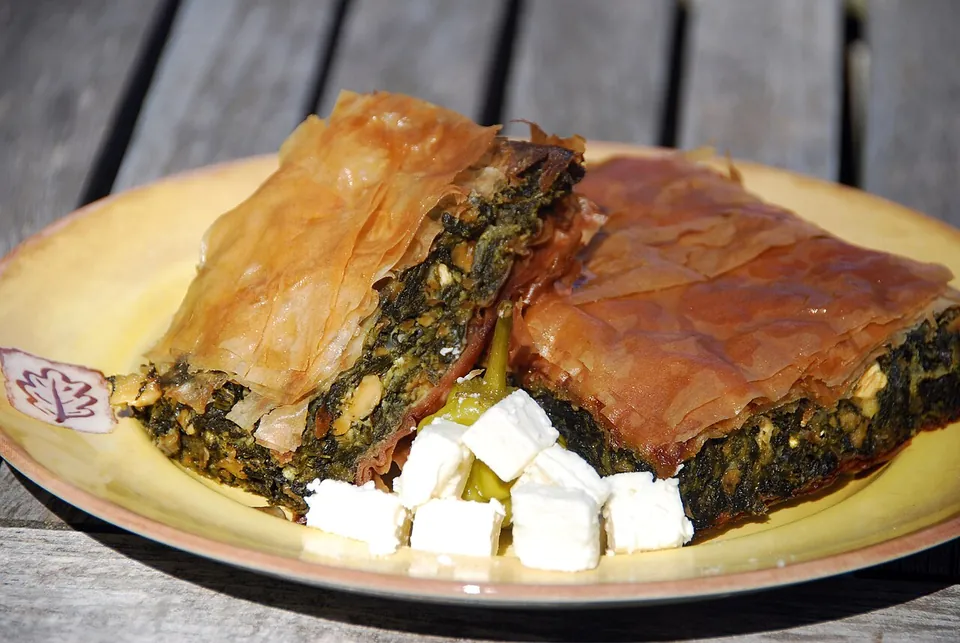
Spanakopita is a Greek savory pie: many sheets of tissue-thin phyllo pastry wrapped around a filling of spinach and feta cheese and baked. Its appeal lies in the crisp, layered pastry set against salty cheese and greens.
The ingredients were all long present in this region. The feta, made from sheep's milk, and the wheat behind the pastry are both local. Spinach, the leading green, reached the Mediterranean during the Middle Ages through Arab trade and became available in Greece as well: it appears in the record in Sicily in the 9th century and across the Mediterranean by the 10th, well ahead of the Ottoman-era table that followed.
What makes this dish what it is, is the pastry work: stacking many sheets of very thin dough, wrapping the filling, and baking. This handwork was carried on not only in home kitchens but in monasteries and market pie shops, and it became a fixture rooted in the region. The current form is generally thought to have settled into place during the Ottoman period.
How we know
Spanakopita is trailed by the saying that it has been eaten since the days of ancient Greece. It is true that thin-pastry pies, and the habit of wrapping wild greens in dough, are old. As the 5th-century-BC writer Philoxenos touches on pie, there is no doubt that pie as a food has long been rooted in the Greek table.
But that is the age of a genre—'pie' and 'greens cookery'—not evidence that today's spanakopita, spinach and feta wrapped in paper-thin phyllo, existed as such in antiquity. The age of the genre and the making of the present dish are two different matters.
Two views stand side by side on how today's form came about. One holds that during the Ottoman period the Turkish dough called yufka was refined into thin, layered sheets, which passed to Greece and gave rise to the current spanakopita. This layered dough belongs to the Turkic food culture of Central Asia, and the 11th-century dictionary Dīwān Lughāt al-Turk records the word yuvgha for a folded bread. The food historian Charles Perry argued that this lineage was honed as thin-layered pastry in the Ottoman court and spread across the Mediterranean. The other view holds that thin-pastry pie already existed in the Byzantine era and that the core of today's spanakopita reaches back that far, limiting the Ottoman contribution to a refinement of the pastry technique.
The two views are supported by separate sources, competing without converging to this day. What is certain is that there is no conflict on the ingredient side: spinach had reached the Mediterranean before the present dish took form. How far back the pastry's lineage runs remains an open question.
The full set of origin theories and the detailed verification log — traceable all the way to their sources — are available on the Japanese edition.
See the full origin theories and verification log (Japanese) →