All dishes / 南アジア
Saag paneer Period COrigin theory CVerified
Some fields (dish name, region and gates) are shown from the Japanese-edition data.
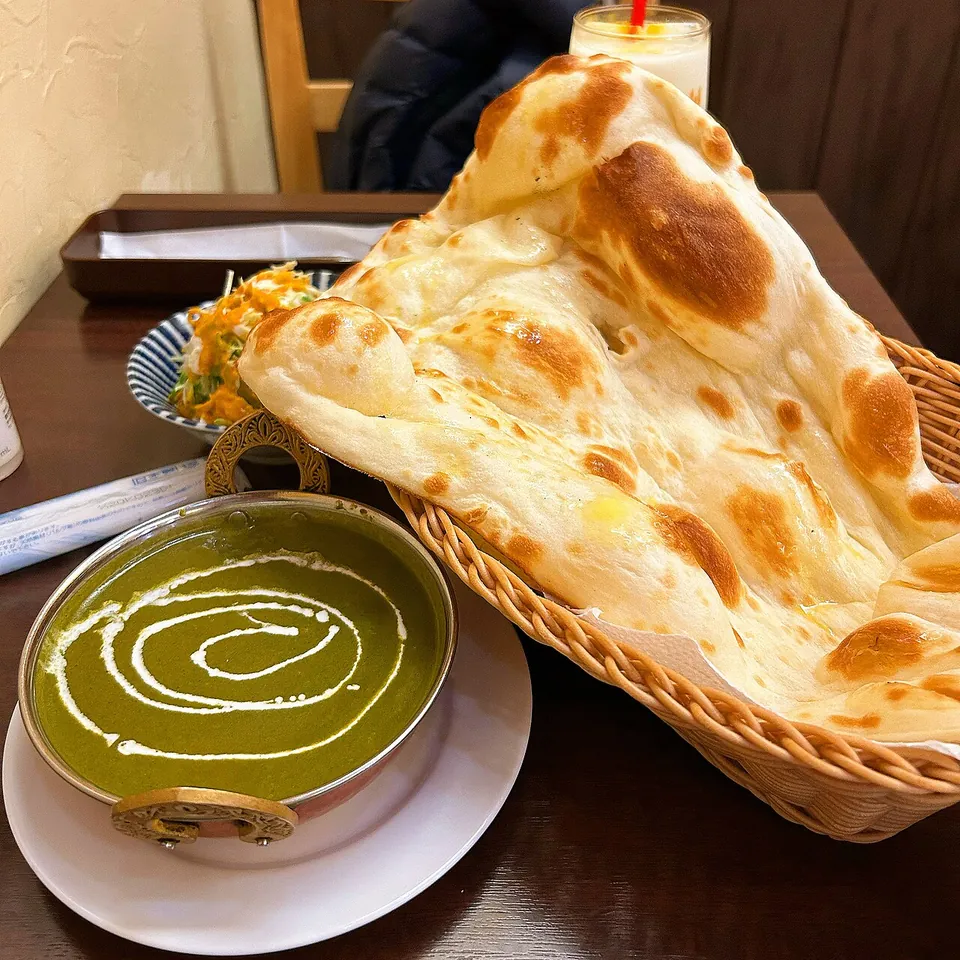
Saag paneer pairs mustard greens with fresh curd cheese in a vegetarian dish from Punjab in northern India. It is a sibling of palak paneer, which uses spinach instead: the same pairing of greens and cheese, parted only by which leaf takes the lead.
Verification highlight popular claim → verdict → evidence
Whether the mustard-greens version came first and the spinach palak paneer followed, or the other way round, is not settled by any source, and the two are kept as equal siblings. Mustard greens have been grown in the Punjab since Harappan times and greens cooked with dairy are an old pairing. Spinach reached South Asia later, around 647 CE, but by 1590 saag was already a word for greens in general rather than for mustard alone: the ninth dish in the kitchen list of the Ain-i-Akbari is "Sag: It is made of spinach, and other greens". The date of the finished dish turns instead on paneer, and paneer's own history is split. The FAO's The Technology of Traditional Milk Products in Developing Countries (1990) states that paneer "seems to have been introduced into India from the Middle East perhaps by Persian and Afghan invaders", and Colleen Taylor Sen (Feasts and Fasts, 2015) and The Oxford Companion to Cheese (2016) likewise place it in the Delhi Sultanate and Mughal centuries. Against that, a peer-reviewed review by Sunil Kumar and colleagues in the Journal of Food Science and Technology reads the heat-and-acid curd of the Kushan and Satavahana periods, cited from the Charaka Samhita, as an ancestor of today's paneer, though the same review repeats the Persian and Afghan account alongside it, so the dairy literature has not resolved the question either. A widely repeated claim that India's National Dairy Research Institute endorses the introduction account traces back only to a sentence in English Wikipedia citing Robinson and Tamime (1996); no NDRI publication saying so has yet been found. And in Blochmann's English translation of the Ain-i-Akbari, read right through, not one dish of Akbar's kitchen uses paneer: the seven occurrences of the letters panir all belong to the fort of Champanir in Gujarat, while spinach and butter appear where they should. Greens were cooked at the Mughal court in 1590; their marriage with the curd is not recorded there.
The three gates
- Ingredient-supply gate
- Mustard greens (saag) are an Old World leaf vegetable eaten daily in the Punjab, so no New World crop holds the dish back. What decides how far back the finished dish can reach is paneer, the acid-set curd cheese, and the origin of paneer itself is unsettled: one account places it in an early local layer (the Kushan and Satavahana periods, 75-300 CE), another has it brought in from Persia or Afghanistan between the thirteenth and seventeenth centuries (FAO technical report, 1990). With the two still apart, paneer cannot simply be called a local food. That the surviving Mughal texts, the Ain-i-Akbari (1590) among them, record no paneer dish sits awkwardly with the introduction account as well.
- Cooking-technique gate
- Setting the curd for paneer, and cooking greens down into a masala gravy; behind both, a culture of keeping milk.
- Venue gate
- Home cooking for ordinary people, everyday fare in Punjabi and North Indian households, vegetarian kitchens among them.
Overview
Saag paneer is a vegetarian dish from Punjab, in northern India, built on greens and dairy. Saag is a general word for leafy greens, but the leaf at the center of this dish is mustard greens (sarson, Brassica juncea). The greens are cooked down into a spiced gravy with fresh curd cheese (paneer) and ghee folded in.
Its sibling, palak paneer, is the same dish made with spinach. The two share one pattern—greens and curd cheese—and diverge only in the leaf they use. Written sources disagree on which one branched from the other, and the question remains unsettled.
Mustard greens are an old Old-World crop, long rooted in the soil of Punjab. Their cultivation reaches back to the Harappan period (around 2300 BCE), and greens have sat on everyday tables here from early on. Paneer, too, is a curd cheese made across South Asia.
What makes this a single dish, though, is the paneer. Cubes of firm curd that hold their shape float in the soft gravy of greens, and that picture depends on a method of setting milk with acid and cutting it into squares. When that method took hold in the kitchens of northern India is disputed: one line of writing has it brought in from outside comparatively late, another holds that it had long been at home in the region. Either way, the moment when greens and curd came together in a finished dish stays out of focus, somewhere across the early-modern to modern span, between 1500 and 1900.
How we know
Which came first, saag paneer or palak paneer? Two views sit side by side on this question, with no written source settling the direction of descent, so the pair stands as siblings.
One view holds that the mustard-greens version came first. Mustard greens (sarson) have been grown in Punjab since the Harappan period, and the pairing of greens with dairy belongs to an old layer of the region's food. Spinach (palak), by contrast, reached South Asia later. On this reading, palak paneer is a later form of the mustard version, shaped to urban tastes outside Punjab. A food-history column in the newspaper Dawn places palak paneer that way.
The other view treats the spinach version as the mainstream. The form that settled as Indian cuisine is palak paneer, and 'saag paneer' is, on this account, more a restaurant label abroad for a mix of assorted greens — a variant rather than an older root. Here saag is read as a difference of naming and region that folds in palak and various greens, and the mustard version is not held to have come first as a system.
Follow the question of which green came first, though, and an older puzzle appears just behind it: the origin of the paneer that holds the finished dish together. When this acid-set curd took root in northern India is a matter scholarship has not settled. One line traces a route in from outside. The UN Food and Agriculture Organization's 1990 technical report on traditional milk products (FAO Animal Production and Health Paper 85) states that paneer "seems to have been introduced into India from the Middle East perhaps by Persian and Afghan invaders," and leaves it there, without fixing a date. The span usually quoted—the thirteenth through seventeenth centuries, from the Delhi Sultanate to the Mughal period—comes from later writing, Colleen Taylor Sen's Feasts and Fasts among it, with the Persian word panir offered as corroboration.
The other line reaches much further back. B. N. Mathur read the ancient medical compendium Charaka Samhita as already describing milk heated and set with acid in the Kushana and Satavahana era (75–300 CE), and a peer-reviewed review of paneer in the Journal of Food Science and Technology (Kumar, Rai, Niranjan and Bhat, 51(5):821–831) takes that reading to run on into the cheese made today, treating paneer as native to the northwest of South Asia. The same review, however, also sets down the account in which travellers from Afghanistan and Iran carried it in: the dairy-science literature has not converged even inside a single article. Before one can argue which green came first, the curd that carries the greens has yet to be dated.
So where does this dish first surface in writing? One thread runs through the Āʾīn-i Akbarī, Abu'l-Fazl's record of Akbar's court completed in 1590. Ninth in its list of court dishes stands sāg, described as made of spinach and other greens and counted among the most agreeable dishes, with ghee, onion, ginger, pepper, cardamom and cloves. A dish of greens under that name was on the imperial menu by that year at the latest. Note which green is named first: spinach. Saag, in this line, is a word for greens at large rather than for mustard greens in particular, and the second view above finds its echo here.
Paneer, on the other hand, is absent from that list of dishes. The spelling panir does turn up in Blochmann's English translation of the first volume, but only inside Champanir, the name of a fort in Gujarat, never as something to eat. The Mughal court of 1590 had saag; it did not have saag with paneer. That absence takes neither side. If paneer had come in from outside after the thirteenth century, the fact that the record of Akbar's kitchens holds not one dish made with it sits just as awkwardly. The greens have their first line in 1590. The finished pairing of greens and curd has yet to yield one.
The full set of origin theories and the detailed verification log — traceable all the way to their sources — are available on the Japanese edition.
See the full origin theories and verification log (Japanese) →