All dishes / 北米
Clam chowder Period BOrigin theory CVerified
Some fields (dish name, region and gates) are shown from the Japanese-edition data.
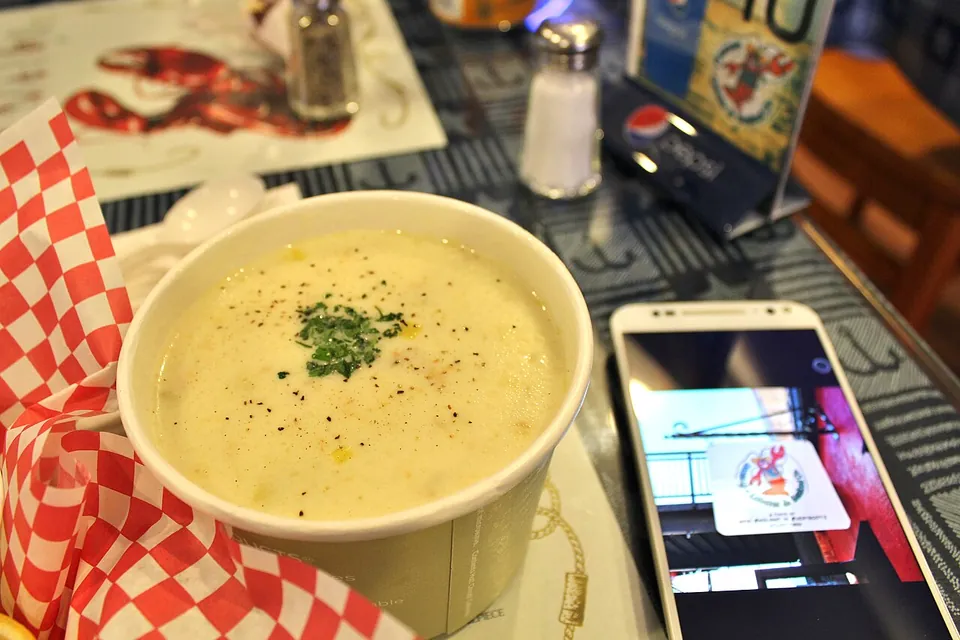
New England clam chowder, the white shellfish soup, came together on a coast where the region's Native peoples had been simmering local clams since deep antiquity, joined by a pot-stew tradition of Breton origin. Its name, chowder, is not the English dialect word for a fishmonger (jowter) but a corruption of the French chaudière, meaning a cauldron.
Verification highlight popular claim → verdict → evidence
Myth: clam chowder is a purely American invention of New England. Verdict: the name comes from the French chaudière or chaudron, a cauldron, and the habit of simmering in one was carried by Breton fishermen by way of Newfoundland to New England, where it met a clam-eating tradition already ancient among the region's Native peoples; the earliest recorded recipe with clams is Lydia Maria Child's The American Frugal Housewife (1832). Main sources: Online Etymology Dictionary; Oxford English Dictionary (clam chowder, 1822); L. M. Child (1832, primary source).
The three gates
- Ingredient-supply gate
- The lead ingredient, hard-shell clams, is native to the North American Atlantic coast. Potatoes, dairy, and pork had all arrived by the colonial period, so no ingredient sets an earliest possible date for the dish. Canned clams later carried it inland: Burnham & Morrill began commercial clam canning at Blue Point, Maine, before 1869 — the first such operation in the United States — supplying clams to places where fresh ones could not be had.
- Cooking-technique gate
- The white, milk-based style of chowder settled into place in the first half of the nineteenth century, attested in L. M. Child's 1833 edition among others. Salt pork is rendered for its fat, and clams and potatoes are then simmered in milk or cream.
- Venue gate
- Cooked at home and served in eating houses, it was everyday food for ordinary people, and it belonged to the fishing villages of the coast.
Overview
From port town to the interior
Clam chowder is a white soup of New England: clams as the star, simmered with potatoes, milk or cream, and salt pork. The milk-based form we know today settled into place in the first half of the nineteenth century—roughly the 1830s to the 1860s—around Boston.
The clams at its heart are shellfish long native to the North American east coast. The region's Native peoples were simmering them long before colonization, dropping heated stones into water-filled vessels to cook the shellfish. Shell middens, some reaching back four thousand years, testify to the depth of that food tradition. Potatoes, dairy, and pork had all reached this coast by colonial times.
Onto this came a pot-stewing method carried over from Europe. Render fat from salt pork, then simmer clams and potatoes until soft in milk or cream: this layered way of building up the pot took hold as the white chowder in the early nineteenth century. It began in the homes and harbors of fishing villages, or as shipboard cooking, and its makeup—cheap, easily gathered shellfish paired with keeping-quality salt pork—mirrors the life of coastal working people. In time it spread to city eating houses.
One thing carried the dish to inland towns far from the sea: clams that could not travel fresh were turned into something that could. By 1869 the firm of Burnham & Morrill had begun canning clams at Blue Point, Maine—the first commercial clam canning in the United States—supplying clams even to an interior that had never had them fresh. Just when the spread of the railroads reinforced this is not yet known.
How we know
Where the name chowder came from has long been debated between two accounts. One holds that jowter, a sixteenth-century word for a fish peddler in the dialects of Cornwall and Devon in southwestern England, turned into chowder. The other holds that it is a corruption of the French chaudière, meaning a cauldron or kettle.
Of these, the English-dialect jowter account is mentioned as a rival hypothesis, but the Oxford English Dictionary does not accept it as a reliable etymology. What lexicography treats as the leading account is derivation from French chaudière—a cauldron, in use since the twelfth century. Breton fishermen carried the habit of simmering in a cauldron to Newfoundland, and from there it passed through the Maritimes to New England. The dish is first recorded in North America in a Boston newspaper of 1751, but the chowder printed there is a simmer of fish, pork, and biscuit, with no clams, potatoes, or milk. The words "clam chowder" appear no earlier than the 1822 entry the Oxford English Dictionary cites from William Kitchiner, and the first written direction for making it with clams comes in 1832, in the household book of Lydia Maria Child.
There is a second, often-erased backstory. Clam chowder is often told as "an American invention of New England," but the tradition of cooking and eating clams was here long before Europeans arrived—it belonged to the Native peoples of the land: the Mohegan, Pequot, Narragansett, and Wampanoag. They made soups by simmering local clams in watertight vessels with heated stones, and the depth of that tradition shows in shell middens reaching back four thousand years. Today's clam chowder is that old Native tradition of eating local clams joined to a Breton-derived layered pot-stew and to the name chowder. A story that strips out the Native tradition to make the dish a purely American invention oversimplifies that convergence.
The full set of origin theories and the detailed verification log — traceable all the way to their sources — are available on the Japanese edition.
See the full origin theories and verification log (Japanese) →