All dishes / 北米
Lobster roll Period BOrigin theory CVerified
Some fields (dish name, region and gates) are shown from the Japanese-edition data.
Who made the first one? To that question the famous answer is 'invented at Perry's in Connecticut in 1929'—but the record points to a different current, a full century older. The lobster roll is a dish with no single inventor.
Verification highlight popular claim → verdict → evidence
Popular claim: Perry's of Milford, CT 'invented' the hot buttered lobster roll in 1929. Verdict: one regional style among several, not a sole origin -- food historians trace a continuous cold lobster-salad lineage back to Lydia Maria Child's 1829 cookbook, with the term 'lobster roll' first appearing in print in the New York Times in 1937 (Stavely & Fitzgerald; Mariani's Encyclopedia of American Food and Drink).
The three gates
- Ingredient-supply gate
- Atlantic lobster is a native crustacean of the North American coast (native); the wheat for the bun is Old World in origin but long naturalized.
- Cooking-technique gate
- Boiled lobster meat tossed with mayonnaise or butter and packed into a split-top bun.
- Venue gate
- New England coastal seafood shacks and drive-ins, later spreading nationwide.
Overview
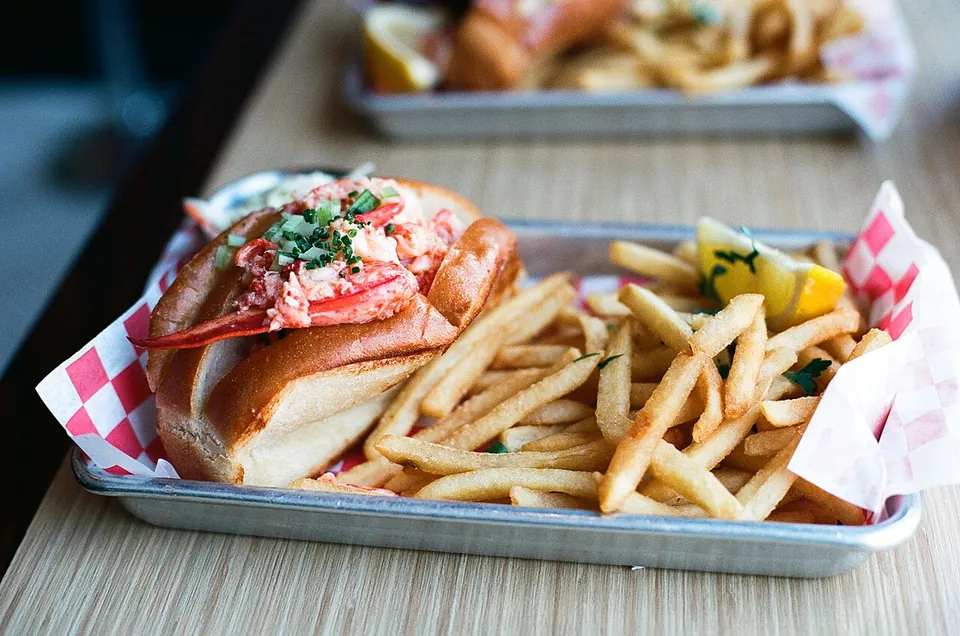
The lobster roll is a sandwich of boiled lobster meat, picked from the shell, dressed with butter or mayonnaise, and packed into a split-sided bun. Its star, the Atlantic lobster, is a crustacean long native to the northeastern coast of North America—a commonplace of these waters. The wheat of the bun came over from the Old World but had long since become a local crop. Picking the meat, dressing it, and tucking it into a bun is no elaborate feat, either.
With the ingredients and the handwork both at hand, what lifted this plate into a dish of its own was the spread of the places that served it. In the first half of the twentieth century, drive-ins along the New England coast and plain seaside eateries—lobster shacks—sold this easy sandwich to tourists and day-trippers. It caught on as a summer food to grab by the shore, and in time it spread beyond New England across the whole country.
There are two broad styles. One is the Connecticut style, warm lobster meat dressed in melted butter. The other is the Maine style, cold meat dressed in mayonnaise. Both share the same star, lobster, and the same split-sided bun, yet they stand in contrast in dressing and temperature. The cold mayonnaise version that most people picture today belongs to the latter line, and it took hold in the 1950s, when shacks multiplied in the postwar tourist boom.
How we know
The origin most often told is that at Perry's, an eatery in Milford, Connecticut, Harry Perry put warm butter-dressed lobster into a bun around 1929 and 'invented' the lobster roll. John F. Mariani's Encyclopedia of American Food and Drink carries this claim, long known as the earliest traceable claim by a particular shop.
But that invention tale rests on the account handed down by Perry's grandson, and it stays the story of one shop. Keith Stavely and Kathleen Fitzgerald, tracing New England foodways through the written record (University of Massachusetts Press), showed that the current of cold lobster salad runs back far earlier than 1929. Its starting point is the cold lobster salad in Lydia Maria Child's The American Frugal Housewife of 1829—dressed with egg yolk, oil, vinegar, mustard, cayenne, and shredded lettuce. After the Civil War, amid the culture of seaside clambakes and picnics, that magazine-printed salad became the filling of a sandwich and was eventually tucked into a hot-dog bun. Branden Lewis of Johnson & Wales counts as an ancestor the practical food in which English and Portuguese fishermen packed the unsellable tail and claw meat into bread (National Geographic).
Follow that continuous current, and no single inventor or year of invention can be assigned to the lobster roll—so food history holds. Perry's 1929 is a separate thing: the claim of one shop for one style, the warm one, apart from this long cold-salad lineage. The word 'lobster roll' itself first appears in print in 1937, in The New York Times (a 'quick lunch delicacy' at Cape Ann, Massachusetts)—later than Perry's 1929. The first appearance of the word is not the birth of the dish itself.
The full set of origin theories and the detailed verification log — traceable all the way to their sources — are available on the Japanese edition.
See the full origin theories and verification log (Japanese) →