All dishes / 中東・北アフリカ
Hummus Period BOrigin theory CVerified
Some fields (dish name, region and gates) are shown from the Japanese-edition data.
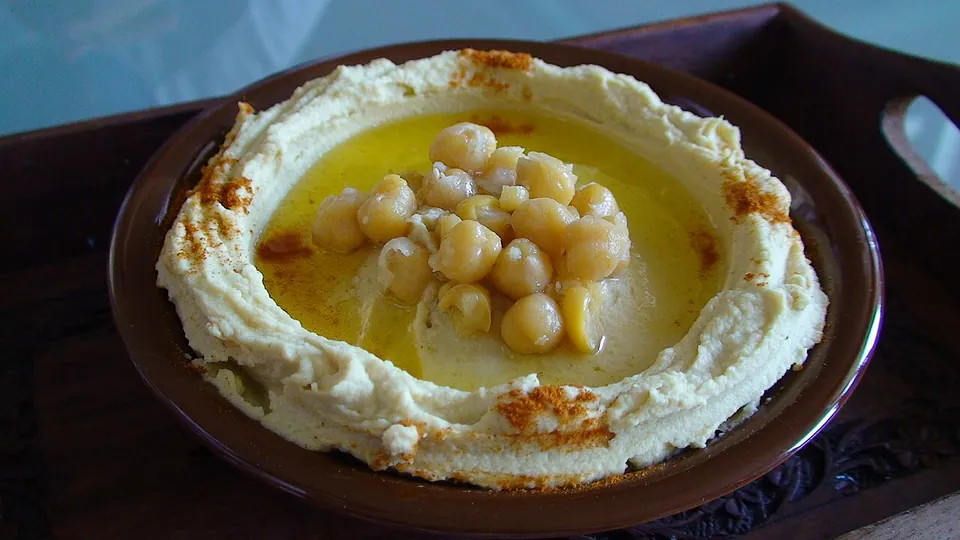
A cold Levantine dish of chickpeas mashed smooth and blended with sesame paste (tahini). Nations quarrel over which one invented it, but the answer food history reaches is that neither the place nor the year of its origin can be pinned down in the sources - a dispute with no winner.
Verification highlight popular claim → verdict → evidence
Myth: hummus is claimed as the invention of a single nation (Lebanon, ancient Egypt/the Pharaohs, Greece, or even attributed to Saladin) — the so-called 'hummus wars.' Verdict: refuted as a single-origin claim; the earliest records close to the modern dish appear in 13th-14th century Levantine/Egyptian cookbooks, but the author, exact place, and date cannot be pinned down (scholarly consensus: insufficient evidence). Main sources: Wikipedia; Charles Perry (2017); Nawal Nasrallah (2018).
The three gates
- Ingredient-supply gate
- Chickpeas, sesame (ground into tahini), and olive oil were all crops long native to the Old World, and every one of them could be had locally without an imported ingredient or a special trade route. Nothing among the ingredients sets an earliest possible date for the dish; it rests on staples already at hand in the region.
- Cooking-technique gate
- Dried beans are simmered soft and ground down in a mortar or on a stone mill, then worked smooth with tahini until the two emulsify. Served cold and finished by hand, it needs no cooking machinery and no special technique.
- Venue gate
- Made at home and served in eateries, it was everyday food for ordinary people, and it has long been rooted in the Arab communities of the Levant.
Overview
Where the dish grew up
Hummus belongs to the tables of the Levant, from Syria across to Lebanon. Dried chickpeas are simmered soft and mashed smooth, then blended with sesame paste (tahini), olive oil, lemon, and garlic. Within the mezze tradition of small plates set out side by side, it has long been an everyday dish made at home.
The chickpeas at its heart, the sesame ground into tahini, and the olive oil are all long-established crops of the Mediterranean, on tables across the region since antiquity. Dried beans are simmered until tender, ground in a stone mill or mortar, and worked smooth with tahini - a cold dish finished entirely by hand, needing no cooking machinery and no special technique.
The oldest written traces reach back to a cookbook of thirteenth-century Aleppo and one of fourteenth-century Cairo, where a dish of mashed chickpeas dressed with tahini appears. Yet the version we know today, with tahini, lemon, and garlic all together, does not turn up complete in the record until a Lebanese cookbook of 1885. Across the long span from the medieval kitchens to the present, the dish spread quietly from ordinary homes into the wider pan-Arab and Mediterranean world. When it took shape is reasonably firm; what wavers is only the single point of its beginning.
How we know
Today hummus is caught up in what people call the "Hummus Wars." Lebanon, Israel, Palestine, and others claim it as their own national dish and compete for the Guinness record with the world's largest plate of hummus - a dispute tangled up with culture and politics. But however heated these national claims grow, none of them answers the question of which country gave birth to hummus.
The oldest surviving records closest to today's form appear in a thirteenth-century Syrian cookbook from Aleppo, the Kitab al-Wusla ila al-Habib (edited and translated by Charles Perry as Scents and Flavors, NYU Press 2017). It was long said to be the work of the Aleppan historian Ibn al-Adim (d. 1262), but only a fraction of the surviving manuscript can be attributed to him, and most of the authorship remains anonymous. And at this stage the recipe shows no garlic. A fourteenth-century Cairo cookbook, the Kanz al-Fawa'id (edited and translated by Nawal Nasrallah as Treasure Trove of Benefits, Brill 2018), records himmas kasa - chickpeas simmered, mashed, and dressed with tahini - in as many as eleven variations, yet here too neither garlic nor lemon is present.
After the fourteenth century the record of hummus breaks off entirely, and the present form, with chickpeas, garlic, lemon, and tahini all together, does not reappear in writing until that Lebanese cookbook of 1885. Between them lie several centuries of silence.
Those who argue for a Levantine origin and those who argue for an Egyptian one each rest on one of these oldest fragments, yet none matches the dish as we know it, and none is decisive. Chickpeas, sesame, and lemon were all eaten across the whole Mediterranean since antiquity, and no contemporary testimony points to any single spot as the beginning. The consensus food history has arrived at is simply that the evidence is not enough. Who made it first will never be settled - and that very absence of an answer has become the shape of the dish itself.
The full set of origin theories and the detailed verification log — traceable all the way to their sources — are available on the Japanese edition.
See the full origin theories and verification log (Japanese) →
Related dishes
Cross-links Sister dishes & same-name dishes (separate lineage)
Shares the key ingredient
- Proto-chickpea curry (chana masala proto-layer)North Indian subcontinentB
- HariraMoroccoC
- Pre-tomato chickpea-and-lentil thickened soup (Harira precursor)Maghreb / Al-AndalusC