All dishes / 東アジア
Lamian (Lanzhou lamian) Period BOrigin theory CVerified
Some fields (dish name, region and gates) are shown from the Japanese-edition data.
Twisting, stretching, and folding the dough to draw out a single strand of noodle—this hand-pulling lā technique is the core of Chinese lamian, and the ancestral form that would later cross the sea to become Japanese ramen.
Verification highlight popular claim → verdict → evidence
The technique is documented and the dish is disputed. Pulling noodles by hand, the dough twisted and stretched until strands come away, is described in Song Xu's Songshi yangsheng bu of 1504, a Ming book on nourishing life, and can be read in the facsimile of the Siku quanshu edition; the method may reach back to the Tang or Song, but 1504 is the oldest description anyone can open. Lanzhou beef noodles as served in restaurants are far later. The usual account credits the Hui cook Ma Baozi, whose "hot-pot noodles" are commonly dated to 1915, with his son Ma Jiesan taking over in 1925 and the Chen brothers fixing the standard of clear broth, white radish, red chilli oil, green coriander and yellow noodles; the Encyclopedia of China names Ma Baozi as the man who established the modern bowl but gives no year. A rival account moves the source east: Chen Weijing of Qinghua in Huaiqing prefecture, Henan, is said to have taught the method to Ma Liuqi, who carried it to Lanzhou in the Jiaqing reign of the early nineteenth century, and descendants of both families have accepted that line. Which of the two the technique came from is not settled.
The three gates
- Ingredient-supply gate
- Wheat has long been grown in northern China, with wheat flour established by 700 at the latest, so the grain sets no limit on the date.
- Cooking-technique gate
- Noodles drawn by hand: the dough is twisted, stretched and folded until strands are pulled out of it. The oldest written description stands in the Songshi yangsheng bu of 1504, so the technique existed by then at the latest, and it is this that sets the date.
- Venue gate
- The noodle houses of northern and north-western China, Lanzhou among them. The bowl as sold today takes its settled form with Ma Baozi in 1915.
Overview
Chinese lamian is a wheat noodle of northern and northwestern China, built around the lā technique of hand-twisting and stretching the dough, folding it again and again, and pulling out a fine noodle strand.
Wheat was a grain long rooted in this land, and wheat flour was established by the eighth century at the latest; the land wanted for nothing in noodle-making material. What shapes this dish is the handwork of drawing out a single strand. Slapping the dough down, giving it a twist, folding and pulling it long again—this skilled noodle-making is what makes Chinese lamian. In the written record, the technique first clearly appears in the Songshi yangsheng bu, a treatise on nourishing life written in 1504 during the Ming dynasty.
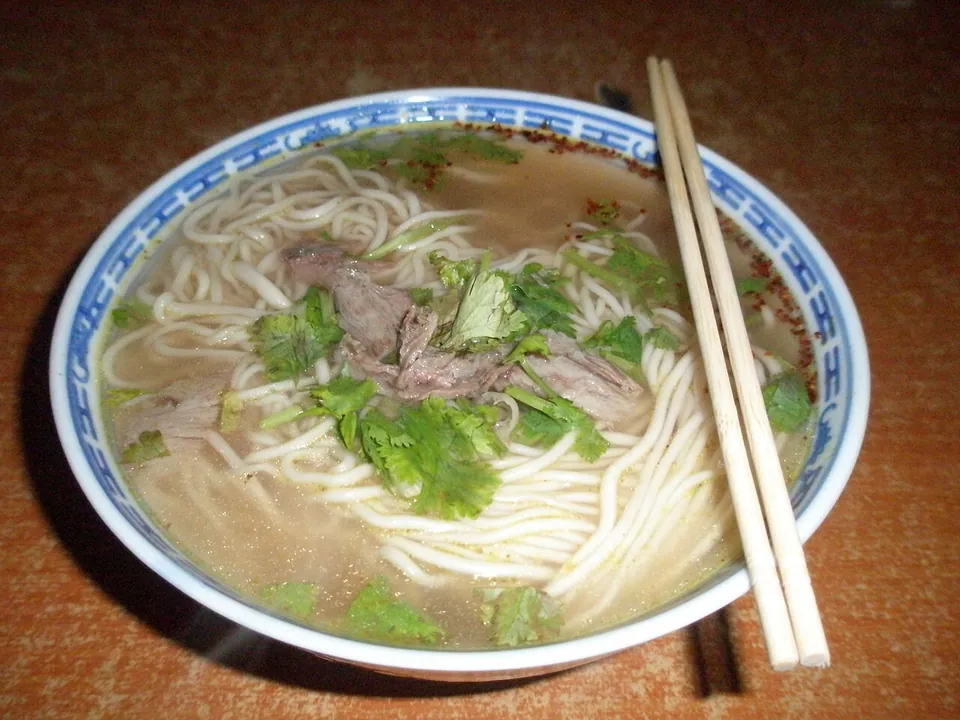
The particular form served in restaurants today—Lanzhou beef noodles—converged only in the twentieth century. Hand-pulled noodles in a clear beef broth, presented with the five colors of clear soup, white radish, red chili oil, green coriander, and yellow noodle, began with the reguozi mian created by the Hui Muslim cook Ma Baozi in the early twentieth century; it spread to the public through his son Ma Jiesan's continuation (1925) and the standardization worked out by the Chen brothers. The old handwork of pulling noodles and the present-day Lanzhou beef noodles as a regional dish belong to separate layers and need to be told apart.
How we know
With Chinese lamian, trying to answer 'when was it born' with a single point ties itself in knots, because the age of the noodle technique and the newness of the dish eaten today belong to different layers.
Take the noodle technique first. The hand-pulling method that draws out a noodle strand has its oldest description in the 1504 Ming treatise Songshi yangsheng bu (by Song Xu). Song Xu's larger compendium, the Zhuyu shanfang zabu, records the hand-pulled noodle method of the early sixteenth century in its yangsheng section as well, and this is corroborated by the Ishige Naomichi archive at the Ajinomoto Foundation for Dietary Culture and by the sinology reference ChinaKnowledge.de; a facsimile of the Siku quanshu edition of the text has been reached directly. Some see the technique reaching back to the Tang or Song, but what can be firmly pinned down in writing is the early sixteenth century, and that is the part that stands as settled.
The current form served in restaurants—Lanzhou beef noodles—is far younger. The records gather around the account that Ma Baozi created it in the early twentieth century, conventionally given as 1915, and the Encyclopedia of China likewise names Ma Baozi as the man who established the present-day beef noodle.
There is, however, another lineage told of that reaches back about a century earlier than this current form. By this account, the cooking technique of Lanzhou beef noodles was learned from Chen Weijing of Huaiqing prefecture in Henan by Ma Liuqi of the Dongxiang people, who carried it to Lanzhou during the Jiaqing era of the Qing (early nineteenth century, some two hundred years ago). Descendants of both the Chen and Ma families are reported to have acknowledged the origin of the secret method, and the Encyclopedia of China follows this line of transmission as well. Because it asserts a Henan origin, it clashes with the conventional Lanzhou account, and the two questions—when the current commercial form was created, and where the cooking technique's lineage came from—overlap without resolution.
So Chinese lamian holds two timescales: an old noodle-making technique that leaves a firm trace in the sixteenth century, and a regional dish that converged in the twentieth. It was this hand-pulling technique that, carried across the sea, grew into a different noodle dish—Japanese ramen.
The full set of origin theories and the detailed verification log — traceable all the way to their sources — are available on the Japanese edition.
See the full origin theories and verification log (Japanese) →