All dishes / 中東・北アフリカ
Fesenjan Period COrigin theory DVerified
Some fields (dish name, region and gates) are shown from the Japanese-edition data.
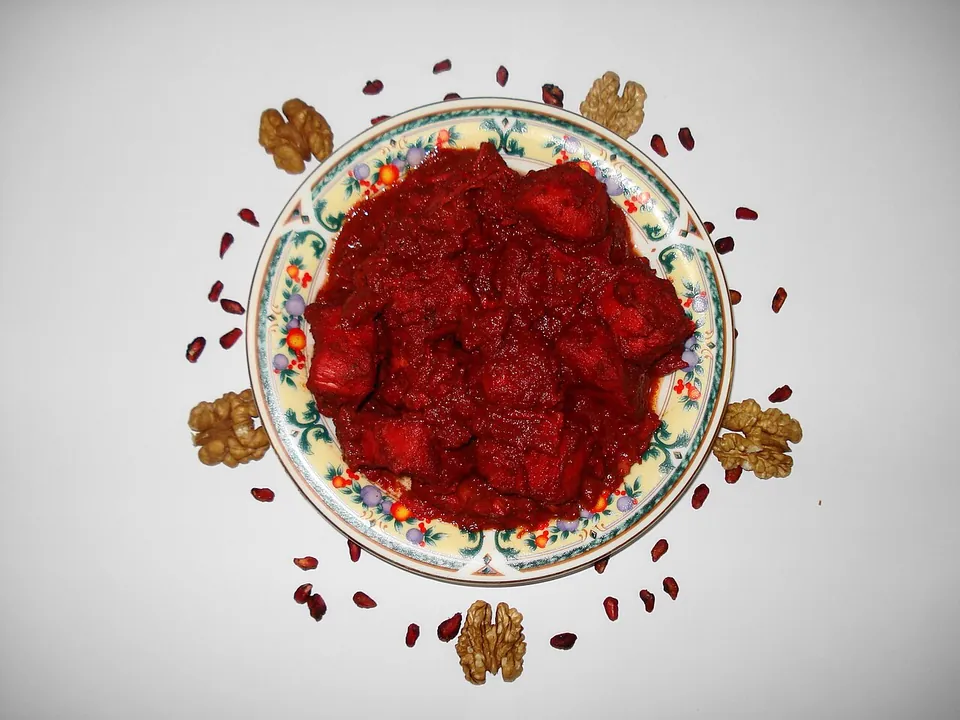
A dark, sweet-and-sour stew of pomegranate and walnut with chicken sunk into it, served at Iranian weddings and feasts. It is often described as a dish that has come down from the ancient Achaemenid court, yet its name and form appear in written records only much later.
Verification highlight popular claim → verdict → evidence
Myth: fesenjan dates back some 2,500 years to the Achaemenid Empire, allegedly recorded at Persepolis. Verdict: rejected -- the Persepolis Fortification tablets are administrative rationing records, not recipes, and no ancient or medieval text names fesenjan or its method; the earliest solid textual trail runs from a Safavid-era cookbook precursor (16th century) to the dish's name and current form first appearing in the late 19th century (Sofra-ye at'ema, 1883-84; the dictionary Farhang-e Anandraj, 1888-89). Key source: Encyclopaedia Iranica, "COOKBOOKS i. Classical Persian Cookbooks" and "QAJAR DYNASTY xiv. Qajar Cuisine."
The three gates
- Ingredient-supply gate
- Both walnuts and pomegranates are native to the Persian plateau, so the ingredient bottleneck is loose since neither is a late arrival.
- Cooking-technique gate
- The long, slow-simmering khoresh technique.
- Venue gate
- From royal court cuisine to a home festive dish.
Overview
Fesenjan is a khoresht (slow-braised stew) built from ground walnuts and pomegranate juice or paste, cooked down for a long time into a thick, deep-brown sauce, with chicken braised in it. Sweetness, acidity and richness fuse into a single flavor, and the dish is known above all as a centerpiece of weddings and festive tables.
Its two lead ingredients, pomegranate and walnut, are long-established crops of the Iranian plateau, on hand from early times. Cook the two down slowly and the oil of the walnut and the acid of the pomegranate melt together, turning into a thick, dark sauce. It was this long braising, with its distinctive body and sheen, that carried fesenjan from the palace kitchen to the festive tables of ordinary homes.
In the written record, the ancestor of the dish—a braise of pomegranate and walnut—reaches back to the Safavid court of the sixteenth century. The name fesenjan and its many present-day variants appear plainly only in the later nineteenth century. There is no need to trace its origin to antiquity to give a full account of how the dish came to be.
How we know
Recipe blogs and travel pieces often tell fesenjan's history as one reaching back 'to the Achaemenids (around 500 BCE),' with claims that 'its name appears in records unearthed at Persepolis.' It is a familiar kind of origin story, one that lends a dish authority through sheer age.
But the footing for antiquity is thin. The Persepolis fortification tablets are administrative records of rations and supplies, not recipes. No ancient text names fesenjan or describes how it was made, and the 'Sasanian origin' sometimes claimed later has no source behind it either.
The solid evidence lies in cookbooks of a much later era. The ancestor—a braise of pomegranate and walnut—is recorded as a court stew in some of the oldest surviving Persian cookbooks: the Karnama (1521, from the reign of Shah Ismail I) and the Maddat al-Hayat (late sixteenth century), written by a cook of Shah Abbas I. The scholarly footing for this ancestor is the entry on classical Persian cookbooks in the Encyclopaedia Iranica.
The first firm attestation of the name fesenjan, alongside some ten variants, is the court cookbook Sofra-ye at'ema, from the reign of Naser al-Din Shah. Its publication date is given as 1881 in some sources and as 1301 AH (1883-84) in the Encyclopaedia Iranica's entry on Qajar cuisine, settling roughly in the 1880s. The dictionary Farhang-e Anandraj (1888-89) then entered the braise under the form fasujan for the first time, describing it as 'a dish of the Gilan region.' A first appearance in a cookbook and a first appearance as a headword in a dictionary—two different kinds of source—converge in the later nineteenth century.
So the dish forms a layered history: its genre's ancestor reaches back to the early-modern (sixteenth-century) court, while the firm lower bound for fesenjan taking its name and settled form lies in the later nineteenth century. There is no need to reach back twenty-five centuries to antiquity. That the craft of cooking down pomegranate and walnut has been handed on across the centuries is itself a rich enough history.
The full set of origin theories and the detailed verification log — traceable all the way to their sources — are available on the Japanese edition.
See the full origin theories and verification log (Japanese) →