All dishes / ラテンアメリカ
Callaloo Period BOrigin theory CVerified
Some fields (dish name, region and gates) are shown from the Japanese-edition data.
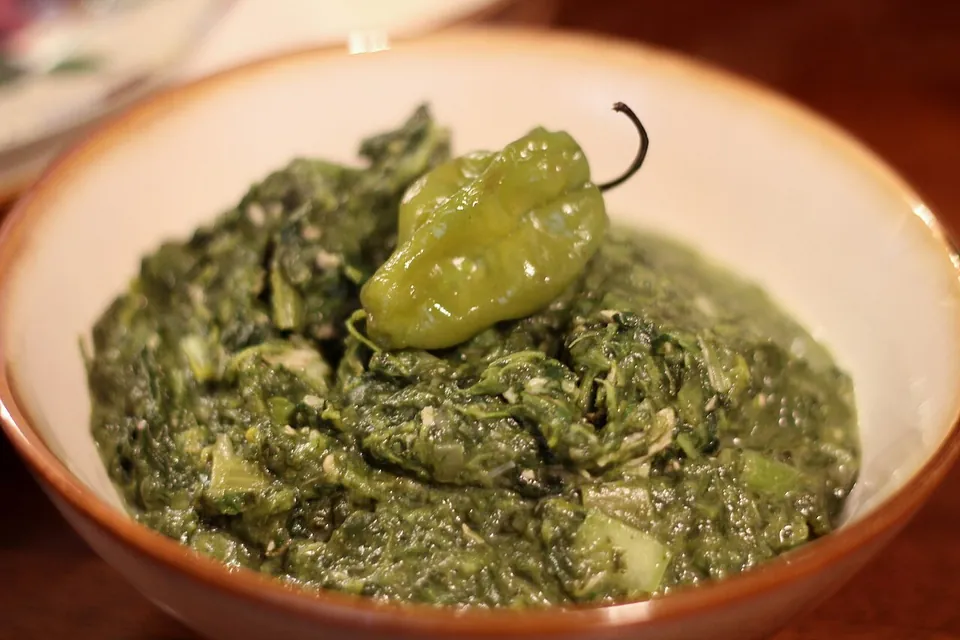
Callaloo, a Caribbean dish of taro leaves and okra simmered soft and thick. Its name and its taste still carry, to the tables of Trinidad and Tobago, the memory of a West African leaf-and-vegetable stew that crossed the Atlantic.
Verification highlight popular claim → verdict → evidence
Two etymologies for the name are each backed by scholarship -- Hamilton (2007) treats Kimbundu 'calulu' and Tupi 'caruru' as separate lineages, while the OED traces a Tupi-derived chain. The dish first appears in the written record in 1696, in Hans Sloane's catalog of Jamaican plants. Its two key ingredients -- okra (brought to the Caribbean via the slave trade in the 17th century) and taro leaf (native to the Old World) -- set the earliest possible date for the dish's formation.
The three gates
- Ingredient-supply gate
- Okra and taro came from West Africa/the Old World via the slave trade and were then cultivated locally.
- Cooking-technique gate
- Simmering leafy greens with okra, a technique of West African origin.
- Venue gate
- A staple home dish, especially for Sunday meals.
Overview
Callaloo is a home dish of Trinidad and Tobago and other parts of the Caribbean, made by simmering taro leaves (locally dasheen bush), okra and amaranth leaves until tender. The form these islands know best enriches it with coconut milk and pairs it with seafood such as crab and shrimp, working it into a deep green thickness. It has struck root in daily life as a standard for the Sunday table and for feast days.
The okra and taro at its heart are crops with homelands in the Old World and Africa. In the era of the Atlantic triangular trade they crossed to the Caribbean islands with enslaved Africans and came to be grown in the warm soil there. West and Central Africa have a long tradition of leaf-and-vegetable stews, simmering amaranth leaves, cocoyam and taro leaves and okra together in one pot. That way of the pot crossed the ocean and took root amid the ingredients and climate of a new land.
The dish takes many forms island by island. In Trinidad and Tobago and in Grenada it brings together taro leaves and okra, coconut milk and seafood, but it has shifted its expression from place to place according to the leaves and ingredients at hand. Dishes spoken of as sisters of the West African leaf stew remain on the mainland as well, and Cameroon's ndolé is cited as belonging to the same line. Caribbean callaloo is a dish of transplant and taking root, where a carried-over way of cooking grew up within the life of the islands.
How we know
The history of callaloo carries two coexisting views of where its name came from.
The one usually held to be stronger reads a West African origin into the etymology. The dish-name callaloo is traced to the Kimbundu word kalulú (meaning okra, or a vegetable dish of Angola), and in Haiti the name survives almost unchanged as kalalou. On this reading, callaloo is the tradition of West and Central African leaf-and-vegetable stew, carried to the Caribbean along the middle passage of the Atlantic triangular trade with enslaved people.
The other view seeks the etymology in the Tupi-Guarani caárurú (meaning thick leaf), which became the Portuguese carurú and Spanish calalú and settled into colonial-era Brazil and the Caribbean. On this reading, callaloo is understood as a dish born of the mingling in the New World of the indigenous Taíno's native leaf vegetables and cooking with the leaf stew brought from Africa.
The study by the Hamiltons (in the journal Callaloo, 2007) does not lump these two together into a single easy etymology; it separates the Kimbundu-family calulu from the Tupi-family caruru and argues them as distinct lines. The Oxford English Dictionary too follows a chain of words from Tupi. As the scholarship sees it, the path of the name is not a single strand: it runs from both Africa and the New World.
The dish's own passage has left traces in writing as well. In the catalogue of Jamaican plants that Hans Sloane compiled in 1696, the name that would later become callaloo stands in the spelling culilu. Through the eighteenth and nineteenth centuries the spelling calalue appears too, in uses recorded in 1774 and in 1814. None of these marks the year the dish was born. They set a lower bound in time, showing that by 1696 at the latest the name and the dish had become part of daily life on the islands across the Atlantic.
Rather than settling firmly on one side or the other, holding both readings together is the present view. Callaloo is told as a dish of plural origins, where a way of cooking carried by the slave trade overlapped with the food culture of indigenous peoples and the ingredients of the islands.
The full set of origin theories and the detailed verification log — traceable all the way to their sources — are available on the Japanese edition.
See the full origin theories and verification log (Japanese) →