All dishes / 北米
Eggs Benedict Period BOrigin theory CVerified
Some fields (dish name, region and gates) are shown from the Japanese-edition data.
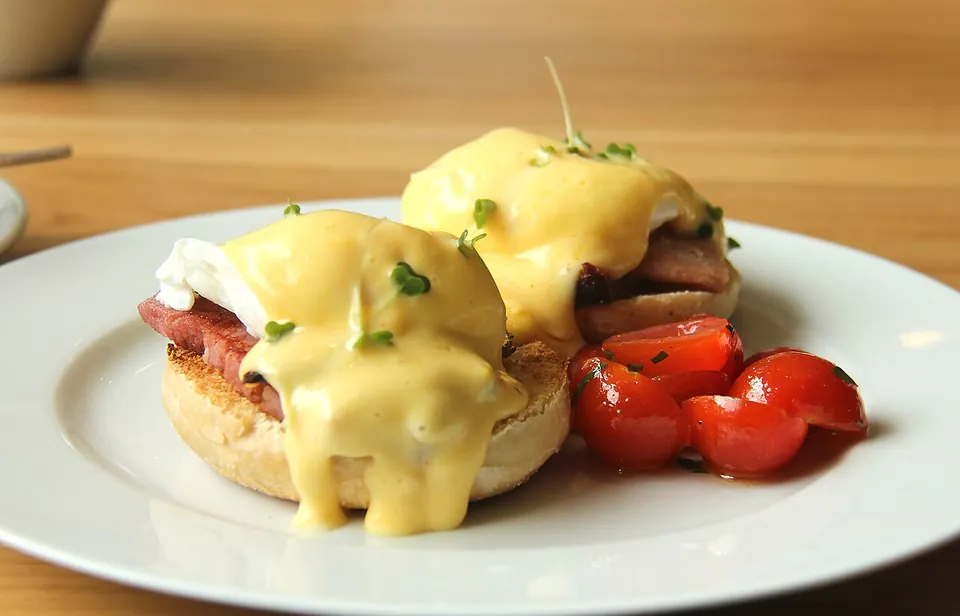
An English muffin, ham, a poached egg, and a pour of glossy hollandaise—eggs Benedict, the king of brunch. Who first thought it up is still an open argument, hangover legend and all, with several claimants standing side by side.
Verification highlight popular claim → verdict → evidence
Popular claim: a single, clearly dated origin story (Delmonico's 1860, or the Waldorf 1894 hangover tale). Verdict: unresolved — multiple competing accounts exist, and the earliest confirmed print evidence for the current recipe is Ranhofer's The Epicurean, though historians now date that recipe to a 1912 second printing rather than the 1894 first; the name itself is independently attested in print from January 1894. Key sources: Ranhofer, The Epicurean (1894); The New Yorker (1942); Sandwich Tribunal (2023).
The three gates
- Ingredient-supply gate
- Eggs, wheat, pork (ham), and butter were all native/available ingredients.
- Cooking-technique gate
- Poaching eggs and emulsifying hollandaise sauce.
- Venue gate
- Brunch culture of upscale New York hotels and restaurants.
Overview
Eggs Benedict is a split English muffin topped with ham and a poached egg, finished with hollandaise, a sauce of egg yolk and butter emulsified together. It surfaces in the record in New York in the closing years of the nineteenth century and became known through the brunch culture of upscale hotels and restaurants.
Eggs, wheat, pork, and butter had all been available in this city for a long time. Beyond the ingredients, the plate asks for two techniques: dropping an egg cleanly into shape in simmering water, and bringing yolk and butter together into a smooth emulsion without letting them split. Only a kitchen that could manage both with ease could assemble this combination on a plate.
The kitchens that could were New York's fine establishments. Celebrated houses like Delmonico's, and hotel dining rooms like the Waldorf, were the stage for the brunches at which the well-to-do were received, and there the combination took form on the menu. On the tables of the city's expensive dining rooms, in the New York of the late nineteenth century, eggs Benedict came to be served in the form we know.
How we know
Eggs Benedict has two famous rival stories about who devised it.
One belongs to Delmonico's, the celebrated New York house. A regular, Mrs. LeGrand Benedict, is said to have asked for something new, and the chef Charles Ranhofer to have obliged. The usual clincher is Ranhofer's own cookbook, The Epicurean. A copy dated 1894, held by the Boston Public Library, prints an 'Eggs à la Benedick' combining muffin, ham, poached egg, and hollandaise—so its facsimile shows. But another variant of that same 1894 printing carries, under the same recipe number, no Benedick name at all. Food historians converge here: the Sandwich Tribunal and Annabelle Wharton writing for Literary Hub hold that this present-form recipe was not in the 1894 first printing but added in the 1912 second printing. As for the '1860' the house claims as its year of creation, no contemporary document can be found to back it.
The other belongs to the Waldorf. The stockbroker Lemuel Benedict, the story goes, ordered toast, a poached egg, bacon, and hollandaise in 1894 to settle a hangover, and the maître d'hôtel Oscar Tschirky put it on the menu, swapping in ham and an English muffin. The source here is an interview Benedict himself gave to The New Yorker on 19 December 1942—a recollection offered half a century after the fact.
Which came first cannot be decided from these two accounts alone. The clues lie instead outside them. The earliest appearance of the name in print is in a short story by Horace Vachell in the January 1894 issue of Overland Monthly, where 'eggs a la Benedict' turns up at the lunch of a San Francisco social club. Tied to neither shop's claim, that single line shows the name had already reached the social set as far away as the West Coast by the start of 1894. The oldest written recipe, too, sits outside the shops: Cornelia Bedford, former principal of the New York Cooking School, set it down in Table Talk in February 1897 at the request of a reader in Savannah—so by 1897 the demand for the recipe had reached households in the South.
So the name was in circulation by early 1894, and the recipe was in print by 1897. Yet what points squarely to the present dish can only be traced with certainty back to 1912, and neither Delmonico's 1860 nor the Waldorf's 1894 can be pinned down by a primary source. That it was born in the New York of the late nineteenth century is clear. Only the last question—who—hangs in the air, and that, in a way, is the flavour of this dish.
The full set of origin theories and the detailed verification log — traceable all the way to their sources — are available on the Japanese edition.
See the full origin theories and verification log (Japanese) →