All dishes / 北米
Butter tart Period BOrigin theory BVerified
Some fields (dish name, region and gates) are shown from the Japanese-edition data.
A pastry that stands for Canada. The well-known origin tale—that the French settler women known as the 'King's Daughters' brought it over—is a story food historians reject and one that lacks any backing; the oldest record that can actually be traced sits in Ontario, in 1900.
Verification highlight popular claim → verdict → evidence
The earliest documented published recipe (1900, Barrie, Ontario) and the competing accounts of forerunner pastries -- an English/Scottish lineage (border tart / Eccelfechan tart) versus a Quebec sugar-pie lineage -- are treated under the origin-theory entries.
The three gates
- Ingredient-supply gate
- Wheat, butter, and sugar became locally available as settlers brought them; sugar arrived through colonial trade.
- Cooking-technique gate
- Pastry baking.
- Venue gate
- A baked treat from pioneer farm households that grew into a national dessert.
Overview
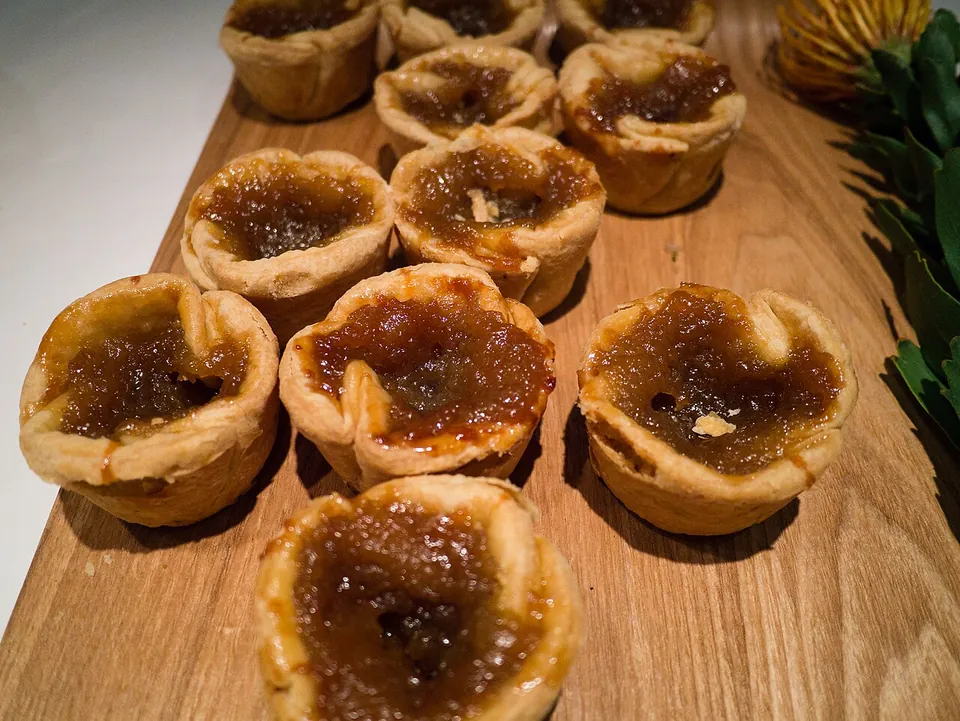
The butter tart is a small, sweet baked good: a shell of pastry filled with egg, sugar, syrup and butter, then baked. It has been cherished as a pastry that stands for central Canada, and Ontario above all.
Its present form was born in the settler households of late-nineteenth-century Ontario. It is made from plain, easily obtained ingredients—egg, wheat, syrup, sugar and pastry. Wheat, butter and sugar all became available locally as settlers arrived, and the sugar came by way of colonial trade. Cheap and easy to make, this pastry spread as a household bake of the frontier, and in time grew into a Canadian national sweet.
How we know
Old pastries almost always come furnished with a story of distinguished ancestors. The butter tart had two such ancestor tales.
One is the story that between 1663 and 1673 about 800 settler women sent from France to Quebec, the 'King's Daughters' (filles du roi), brought over the sugar pie (tarte au sucre). But food historians reject it. Quebec's sugar pie belongs to a separate line descending from French regional pastry, and there is no ground for tracing it and the Ontario butter tart back to the same lineage (Beer Et Seq goes so far as to write that the sugar pie 'does not enter into the historical reckoning'). The fillings differ too: cream and salt for the sugar pie, egg and syrup for the butter tart. It was an origin myth in which only the glamour of the story ran ahead on its own.
The other line is plainer but stands on firmer ground. The English words 'butter tart' appear in Halliwell's Dictionary of Archaic and Provincial English (1857), which cites as its source the 1709 cookbook The Queen's Royal Cookery—an English word far older than the first Canadian record. A pastry of the same name and the same make existed as the border tart in Ecclefechan, on the Scottish border. And between 1815 and 1870 about 170,000 Scottish immigrants settled in Ontario, where in the early days this pastry was indeed called the 'border tart.' The name, the make, and the flow of migration all point to an English and Scottish forerunner.
The firmest footing lies in a plainer place still. The oldest published recipe on record is 'Filling for Tarts,' contributed by Mary Ethel MacLeod to page 88 of the Royal Victoria Hospital Women's Auxiliary cookbook, compiled in Barrie, Ontario, in 1900 (sugar, butter, egg and currants). The Simcoe County Archives holds the document, and the Canadian Encyclopedia independently confirms it. It also appears in a 1915 pie cookbook, by which time the pastry had taken root in English-speaking central Canada.
The glamorous tale reaching back to distant France is set aside, and what remains is a plainer line: born as a simple household pastry in late-nineteenth-century Ontario, owing its name and its make to the border tart of England and Scotland.
The full set of origin theories and the detailed verification log — traceable all the way to their sources — are available on the Japanese edition.
See the full origin theories and verification log (Japanese) →