All dishes / 西欧
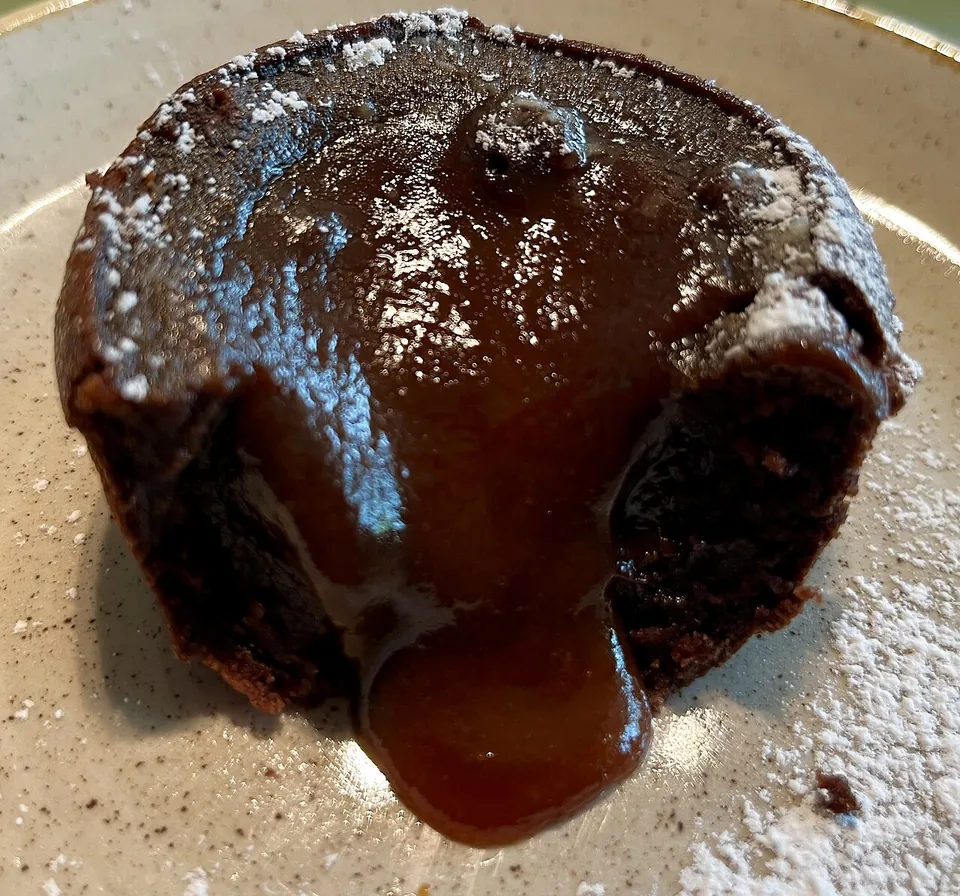
Molten chocolate cake (Fondant au chocolat) Period BOrigin theory CVerified
Some fields (dish name, region and gates) are shown from the Japanese-edition data.
The warm little cake that spills melted chocolate the moment you cut into it. Who "invented" it has been argued over for decades, but follow the record and the earliest starting point narrows to a single name.
Verification highlight popular claim → verdict → evidence
Attribution of the inventor remains contested. The leading account credits Michel Bras of Laguiole, France, who in 1981 devised the technique of sealing frozen ganache inside batter and baking it so the molten center flows out; press coverage and professional sources (including the Michelin Guide) consistently trace the dish to him. Jean-Georges Vongerichten's account of discovering a molten center from an underbaked cake in New York in 1987 is also cited, but it came six years after Bras and independently, so while Vongerichten helped popularize the dish, his claim to have invented it is rejected on priority grounds. A claim tracing the dish to 1980s American lava-cake desserts is also rejected for lack of evidence connecting it directly to the current form. Multiple sources support 1981 as the year of invention, but the year the recipe first appeared in print (in Bras's own book or in a trademark filing) could not be confirmed from sources available online and still needs verification.
The three gates
- Ingredient-supply gate
- Cocoa is a New World crop, but by the 20th century it had long since spread through the Old World, so it no longer acts as a practical limiting factor and can be treated as native.
- Cooking-technique gate
- The dish depends on baking control: searing the outside while leaving the center underbaked so it flows out molten.
- Venue gate
- It originated in fine-dining restaurants and spread from there worldwide.
Overview
Fondant au chocolat is a dessert whose outside is baked firm while the center is left barely set, so that molten chocolate runs out the instant it is cut open. All of its drama rests on controlling that degree of bake: leaving the core unset yet holding a shell that does not collapse. This precise touch at the oven is what sits at the heart of the cake.
The ingredients themselves are nothing unusual: chocolate, eggs, butter, flour. Cacao originally came from the New World, but by the late twentieth century in France it had long since become an everyday part of French pastry, and getting hold of it posed no difficulty. The drama comes from somewhere else. To aim for that flowing "lava" on purpose takes a careful bake that stops the center just short of setting. So this cake came not from a lucky accident in a home kitchen but from the gastronomic restaurant, a place where a technique like this could be tried and refined, and from there it spread across the world.
The documented starting point lies in Laguiole, France, in 1981. The chef Michel Bras, working from the memory of a hot chocolate he had drunk after a day of skiing, spent two years developing a method of wrapping frozen ganache in batter and baking it so the center would flow. He registered the result, name and all, as the "coulant®."
How we know
"Who invented the chocolate cake that flows like lava?" For a long time several answers competed for that question. Where it leads is Michel Bras, in Laguiole, France, in 1981. From the memory of a post-ski hot chocolate, Bras spent two years perfecting a technique of sealing frozen ganache inside batter and baking it, and he registered the result as the "coulant®," name included. Press coverage and specialist writing broadly agree on this 1981 starting point, and the Michelin Guide's culinary encyclopedia independently reports Bras's creation at Laguiole. The earliest recorded invention in the fondant-au-chocolat family sits here.
Once that starting point is fixed, the other claims to be the "inventor" fall into place differently. The one most often told in the United States is that Jean-Georges Vongerichten, in New York in 1987, found the flowing center in an underbaked "failure" and then served it deliberately. There is no doubt that he was the figure who made "molten chocolate cake" spread explosively in America. But Bras had done his work in the Aveyron six years earlier, and Vongerichten's was a separate, independent discovery. A claim to be the "inventor" does not hold up against that six-year gap, though this takes nothing away from his role in popularizing the dish.
A third account puts the origin in the American lava-cake line of the 1980s altogether. But earlier flowing centers such as Pillsbury's "Tunnel of Fudge" (1966) belong to a different lineage and are not the direct starting point of today's coulant or fondant. The United States was the place of popularization, and no record survives of a creation predating Bras in 1981. The three-way fight over the inventor thus settles into a division of roles: the first documented creation belongs to Bras, and the great popularization in America to Vongerichten. The date of its emergence is firmly established, while the primary evidence behind each claim about whose creation it was still leaves room to be pinned down.
The full set of origin theories and the detailed verification log — traceable all the way to their sources — are available on the Japanese edition.
See the full origin theories and verification log (Japanese) →