All dishes / 北米
Caesar salad Period AOrigin theory BVerified
Some fields (dish name, region and gates) are shown from the Japanese-edition data.
Caesar salad, an American staple, takes its name not from the Roman emperor but from Caesar Cardini, an Italian immigrant cook who ran a restaurant in the Mexican border town of Tijuana. Yet who first made it, and when, remains a question with rival testimonies still standing side by side.
Verification highlight popular claim → verdict → evidence
Caesar Cardini, an Italian-immigrant restaurateur, is credited with inventing the salad on July 4, 1924, at his restaurant in Tijuana, Mexico, improvising from whatever ingredients were on hand when a holiday crowd depleted his kitchen's stock. Food historians agree on the Tijuana origin and Cardini's Italian-immigrant background, but the 1924 date rests solely on his daughter Rosa's later recollection; the earliest documented appearance of the dish in print is a 1946 Los Angeles newspaper column, two decades after the claimed invention, so the written record does not by itself prove the origin date. Rival claims -- that his brother Alex created it as an 'Aviator Salad,' or that an employee, Livio Santini, brought his mother's recipe -- remain unresolved but have not displaced the Cardini attribution.
The three gates
- Ingredient-supply gate
- The main ingredients -- romaine lettuce, wheat, and cheese -- are all Old World foods already established locally by the 1920s, so the ingredient side is not the binding constraint; the limiting factor is the invention event itself.
- Cooking-technique gate
- An egg-yolk emulsified dressing tossed tableside.
- Venue gate
- A restaurant, Caesar's in Tijuana, from which the dish spread to become a standard American salad.
Overview
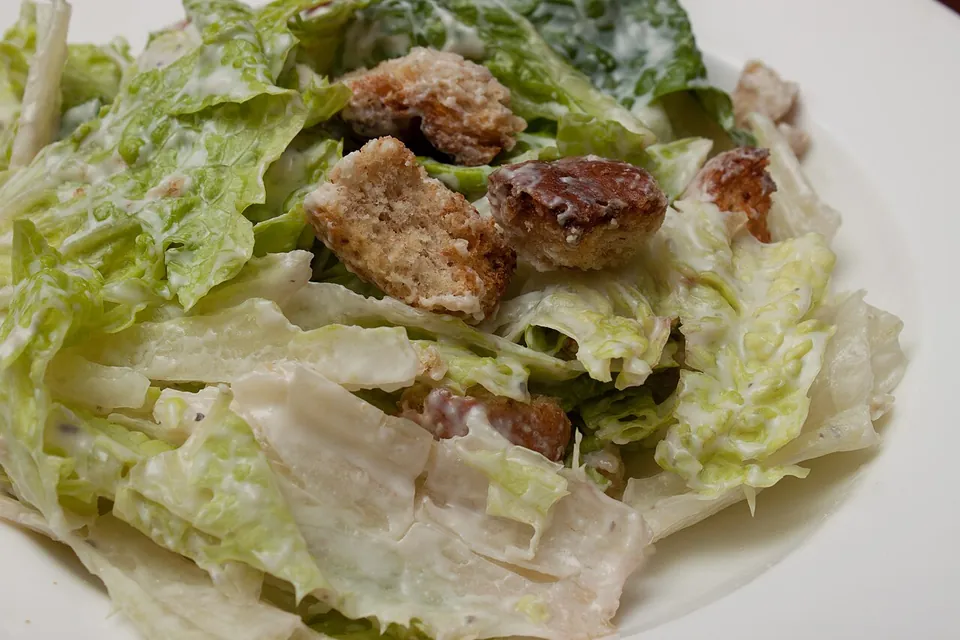
Caesar salad pairs romaine lettuce with Parmesan and croutons, dressed with an egg-rich dressing tossed at the table before it is served. The romaine, the Parmesan, and the wheat in the croutons were all Old World foods long since settled in this region, so gathering the ingredients was never the difficulty.
What gave the dish its character was the smooth emulsified dressing built around egg yolk, and the tableside flourish of tossing the lettuce in front of the guest. The stage was a restaurant in Tijuana, Mexico. Though it was invented in Mexico, from the late 1930s onward it spread into the United States by way of Hollywood, and a dish born in Mexico eventually settled in as one of America's signature salads.
How we know
The name Caesar calls up a Roman emperor, but it comes from a single cook. Caesar Cardini, an Italian immigrant, ran his own restaurant, Caesar's, in Tijuana, Mexico, and that is where the salad is said to have been born. A Tijuana origin, created by an Italian immigrant cook, aligns with the view of food historians such as Jeffrey Pilcher.
The most often repeated story places the moment on 4 July 1924: on Independence Day, a rush of guests drained the kitchen, and Cardini improvised the salad from whatever was left. But no contemporary record supports that year of 1924. The only voice for it is a later account by his daughter Rosa, and the dish surfaces in print far later. Its name is set down on a Los Angeles menu in 1946 and enters the dictionary in 1950 — both more than twenty years after the invention story. Between the birthday that was handed down and the first footprint left on paper lies a gap that wide.
Nor is there a single claimant to the invention. Cardini's brother Alex claimed he had made it as an 'Aviator's Salad' for pilots, spiked with anchovy and Dijon. The employee Livio Santini has his own advocate: his son Aldo has said it was his father who brought his mother Beatriz's recipe into the restaurant in 1925. These voices have risen again and again, from within the Cardini family and outside it, but none has been decisive enough to overturn the view that Caesar Cardini created the dish. Who first tossed it remains an open question, with several testimonies still standing together.
The full set of origin theories and the detailed verification log — traceable all the way to their sources — are available on the Japanese edition.
See the full origin theories and verification log (Japanese) →