All dishes / 北米
S'mores Period BOrigin theory CVerified
Some fields (dish name, region and gates) are shown from the Japanese-edition data.
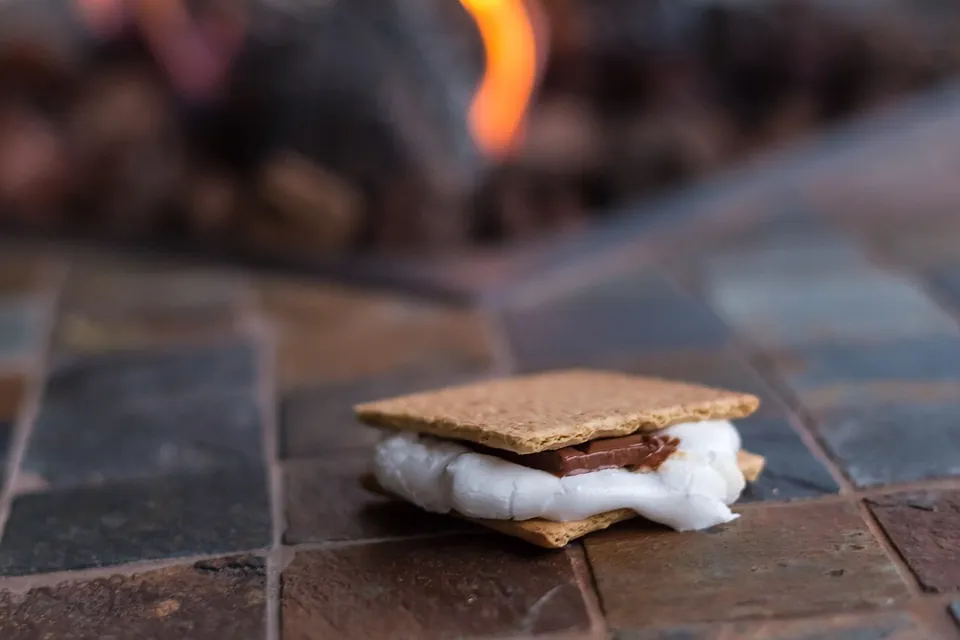
Marshmallows toasted over a campfire and chocolate, pressed between graham crackers—the s'more is an American camping treat. The widely told tale that a Girl Scout leader named Loretta Scott Crew invented it in 1927 is a fabrication; even that person's existence cannot be confirmed.
Verification highlight popular claim → verdict → evidence
Myth: s'mores were invented by Girl Scout leader Loretta Scott Crew and first appeared in the 1927 book Tramping and Trailing with the Girl Scouts. Verdict: refuted — a Girl Scouts USA historian found no record that Crew ever existed, and the 1927 book contains no recipe at all, only a quotation from Kenneth Grahame. Key source: Dorothy 'Cookie' Moore's recipe published in The Girl Scout Leader magazine, May 1925, the earliest verifiable record.
The three gates
- Ingredient-supply gate
- Cacao (a New World crop) was already an industrially distributed chocolate product, and marshmallows were also industrially produced by this time.
- Cooking-technique gate
- A marshmallow is toasted over a campfire and sandwiched between the other ingredients.
- Venue gate
- Girl Scout and other camping culture; the earliest known recipe appeared in a 1925 magazine.
Overview
A s'more is nothing more than a bar of chocolate and a toasted marshmallow pressed between two graham crackers, a campfire sweet rooted in American camping culture. None of its parts are unusual. Chocolate had been sold in industrial bars since the nineteenth century, and marshmallows were being mass-produced by the same period; graham crackers, too, were long since on American shelves by the early twentieth century.
Yet with the ingredients on hand, the s'more is still not there. It appears only in a scene out of doors: gathered around a fire, a marshmallow on a stick is toasted until it turns pale gold and softens, then pressed while hot between chocolate and crackers. As Girl Scout and other camping cultures spread, this became a sweet that children could easily make outside, and the whole ritual settled into place along with it. The name itself is a shortening of "some more"—the request called out around the fire, which seems to have passed straight into the name of the dish.
The s'more, then, is best seen not as one person's invention but as a sweet that arose within American camping culture, was passed along by word of mouth, and was eventually set down in print.
How we know
The s'more has a long-repeated origin story. A Girl Scout leader named Loretta Scott Crew is said to have devised it, and the first recipe is said to have appeared in a 1927 handbook, Tramping and Trailing with the Girl Scouts. With an inventor's name and a publication year both so specific, the tale has circulated as if it were plain fact.
But try to check it and the story falls apart twice over. Shannon Browning-Mullis, a historian at Girl Scouts of the USA, says no record of a person named Crew can be found anywhere, and called her existence "as imaginary as Rat and Mole." The Wikipedia page that once introduced her was deleted more than a decade ago. And when the 1927 book itself is actually examined, it contains no s'more recipe—only a quotation from children's literature, the Rat and Mole of Kenneth Grahame's The Wind in the Willows. Both the inventor and the first-appearance date were left without support. Text still circulates online claiming to be "the original recipe from the 1927 book," but this is the myth reproduced by people who never checked the source.
So what is the earliest record that can actually be traced? According to reporting by National Geographic and others, it is a recipe published in May 1925 by Dorothy "Cookie" Moore, a British-born Girl Guide leader, in the magazine The Girl Scout Leader. It used graham crackers, Hershey's chocolate and marshmallows, toasted until the marshmallow turned pale gold and soft. That same year of 1925, the same sweet surfaces from quite different sources: at a conference in Buffalo, New York, it was introduced as a "Somemore"; a Rochester newspaper ran a recipe under the headline "Yummie Dessert"; and in Kalamazoo, Michigan, "summore" was added to a Scout menu. A magazine and several local papers—separate kinds of record—all point to around 1925.
The history of the word does not clash with this. According to the Oxford English Dictionary, the spelling "s'more" appears in print in 1934, and the plural "s'mores" later still, in 1937. The dish itself is recorded in 1925; its name settled into writing only afterward. The true origin of the s'more lies not in a single hero but in the habits of a group gathered around a fire.
The full set of origin theories and the detailed verification log — traceable all the way to their sources — are available on the Japanese edition.
See the full origin theories and verification log (Japanese) →