All dishes / 南アジア
Dhokla Period BOrigin theory BVerified
Some fields (dish name, region and gates) are shown from the Japanese-edition data.
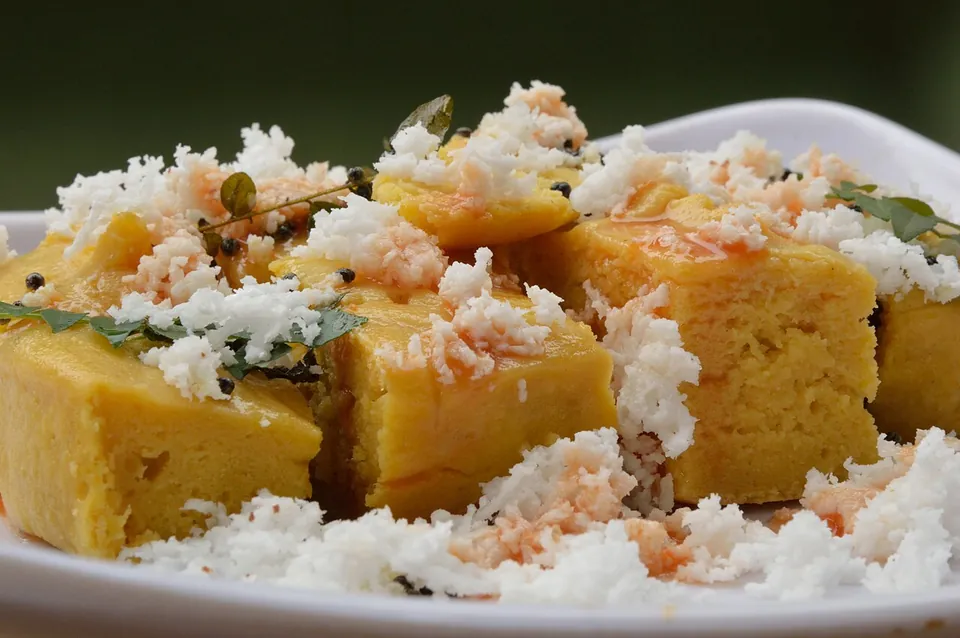
Dhokla is a light, savory steamed cake from Gujarat in western India, made from fermented besan (chickpea flour). Its steamed appearance sometimes gets it introduced as a South Indian dish, but both its name and its forerunner trace back, in every case, to Gujarat.
Verification highlight popular claim → verdict → evidence
Popular claim: dhokla is a South Indian dish. Verdict: refuted — textual evidence points to Gujarat: the word 'dhokla' is first attested in the Gujarati text Varanaka Samuchaya (1520), with a precursor dish 'dukkia' mentioned in a Jain text from 1066; the South Indian attribution appears to stem from a superficial resemblance to idli. Key sources: K.T. Achaya, Indian Food: A Historical Companion; Tamang & Tamang (2022), Journal of Applied Microbiology.
The three gates
- Ingredient-supply gate
- Chickpeas (besan flour) are a native South Asian staple, so the food-supply gate was satisfied early and is not the limiting factor.
- Cooking-technique gate
- Fermenting a legume-flour batter and steaming it.
- Venue gate
- Spread through vegetarian Jain and Vaishnava households in Gujarat, later as a common tea-time snack.
Overview
The batter for dhokla is besan (chickpea flour) and rice mixed with water and left to ferment. Chickpeas are a crop grown in South Asia since remote antiquity, a long-established local ingredient, and there was never any difficulty in finding them. The fermentation works air into the batter, and steaming it yields a fine-grained, airy piece. This method, fermenting the batter and then steaming it, is the central technique that makes dhokla what it is. The food historian K. T. Achaya recorded a preparation in which rice flour and besan are fermented in a ratio of about two to one and then steamed.
This steamed cake is deeply rooted in the vegetarian traditions of Gujarat's Jain and Vaishnava communities. Within a food culture that avoids meat, a light dish built on a pulse found favor at the family table and with tea, and spread from there.
How we know
When it comes to where dhokla belongs, the name of South India often comes up. The steaming method, and a plump appearance reminiscent of idli, lead more than a few web articles to present it that way.
But both the word and the sources point to Gujarat in western India. The earliest literary appearance of the word dhokla is in the Gujarati Varanaka Samuchaya (1520). Its reputed forerunner, a pulse-based dish called dukkia, is named earlier still, in a Jain text of 1066. These dates are recorded independently in the work of the food historian K. T. Achaya (1994) and in a peer-reviewed study of fermented foods by Tamang and Tamang (2022), two scholarly accounts pointing to the same Gujarati and Jain food culture as the point of origin. A primary source or scholarly account supporting a South Indian origin is, for now, nowhere to be found.
It is likely the form of a steamed cake, and its outward closeness to idli, that invite the mistaken attribution. But the origins of this dish, whose forerunner appears in a Jain text nearly a thousand years old and whose name is inscribed in a sixteenth-century Gujarati text, lie in western India.
The full set of origin theories and the detailed verification log — traceable all the way to their sources — are available on the Japanese edition.
See the full origin theories and verification log (Japanese) →