All dishes / 北米
Macaroni and cheese Period BOrigin theory CVerified
Some fields (dish name, region and gates) are shown from the Japanese-edition data.
An American comfort-food icon. A well-worn story credits President Thomas Jefferson with inventing it, but the Monticello foundation that keeps his legacy rejects that tale as a fabrication, and the dish of pasta baked with cheese reaches back to medieval European manuscripts.
Verification highlight popular claim → verdict → evidence
It is often said that Thomas Jefferson, or his enslaved cook James Hemings, invented macaroni and cheese or first brought it to America. The Jefferson foundation at Monticello says otherwise: baked pasta with cheese was already common in France before Jefferson arrived there in 1784, and Hemings learned it during his training in Paris. Pasta baked with cheese goes back to the fourteenth-century Neapolitan Liber de coquina and to the makerouns of the English Forme of Cury (1390), and the béchamel version was set out by Elizabeth Raffald in 1769. The earliest American mention is Manasseh Cutler's note on an 1802 dinner of "a pie called macaroni", a dish with onion or shallot in a heavy crust that cannot be identified with the cheese dish known today; the first recipe published in the United States is Mary Randolph's in The Virginia House-Wife (1824), macaroni, cheese and butter layered and baked hot. Jefferson's autograph macaroni recipe of about 1787 survives at the Library of Congress and may well have been taken down from Hemings or Fossett. What Hemings did was cook the dish, serve it and spread it, not invent it. The Kraft box came in 1937, long after.
The three gates
- Ingredient-supply gate
- Macaroni of hard wheat and cheese are both Old World foods, carried to America in the eighteenth century; a steady supply within the country is what sets the earliest possible date.
- Cooking-technique gate
- Boiling dried pasta and baking it under a cheese sauce of the béchamel kind.
- Venue gate
- Home cooking and comfort food, settled into American kitchens as a dish out of the South. The Kraft box of 1937 belongs to how the dish spread rather than to how it came about.
Overview
From medieval Europe to the American table
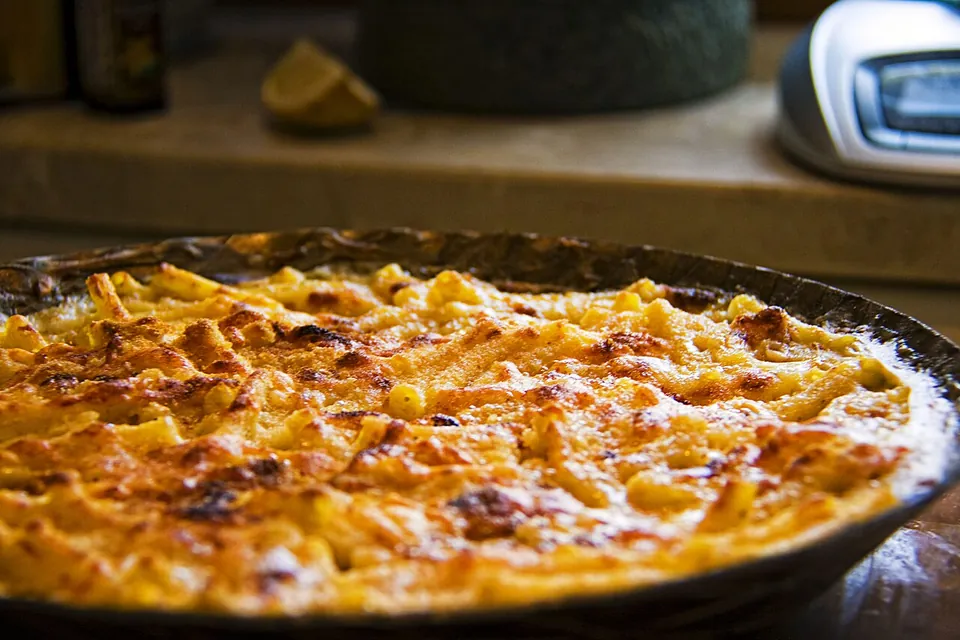
Macaroni and cheese is boiled macaroni bound in a cheese sauce and baked, and it is one of the defining dishes of the American home kitchen. Cheap, warm, and filling, it spread out of Southern households across the country and settled in as everyday comfort food.
The pairing of pasta and cheese, though, was not an American idea. Its roots lie in medieval Europe. A fourteenth-century Neapolitan manuscript, the Liber de coquina, describes a dish of layered pasta and cheese, and by the end of the same century an English cookbook, The Forme of Cury (1390, compiled by the cooks of Richard II), records it under the name makerouns. In eighteenth-century England, Elizabeth Raffald set down a béchamel-based version close to the modern one in 1769. American macaroni and cheese is the direct descendant of this English cheese-and-pasta line.
Macaroni and cheese are both Old World foods, carried to America through eighteenth-century colonial trade until they could be had without difficulty. Ingredients were never the obstacle; what took shape between the late eighteenth and early nineteenth centuries was the dish itself, as an American thing on the American table. The boxed Kraft mix that arrived in 1937 pushed it further into homes across the country, but that was a matter of spread, not of origin.
How we know
"Thomas Jefferson invented macaroni and cheese"—or, in another version, "his enslaved cook James Hemings was the first to bring it to America." A founding-era hero's tale clings to this humble dish. Yet the foundation that runs Jefferson's estate at Monticello rejects the story itself.
According to Monticello's own encyclopedia, a dish of pasta baked with cheese was already widely eaten in France before Jefferson set sail for the country in 1784. Hemings learned the method during his training in Paris; he did not conjure it out of nothing, nor carry an unknown dish to the New World. What he did was not invention but the cooking, serving, and popularizing of the dish in America—that is the record.
The Jefferson autograph macaroni recipe (c. 1787, held by the Library of Congress), sometimes offered as proof of invention, does not show him to be its author. It reads more plausibly as dictation taken down from cooks such as Hemings or Fossett; a hand on the page is not the same as a mind behind the dish. The earliest American documentary mention, Manasseh Cutler's 1802 note of "a pie called macaroni," describes a thick-crusted dish with onions and shallots that cannot be shown to be the cheese dish we now picture.
So when did it settle into a distinct American form? The first recipe published in the United States appears in Mary Randolph's The Virginia House-Wife (1824): macaroni, cheese, and butter layered and baked hot, a plain dish of just three ingredients. The source lies in medieval European manuscripts; the dish came across as an English descendant and put down roots as its own plate on the American table of the late eighteenth and early nineteenth centuries—not conjured overnight by a president, but settled into place at the end of a long history.
The full set of origin theories and the detailed verification log — traceable all the way to their sources — are available on the Japanese edition.
See the full origin theories and verification log (Japanese) →