All dishes / 北米
Cobb salad Period AOrigin theory CVerified
Some fields (dish name, region and gates) are shown from the Japanese-edition data.
A lavish salad from Los Angeles in Hollywood's golden age, its colorful ingredients finely chopped and laid out in neat rows. But who first made it, and when, has never been settled: one story credits the restaurant's owner, improvising late at night, while another names the head chef, and the two accounts contradict each other to this day.
Verification highlight popular claim → verdict → evidence
Myth: owner Bob Cobb invented the salad single-handedly one night in 1937, tossing together leftovers from the refrigerator. Verdict: rejected as a tidy single-origin story — the accounts disagree on who made it (Cobb himself, head chef Robert Kreis, or chef Paul Posti) and on when (the Hollywood restaurant opened in 1929; a menu listing in 1935; Cobb's naming anecdote in 1937), and the late-night episode itself is told in conflicting versions. The earliest date anyone can point to is the 1935 menu listing recalled by Cobb's grandson Bob Walsh; no original menu or contemporary newspaper has yet surfaced to fix the year. What holds across every version: the salad came out of the Brown Derby in Hollywood in the 1930s and carried Cobb's name. Key sources: Celebrate California (California State Library); Food Republic.
The three gates
- Ingredient-supply gate
- Romaine and other greens were locally available; tomato and avocado (New World foods) circulated widely enough in 1920s-30s America not to be limiting. Ingredients did not constrain when the dish could arise — the venue did.
- Cooking-technique gate
- Chopped ingredients arranged in rows, dressed with a red wine vinaigrette; no special technique required, aided by refrigerated distribution.
- Venue gate
- A restaurant dish: made and served at the Brown Derby in Hollywood, for the middle-class, urban clientele of the film world.
Overview
Born in a Hollywood eatery
The Cobb salad appeared in Los Angeles in the early twentieth century, and even the room it came from is known. During the 1920s and 1930s, when the film industry was at its height, Hollywood's glittering crowd gathered at a restaurant called the Brown Derby. It was in that kitchen that a salad of finely chopped ingredients, arranged for the eye, began to be served.
The parts were all close at hand. In Los Angeles of the 1920s and 1930s, lettuce was a local staple, and tomatoes and avocados filled the markets. The method was just as plain: chop the ingredients, lay them out, and dress them with vinaigrette. Those familiar ingredients and that simple handwork came together, in a golden-age Hollywood restaurant, as a single signature dish.
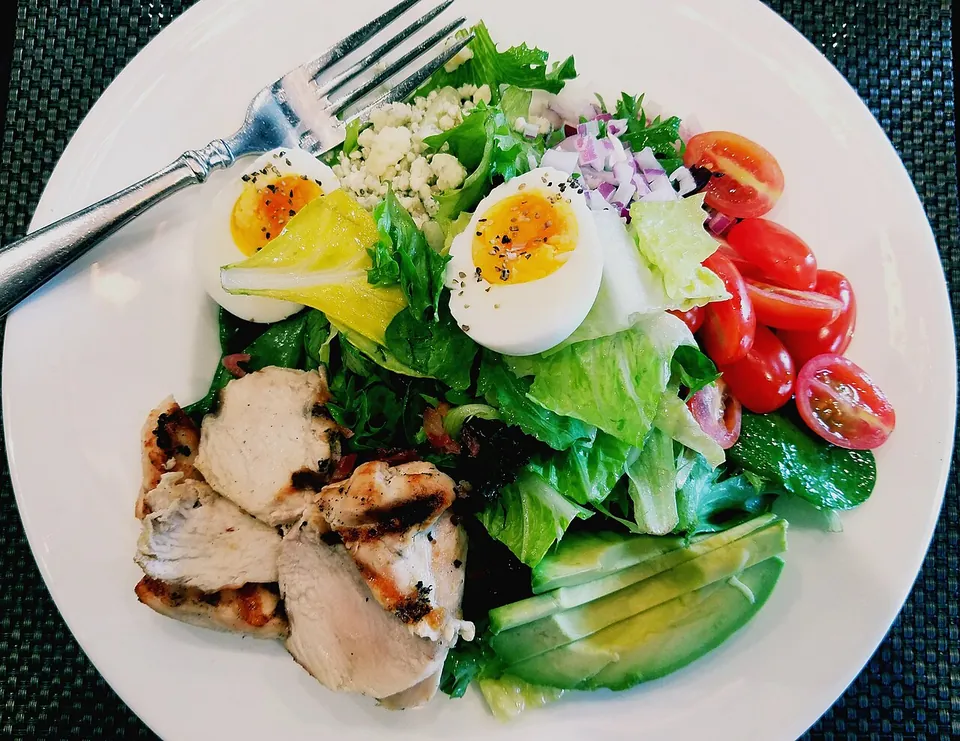
Each ingredient of a different color is chopped fine and set out across the plate in bands: bacon, chicken, hard-boiled egg, tomato, avocado, blue cheese, and a red-wine vinegar dressing. The bright look and the heartiness made it a favorite in the city of the movies, and it settled in as the restaurant's specialty. A dish that an urban restaurant devised for its customers, and that its customers carried outward: it is that kind of food.
How we know
The origin of the Cobb salad has long come wrapped in a story fit for Hollywood. Bob Cobb, the owner of the Brown Derby, is said to have pulled the odds and ends left in the kitchen one late night, chopped them, dressed them, and eaten them, and that this was the beginning. A further flourish has him chopping the ingredients small so that the impresario Sid Grauman, fresh from dental work, could eat them easily. The naming is usually placed in 1937.
Alongside that story runs another. By this account, the salad was devised in 1929, the year the Hollywood location opened, by the head chef, who gave it Cobb's name; a variant names a different chef instead. So the accounts disagree on the essentials: was the maker the owner himself or the head chef, and was the year 1937 or 1929? Even the tale of the night Grauman was entertained wavers between a version served to Grauman and a version in which Cobb ate it himself late at night, and the details are unconfirmed.
The nearest thing to a fixed point comes down through the creator's grandson, Bob Walsh. By his account, the dish worked up from leftovers in the 1930s was put on the Brown Derby menu, in an improved form, in 1935. That 1935 listing is the earliest record that can be traced today, and it sits neatly between the 1929 opening and the 1937 naming anecdote. Even so, no menu of the period and no contemporary newspaper have turned up, and the creator and the year cannot be narrowed to one.
What remains is the single point on which all the competing stories agree: that this chopped salad came into the world from the Brown Derby, bearing Cobb's name. Who made the first plate cannot be fixed, but where it was born does not waver.
The full set of origin theories and the detailed verification log — traceable all the way to their sources — are available on the Japanese edition.
See the full origin theories and verification log (Japanese) →