All dishes / 北米
Po' boy Period BOrigin theory CVerified
Some fields (dish name, region and gates) are shown from the Japanese-edition data.
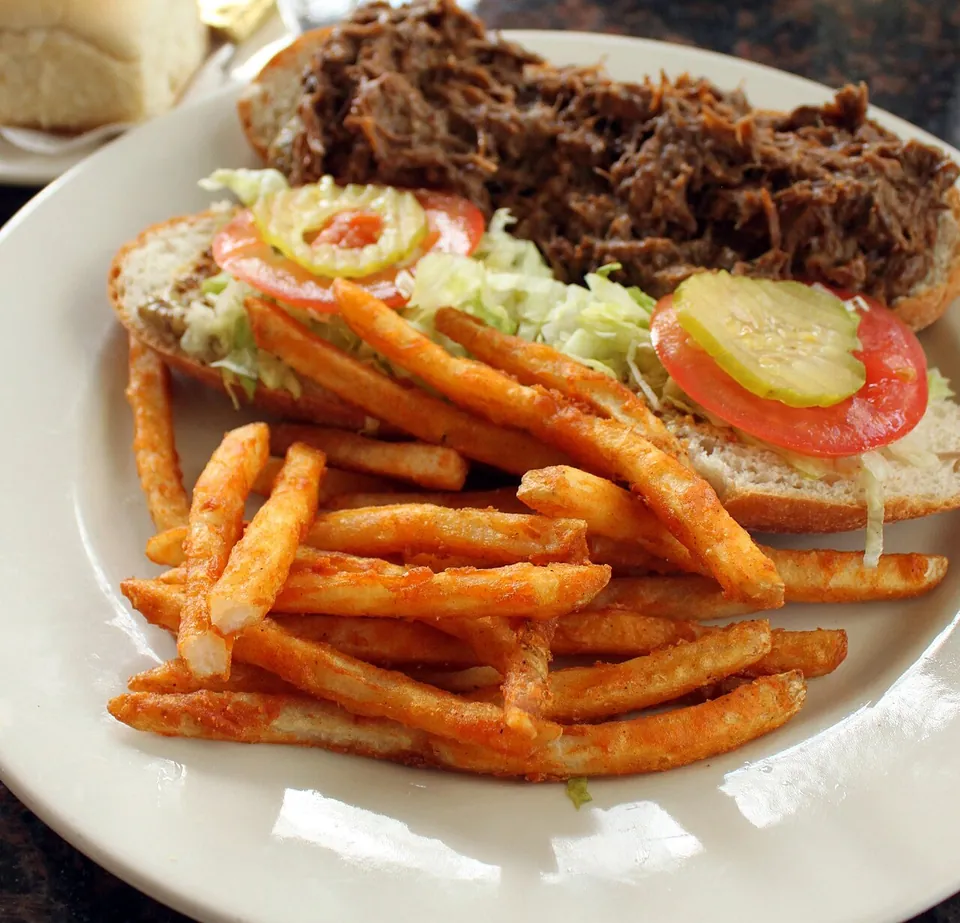
A New Orleans sandwich, its long French roll packed with fried oysters or roast beef. The famous story ties the name "po-boy" (poor boy) to the streetcar strike of 1929, when the Martin brothers popularized it, yet the name seems to have been heard on the city's streets before then, and its true origin resists a single answer.
Verification highlight popular claim → verdict → evidence
Myth: the sandwich's name originated with the Martin brothers during the 1929 streetcar strike. Verdict: disputed — the strike-era letters never mention 'poor boy' or the sandwich, and print claims crediting Martin only appear from 1969 (40 years later); Bechet's 1960 memoir and Goffin's 1947 Armstrong biography independently place 'Poor Boy' sandwiches in New Orleans in the 1910s, before Martin arrived in the city (1917). What is solid: the modern po'boy is fixed by Gendusa's special 40-inch loaf (1929), first documented in Meigs Frost's New Orleans States article (1929-11-04); Cohen (1950, American Speech) corroborates the word history.
The three gates
- Ingredient-supply gate
- Limiting factor: mass production of the New Orleans-style 40-inch French loaf (Gendusa's special rolls, 1929). Fillings like fried oysters and roast beef were locally available and not limiting.
- Cooking-technique gate
- NO-style French bread (thin, light crust; airy crumb) baking combined with frying technique (fried oysters/shrimp). Gendusa began baking the special rolls in 1929.
- Venue gate
- snack stalls/stands in the French Market; working class; urban; laborers.
Overview
The po-boy is a sandwich that took shape in New Orleans, Louisiana. Fried oysters, roast beef, or shrimp are crammed into a long loaf of French bread. The city's French bread has a thin, light crust and a soft, airy crumb, so it can carry a generous filling without turning heavy.
The sandwich as we know it comes clearly into view in 1929. Benjamin and Clovis Martin, who ran a stand at the French Market, wanted to cut several sandwiches from a single loaf and hand them out cheaply and in quantity. They asked a baker, John Gendusa, to make them a forty-inch roll of even thickness from end to end. Once Gendusa baked this dedicated loaf, the Martins could slice one long roll into a run of sandwiches stuffed with fried oysters or roast beef. The oysters and beef themselves were never scarce: they came ashore daily at the mouth of the Mississippi and filled the city's markets. The moment the long sandwich took its present form falls on 1929, the year Gendusa's special bread was first baked.
The setting was a lunch stand at the French Market. In a corner of a working-class city, it was served as a cheap way to fill the stomach, and in time it became one of the dishes that define New Orleans.
How we know
The best-known account of how the po-boy got its name belongs to the summer of 1929. That July, the streetcar operators of New Orleans went on strike. The Martin brothers, Benjamin and Clovis, had themselves once worked as conductors, and from their French Market stand they fed the striking men free of charge. Each striker who came in, the story goes, was greeted as "another poor boy" walking through the door. A letter from the brothers survives showing that they backed the strike, and the tale is retold widely in Louisiana's regional histories.
Look closely at that origin for the name, though, and the ground shifts. The strike-support letter itself says only that free meals were offered to "the members of Division 194"; it mentions neither the contents of the sandwich nor the name "poor boy." The claim that Martin coined the name did not appear in print until 1969, forty years after the strike, and before that Martin himself described making the sandwich "for the poor boys" among farmers and dock workers, not for any particular striker.
There are also signs that the name was around before the strike. The jazz musician Sidney Bechet, in his 1960 autobiography, recalled eating sandwiches called "poor boys" while touring with Louis Armstrong in the 1910s, and a 1947 biography of Armstrong places the same sandwich on the city's street corners in that decade, naming specific spots. Bechet had already gone north in 1917, before the Martins came to the city, so the two accounts are independent of one another. If they hold, then the 1929 strike and the Martin brothers were not the origin of the name but the moment the sandwich reached its finished form and the name spread and stuck. Memory can add things after the fact, so the question is not settled.
A separate tale traces the name to the French "pour bourre" ("for a tip") and to nuns who gave bread to beggars in the late nineteenth century. But no newspaper or menu of that era records anyone ordering such a sandwich, however hard one looks. Lacking any record to stand on, this explanation has been set aside.
The flowery etymology has lost its footing, and even the Martin brothers' strike-summer story is less certain as the source of the name than it once seemed. What is certain is that the po-boy took its present form in 1929, the year the long, special loaf was first baked.
The full set of origin theories and the detailed verification log — traceable all the way to their sources — are available on the Japanese edition.
See the full origin theories and verification log (Japanese) →