All dishes / 中東・北アフリカ
Tagine Period COrigin theory CVerified
Some fields (dish name, region and gates) are shown from the Japanese-edition data.
Tagine is spoken of as the very emblem of Moroccan cooking, yet the dish and its name have travelled separate roads. The conical earthenware pot is rooted in the soil of the Maghreb, while the word ṭājin reaches back to the eastern Mediterranean — and the notion of an age-old, purely Moroccan invention wavers before the sources of the eastern Arab world.
Verification highlight popular claim → verdict → evidence
Myth: a single Moroccan origin covers both the name and the vessel. Verdict: the name 'tajine' traces to Greek tagenon via medieval Arabic texts (the 13th-century Kitab al-Wusla; Rodinson 1949), while the conical two-part clay pot itself is native to the Berber Anti-Atlas (Gil Marks 2010; Britannica). Name and vessel are separate lineages that coexist rather than converging on a single Moroccan origin.
The three gates
- Ingredient-supply gate
- Lamb, olives, lemon, and spices are all native to the Maghreb or the wider Old World. The dish does not depend on New World ingredients, so its physical floor is low.
- Cooking-technique gate
- Slow, low-moisture braising in a conical unglazed clay tagine pot. The limiting factor is this cooking vessel/technique.
- Venue gate
- household / common people / everyday / Maghreb (Berber/Arab)
Overview
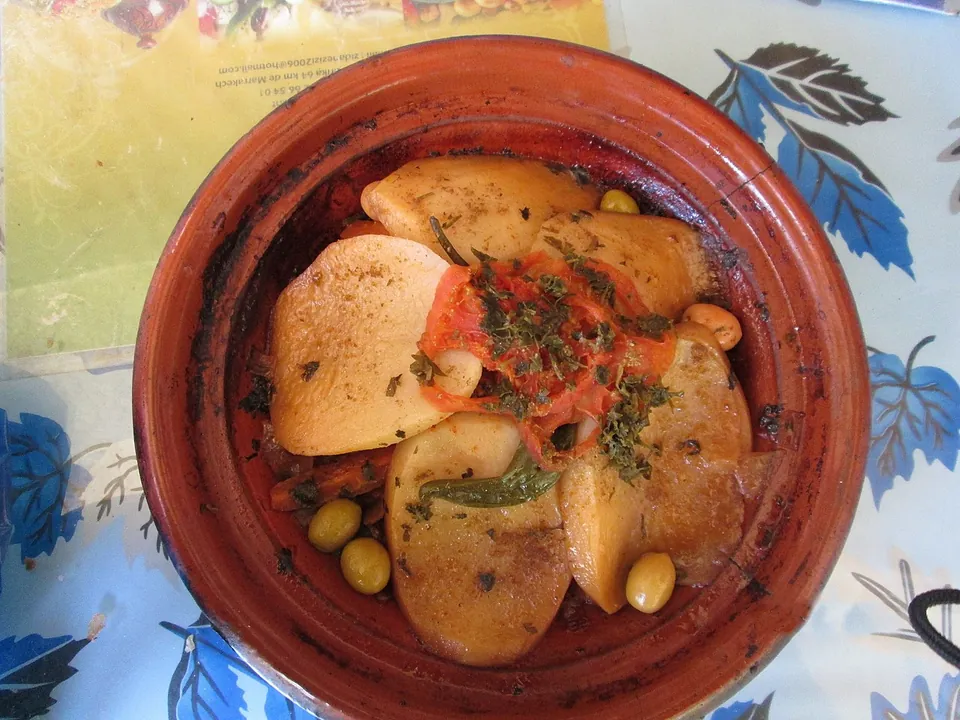
Tagine is a Moroccan dish in which mutton, olives, and preserved lemons are steamed slowly over very little water in an earthenware pot with a conical lid — the pot itself is called a tagine. It goes back to the medieval Maghreb, showing itself by the late Middle Ages at the latest and settling in during the early modern period. Just when its present form was fixed cannot be narrowed to a single point, and the certainty of its date stays middling.
The heart of the dish lies inside that conical lid. Steam rises, cools on the slope of the lid, and drips back down, circling through the pot; so even with little water the meat and vegetables cook moist and tender. It is a well-considered vessel for cooking long and slow while sparing water in a dry land.
The mutton, olives, lemons, and spices are all ingredients long present in the soil of the Maghreb and the Old World. Tagine takes its shape from cooking these local ingredients in that distinctive pot. Spices and preserved lemons carried over from the cooking of al-Andalus and the Abbasid world were added, enriching the outline of its flavour.
Trace who cooked it, and tagine begins in the household and in the cooking of the nomadic Berber camp. Charcoal or embers, a pot set over them, a long slow fire — plain cooking. In time it spread to the tables of the cities and took root as an everyday food of the Berber and Arab common people of the Maghreb.
How we know
What makes tagine's history interesting is that the dish and the name of the dish have come down separate roads.
One is the road of the vessel and the manner of cooking. The conical, two-part red earthenware pot is a native vessel of the Berbers of the Anti-Atlas mountains in the Maghreb, and appears to have developed as a portable camp oven. Cooking slowly over little water is likewise rooted in the stews of this land. Gil Marks, author of an encyclopedia of Jewish food, places this two-part red-clay pot at an Anti-Atlas origin, and Britannica too records a Berber and nomadic origin overlaid with the influence of Andalusian and Abbasid spices.
The other is the road of the name, and this one runs east to the Mediterranean. The word ṭājin (tagine) goes back to the Arabic ṭājin, a shallow earthenware pan, and further back to the Classical Greek τάγηνον (tágēnon), a frying or flat pan. In the scholarly literature this Greek derivation is predominant, while an alternative from the Persian tahchin remains a minority view. The name and the concept of the stew appear in eastern Arab writing. The thirteenth-century Aleppo cookbook Kitāb al-Wuṣla survives as a primary source in the critical English translation of Charles Perry (Scents and Flavors), and ṭājin appears in its account of stewing. Maxime Rodinson, in a 1949 paper, read the manuscripts of such medieval Arab cookbooks with scholarly rigour.
Here a long-repeated tale comes undone: that tagine, dish and vessel both, is an age-old, purely Moroccan invention with no tie to the east. Rodinson held that when similar dishes appear in both east and west, one should first suspect a parallel origin in a shared Graeco-Roman parent. Tagine fits this. The name runs from the eastern τάγηνον into the eastern Arab world; the vessel and the manner of cooking are native to the Maghreb — two separate lineages met, rather than a single land producing the whole on its own.
Even so, the ṭājin of the medieval east meant a shallow flat pan and its stew, a different vessel from the conical pot of the modern Maghreb. That the name appears early in eastern writing does not mean the conical pot itself originated there. Because the two axes — name in the east, vessel native to the west — stand side by side, the origin cannot be settled on a single line, and its certainty stays middling.
The full set of origin theories and the detailed verification log — traceable all the way to their sources — are available on the Japanese edition.
See the full origin theories and verification log (Japanese) →