All dishes / 中東・北アフリカ
Köfte Period COrigin theory CVerified
Some fields (dish name, region and gates) are shown from the Japanese-edition data.
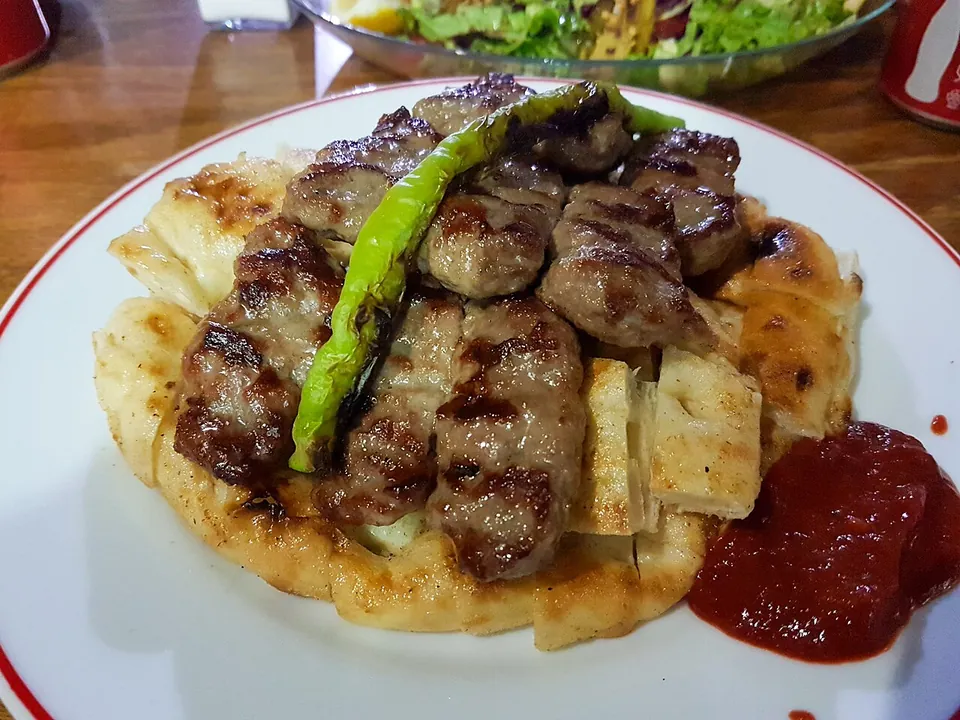
Köfte, the countless meatballs on the Turkish table. Made by pounding lamb into a paste and shaping it, this dish is not a single invention but a collective name for a great family that wears more than two hundred faces from region to region.
Verification highlight popular claim → verdict → evidence
The 'earliest kofta recipes' in medieval Arab cookbooks turn out to be a retrofit: those texts never use the word kofta itself. The name traces to Persian kufta ('to pound'), while the Turkish name koefte is first attested only in 15th-century Ottoman court records. Main source: al-Warraq's Kitab al-Tabikh (10th century) and al-Baghdadi's cookbook of 1226.
The three gates
- Ingredient-supply gate
- Mutton is native to Anatolia (arrival ledger: mutton in Anatolia, 7000 BC, indigenous) and plentiful, so it does not govern the date. Mincing the meat is likewise a long-established local technique, and the ingredient gate was satisfied early.
- Cooking-technique gate
- Shaping minced meat and grilling or simmering it, in meatball and patty forms.
- Venue gate
- Everyday food of the street and the home.
Overview
Köfte is the collective name for a Turkish dish in which lamb (or beef) is pounded into a paste, kneaded, shaped into balls or patties, and grilled or simmered. From a raw variety such as çiğ köfte to versions wrapped on a skewer and grilled over charcoal, to those sunk into a stew, there are more than two hundred regional variants across Turkey, each bearing the name of its place.
At the center is minced lamb. Sheep are a long-established livestock in Anatolian life, and their meat was an ingredient at hand on the land. It is chopped fine, kneaded together with onion, bulgur (cracked wheat), or breadcrumbs, and shaped by hand. The very act of pounding meat into a ball is inscribed in the dish's name: the word is said to derive from a term meaning "to pound" or "to beat."
The Turkish name köfte appears in Ottoman palace documents from the fifteenth century onward. Yet the meatball itself was made in many places long before the name was set down in a Turkish text. The process by which, on the land called Anatolia, sheep and wheat and fire met and branched into countless regional variants is the true nature of this collective name.
How we know
Where köfte was born does not come down to a single answer.
One view links the dish to the lineage of the medieval Arab and Persian cookbooks. The etymology is said to reach back to the Persian kūfta, "to pound" or "to beat," and the oldest surviving Arab cookbooks record a closely similar dish—the tenth-century Baghdad manuscript (Ibn Sayyār al-Warrāq's Kitāb al-Ṭabīkh, in Nawal Nasrallah's English translation) and the thirteenth-century Kitāb al-Ṭabīkh of al-Baghdādī (1226) present large lamb meatballs glazed with saffron and egg yolk.
But here a caution is needed. These old manuscripts themselves do not use the word kufta or köfte. The phrase "the oldest köfte recipe" is a label that later translators and food historians applied, comparing these dishes with the modern meatball and concluding "this is its ancestor." That is, the fact that the form of the dish was certainly present in tenth-century Baghdad and the fact that the dish came to be called köfte must be kept apart as separate events. The Turkish name köfte appears clearly in writing only some centuries later, in the records of the Ottoman court.
Another view traces the meatball to the cooking of the Turkic nomads of Central Asia. What they brought into Anatolia took local root and branched, the argument runs, into the more than two hundred variants. There is at present no means left to verify this route in the sources.
Which came first cannot be settled from the texts. What is certain is that the form of the lamb meatball can be traced back to medieval Baghdad, that the name köfte appears in Ottoman documents from the fifteenth century onward, and that köfte is not a single-origin dish but the collective name for a great family that grew up place by place.
The full set of origin theories and the detailed verification log — traceable all the way to their sources — are available on the Japanese edition.
See the full origin theories and verification log (Japanese) →