All dishes / 中東・北アフリカ
Baklava Period BOrigin theory CVerified
Some fields (dish name, region and gates) are shown from the Japanese-edition data.
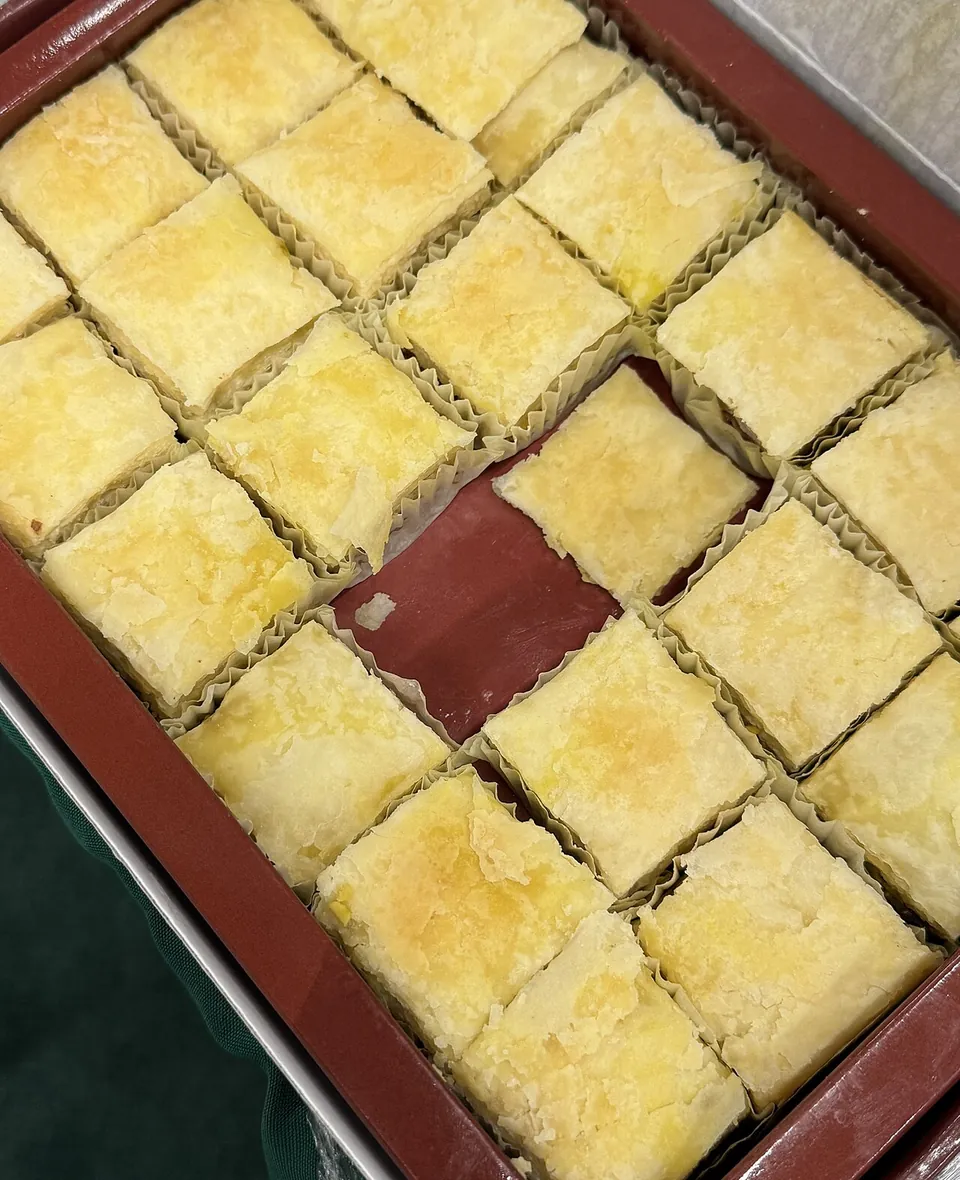
Baklava layers nuts and honey between sheets of pastry rolled as thin as paper, stacked dozens high. A popular story credits the Assyrians of the eighth century BC with inventing it, but that ancient pedigree has no documentary support: the dish in its familiar many-layered form was perfected at the Ottoman court in the fifteenth and sixteenth centuries.
Verification highlight popular claim → verdict → evidence
Popular claim: baklava dates back to ancient Assyria in the 8th century BC. Verdict: refuted as an unsupported legend -- no cuneiform or archaeological evidence backs this claim, and the earliest confirmed mention of the dish by name is a 15th-century Turkish poem (Kaygusuz Abdal). The multilayered, paper-thin phyllo version known today was established and refined in the imperial kitchens of Topkapi Palace in the 15th-16th centuries. Key sources: Mary Isin, Sherbet and Spice (2013); Smithsonian Magazine.
The three gates
- Ingredient-supply gate
- Wheat, nuts, and honey were all locally available. The rate-limiter is the technique for rolling paper-thin dough (phyllo/yufka); the establishment of that method sets the lower bound.
- Cooking-technique gate
- The technique of layering and baking dozens of ultra-thin sheets, refined in the large kitchens of the Ottoman court.
- Venue gate
- court / craftsmen / urban
Overview
Baklava is made by rolling dough into sheets almost as thin as paper, stacking dozens of them, tucking nuts between the layers, and baking the whole with honey or syrup. The form we know today was refined and brought to its finished shape in the Ottoman Empire of the fifteenth and sixteenth centuries, above all in the kitchens of the Topkapı Palace in Istanbul.
Wheat, nuts, and honey were all long-established here, and the ingredients had been on hand for ages. The reason the modern dish belongs to the palace era lies elsewhere: in the craft of rolling dough thin as paper.
The many-layered form appears in the palace era because that skill demanded a large kitchen and a team of accomplished cooks. Rolling each sheet paper-thin, stacking dozens, and baking them together is exacting work, and it was honed in the great kitchens of the Ottoman court. A palace register from 1474 records that during Ramadan a forty-one-layer baklava was baked every day, and that demand ran so high the rolling of the dough was farmed out to women outside the court. A poem by the fifteenth-century poet Kaygusuz Abdal speaks of "two hundred trays of baklava, some with almonds, some with lentils"—the earliest firm mention of the sweet. In time the court confection came down into the streets, and by the sixteenth century specialist baklava makers had appeared in Istanbul.
How we know
The beginnings of baklava are often pushed back into distant antiquity. The most widely repeated version holds that the Assyrians of the eighth century BC layered flat unleavened bread with nuts, drizzled it with honey, and baked it in a wood-fired oven, and that this was the origin of the sweet. Yet no cuneiform record and no charred remains of such a confection have ever been found. Mary Işın's history of Turkish sweets, 'Sherbet and Spice' (2013), and the Smithsonian magazine article that draws on it, both note that these ancient origin claims—not only the Assyrian one but also the stories tracing baklava to Greek or Roman placenta—rest on no textual evidence. The word first appears in writing in the fifteenth century, and the gap from the eighth century BC is simply too vast. This is one of those origin legends that drapes an old and borrowed authority over a dish.
So how far back can it genuinely be traced? Two serious accounts look for its prehistory. One finds a source in Byzantium, where a layered sweet called koptoplakous existed and which one historian regarded as "the same thing as Turkish baklava." The other looks to the layered breads of the Central Asian Turks: the food historian Charles Perry saw the tradition of nomadic Turkic peoples stacking thin bread (yufka) in layers as the underlying base. The history of the word itself is unsettled too, variously derived from a Mongolian word meaning "to wrap or pile," from proto-Turkic, or from a Persian suffix, with no verdict reached.
What these accounts speak to, however, is the antiquity of the layered-sweet type, not the exacting finish of stacking dozens of paper-thin sheets. That finish was honed in the kitchens of the Topkapı Palace. Separate the stories that reach back to antiquity from the form that took hold at court, and the history of baklava comes into far clearer view.
The full set of origin theories and the detailed verification log — traceable all the way to their sources — are available on the Japanese edition.
See the full origin theories and verification log (Japanese) →