All dishes / 東欧
Burek Period BOrigin theory CVerified
Some fields (dish name, region and gates) are shown from the Japanese-edition data.
Börek, the beloved layered pastry of the Balkans, even comes with the name of the craftsman said to have brought it to Niš in 1498. But that founding tale has no documentary backing.
Verification highlight popular claim → verdict → evidence
Popular legend credits a baker, Mehmed Oğlu, with bringing round burek to Niš in 1498, but this is an unsupported founding myth: layered yufka dough is attested centuries earlier, in Mahmud al-Kashgari's 11th-century dictionary and the Mongol-era cookbook Yinshan Zhengyao (1330). Burek instead descends from a Central Asian Turkic tradition of layered yufka dough, spreading through the Balkans under Ottoman rule (15th-17th c.).
The three gates
- Ingredient-supply gate
- Wheat was native. What the dish requires is a thin rolled dough (yufka).
- Cooking-technique gate
- Layers of thin dough rolled and baked.
- Venue gate
- Ottoman-era urban bakeries, later a home and street food.
Overview
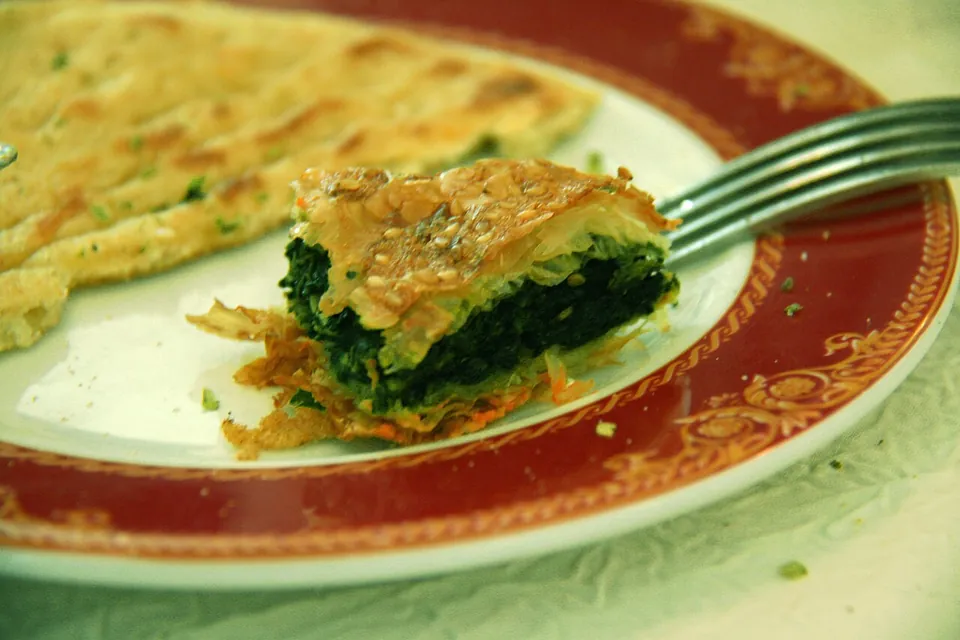
Börek is a pastry made by rolling and layering thinly stretched dough (yufka) around a filling of white cheese or minced meat, then baking it. Across the Balkans, in Serbia and elsewhere, it is a familiar food—from the bakery counter to the family table to street-corner snacking.
Wheat had long grown in this land. What defines börek, then, is the craft itself: stretching dough as thin as paper, rolling and layering it, and baking.
This craft and this dish took root in the Balkans in the Ottoman era. As the Ottomans expanded from the fifteenth century onward, börek spread across the region and settled in. City bakers carried it, and from there it reached homes and the street.
For the transcription used here: the dish is written Börek at first mention and börek thereafter.
How we know
The tradition of thin, layered dough is recorded far earlier than the arrival of the name börek in the Balkans. In the eleventh century, Mahmud al-Kashgari, who compiled a dictionary of the Turkic languages, set down in his Dīwān Lughāt al-Turk the word yuvgha—an older form of yufka—for a folded, layered bread. The oldest surviving record of a börek-type dish as an actual recipe comes from the fourteenth century, in the Chinese dietary manual Yinshan Zhengyao (1330), compiled by the Uyghur court nutritionist Hu Sihui: a päräk, stuffed with mutton, fat, and chives and cooked on an iron plate. As for the name, the Turcologist Andrea Tietze traced it through the Persian bûrak (a general term for yufka dishes) back to the Turkic root bur- (to twist, to roll). Word and cookbook alike point to a tradition of rolled, layered thin dough deeply rooted in Central Asia.
Some look for an older forerunner still, in placenta, the layered dough confection of ancient Greece and Rome. Cato the Elder's farming manual De Agri Cultura (c. 160 BC) gives a recipe for placenta, thin sheets of dough layered with cheese and honey and baked—among the earliest written instances of layered dough combined with cheese. On this view, placenta reached Anatolia by way of Byzantine cheese pies as a forerunner. Yet whether the sweet placenta connects directly to the savory, filled börek is weakly attested, and its relation to the Turkic yufka tradition does not resolve into a single line.
Against this backdrop, one story is told with unusual precision: the legend of how börek settled in the Balkans. A Turkish baker from Istanbul, Mehmet Oğlu, is said to have brought round börek to Niš in Serbia in 1498, and to have spread it from there. Niš festivals and tourist guides still circulate the tale. But layered thin-dough bread can be found, centuries before 1498, in places far from Niš: the yuvgha of eleventh-century Kashgari, the päräk of the fourteenth-century Yinshan Zhengyao. The notion of one craftsman "bringing" börek in one year falls apart here. At most it survives as a local tale about the round shape of Niš börek—a regional style—and even that cannot be confirmed from independent records. That börek settled in the Balkans in the Ottoman era is not at odds with the other views; it is the story pinning its origin to one man and one year that the sources fail to support.
The full set of origin theories and the detailed verification log — traceable all the way to their sources — are available on the Japanese edition.
See the full origin theories and verification log (Japanese) →