All dishes / オセアニア
Fairy bread Period COrigin theory CVerified
Some fields (dish name, region and gates) are shown from the Japanese-edition data.
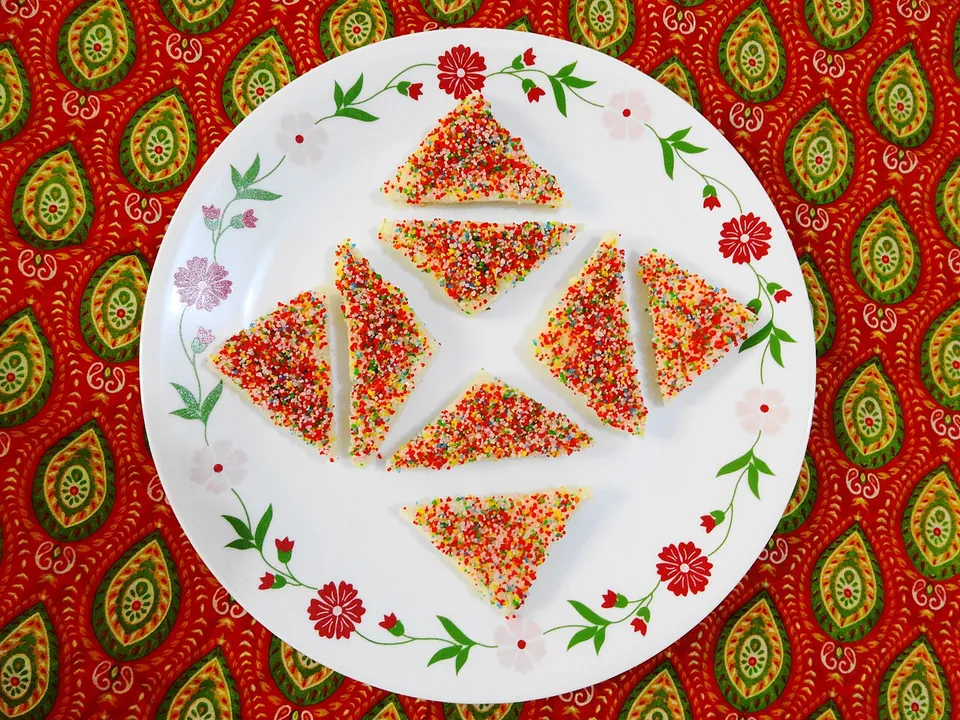
Buttered white bread scattered with tiny coloured sugar balls, this is the treat of Australian and New Zealand childhood. Yet no one can say for certain which of the two countries it came from.
Verification highlight popular claim → verdict → evidence
Earliest confirmed appearance of today's fairy bread (buttered white bread scattered with hundreds and thousands) is an April 1929 notice in Hobart's The Mercury newspaper; the name's link to R.L. Stevenson's 1885 poem "Fairy Bread" remains speculative, and whether Australia or New Zealand originated the dish is unresolved.
The three gates
- Ingredient-supply gate
- Wheat and butter were already available locally; the limiting factor was the spread of industrially produced sugar sprinkles.
- Cooking-technique gate
- No cooking involved — just spreading butter and cutting the bread.
- Venue gate
- Home and popular fare, especially at children's birthday parties.
Overview
Fairy bread is a slice of soft white bread, spread with butter and covered densely with the tiny coloured sugar sprinkles known as hundreds and thousands. Nothing is baked or boiled; you butter the bread and cut it, and that is all. Through the first half of the twentieth century it settled into homes across Australia and New Zealand as the fixture of a child's birthday party.
The wheat for the bread and the butter to spread on it were long-established staples in this part of the world. The industrially made sprinkles, by contrast, were not so simply at hand. Only once confectioners' shops began carrying these tiny coloured sugar balls did the little dish take shape in home kitchens. There is almost no technique to speak of: fairy bread is a popular sweet that appeared where a children's party and a supply of sugar sprinkles came together.
How we know
The earliest surviving record of fairy bread in its present form, buttered bread strewn with sugar sprinkles under that name, is an article in The Mercury, a newspaper published in Hobart, Tasmania, in April 1929. Earlier references to bread dressed with sugar grains do exist, in Caroline Clarke's account of 1886 and in an advertisement placed by the Plaistowe confectionery of Perth in 1921.
The name is sometimes traced to the Scottish writer Robert Louis Stevenson and his poem 'Fairy Bread', collected in his 1885 volume A Child's Garden of Verses. The poem, however, describes no coloured sugar bread, and the connection remains conjecture.
The dispute over which country invented it is likewise unsettled in the record. The word is used on both sides of the Tasman Sea, a distinctly Antipodean term, and it resists being assigned to one nation alone. For that reason both origins are still set down side by side, with neither claimed as first.
The full set of origin theories and the detailed verification log — traceable all the way to their sources — are available on the Japanese edition.
See the full origin theories and verification log (Japanese) →