All dishes / ラテンアメリカ
Bandeja paisa Period BOrigin theory CVerified
Some fields (dish name, region and gates) are shown from the Japanese-edition data.
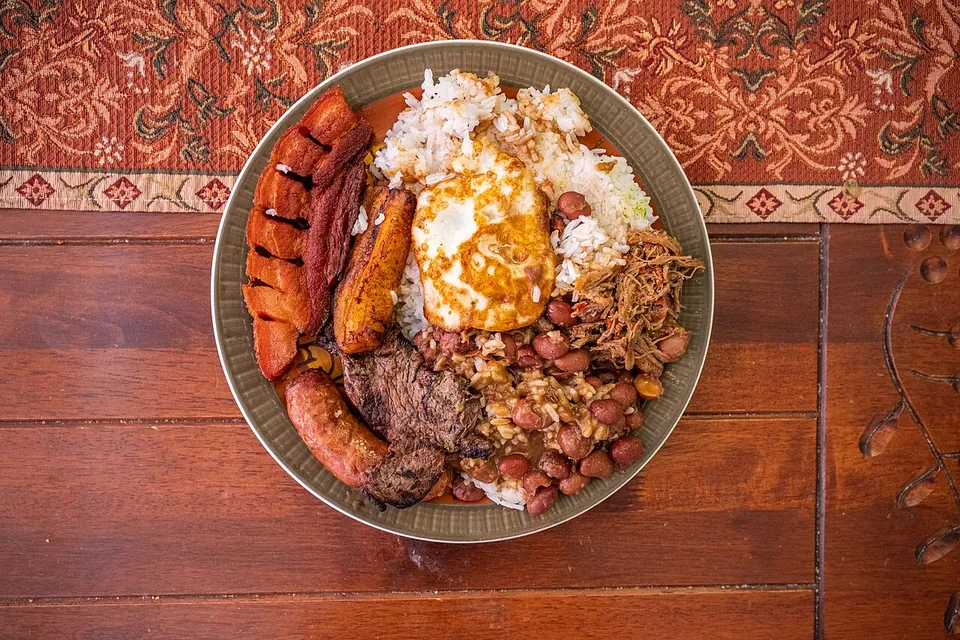
A heaped platter of red beans and rice, fried pork skin and a fried egg: the bandeja paisa is one of Colombia's signature dishes. It is not, however, a country tradition running back through the nineteenth century, but a modern one, made when mid-twentieth-century tourism promotion reshaped an older muleteer's meal into a single large platter.
Verification highlight popular claim → verdict → evidence
Myth: bandeja paisa is an age-old traditional dish of Antioquia. Verdict: refuted -- a full-text search of a major 19th-century Colombian costumbrista literature collection finds zero hits for the phrase "bandeja paisa" against dozens for contemporary dishes like sancocho, frisoles, and arepa, and the dish appears in no Colombian cookbook before 1950. The actual origin is a mid-20th-century tourism-industry repackaging (centered on Bogotá's Cotelco hotel association, or Medellín's tourism office, accounts differ) of the older muleteer meal "seco antioqueño" into a single serving platter. Key sources: Señal Memoria/RTVC, El Tiempo, Vergara y Vergara's Museo de cuadros de costumbres (1866).
The three gates
- Ingredient-supply gate
- A mixed platter of beans, rice, meat, fried pork rind, plantain, egg, and more. This combination could only take shape once Old World pigs, rice, and plantains had arrived, setting a colonial-era earliest possible date.
- Cooking-technique gate
- Stewing, frying, and rice-cooking of each component, all assembled onto one plate.
- Venue gate
- From a farm-labor meal of the Antioquia region (Paisa) to Colombia's national platter dish.
Overview
The bandeja paisa is a set meal from Antioquia in Colombia, the region whose people are the paisas. Built around a stew of red kidney beans, it gathers white rice, fried pork skin (chicharrón), grilled meat, sausage, a fried egg, fried plantain, avocado and an arepa onto one large platter, the bandeja that gives it its name.
The red beans at the centre of the platter are an American crop thousands of years old, domesticated separately in the Andes and in Mesoamerica. The rice, the pork and the plantain that goes into the fryer came from the Old World in the colonial period, the plantain taking root in Colombia and Venezuela in the sixteenth century; these newcomers settled into the region in their turn, until alongside the beans they were simply everyday food. The ways of cooking them, simmering beans, frying meat and pork skin, boiling rice, had long belonged to these mountain kitchens. It is with those ingredients and those skills already in place that a new form appears: setting them all out together on one large platter.
Its forerunner is the seco antioqueño, the packed meal that arrieros, the mule drivers, carried with them from the middle of the nineteenth century onward. Rice, beans, meat, something fried and plantain, with an arepa alongside, this working meal fed the farm labour and the mountain freight trade. Then it was carried into the world of tourism and promotion. On restaurant plates it grew larger, its colours were arranged, and it was set out as a large-platter meal. The bandeja paisa came forward as a national dish only after passing through that mid-twentieth-century reworking.
How we know
Restaurant menus and travel pages like to describe the bandeja paisa as country food that Antioquian farmers have eaten since colonial times. The nineteenth-century costumbrista writers, who set down local manners in close detail, describe no such platter. The best-known gathering of that writing is the two-volume Museo de cuadros de costumbres y variedades, edited by José María Vergara y Vergara and published in Bogotá in 1866. Its pages, and the rest of the costumbrista collection they sit in, can now be read in full through the Banco de la República's digital library. Sancocho turns up there again and again, and so do frisoles, the beans, and arepas; the phrase bandeja paisa does not appear in them at all. Nor, as Colombia's public broadcasting archive notes, does any Colombian cookbook printed before 1950 set out the platter. Neither the name nor the form was on nineteenth-century paper. The anthropologist Julián Estrada calls the dish an 'exaggerated' one, built up by Medellín's tourism promotion.
The details are still argued over. One account, reported in the Bogotá daily El Tiempo and by Radio Nacional de Colombia, holds that the name was coined not in Antioquia at all but in the capital, around 1950, when the existing 'seco' was pushed through the hotel and tourism association Cotelco. The other, argued by Estrada, treats the present form as the creation of Medellín's tourism office, sold in restaurants in the 1960s and in Turantioquia's tourist lodges in the 1970s, and spreading from there. On where and when the name arose the two do not converge, and the question is still open.
The distinction worth keeping is between the making of the name and the making of the dish that preceded it. The muleteer's packed meal, the seco antioqueño, is genuinely old; the enterprise of selling it as a large platter and calling it bandeja paisa belongs to the tourism of the mid-twentieth century. Keeping the two apart is what lets this dish's history be read straight.
The full set of origin theories and the detailed verification log — traceable all the way to their sources — are available on the Japanese edition.
See the full origin theories and verification log (Japanese) →