All dishes / ラテンアメリカ
Mofongo Period COrigin theory CVerified
Some fields (dish name, region and gates) are shown from the Japanese-edition data.
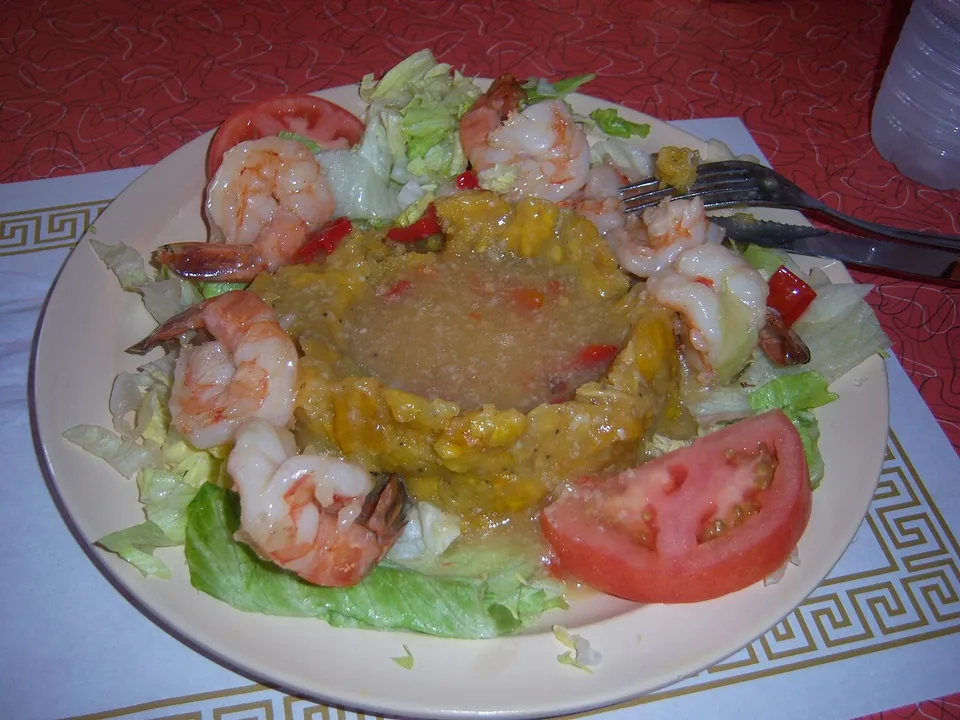
Fried green plantains pounded in a mortar with garlic and pork fat—a Puerto Rican dish. It is often said to be nothing more than West African fufu under a new name, but that reading mistakes both the pounding technique and the history of the ingredients. What actually happened is that three cultures met on the island and made something new.
Verification highlight popular claim → verdict → evidence
A Puerto Rican dish born from the fusion of Central African pounding techniques, the Taino mortar (pilon), and Iberian ingredients like garlic and pork fat, not a simple transplant of West African fufu, from which it differs in both technique and texture. The earliest known record naming the dish comes from an 1856 Ponce newspaper.
The three gates
- Ingredient-supply gate
- Plantain, native to the Old World, was introduced to and became established in the Caribbean through the transatlantic slave trade
- Cooking-technique gate
- Frying then pounding into a paste (pilón), a technique continuous with West African fufu-pounding
- Venue gate
- Home cooking of enslaved and free Black Africans, later spreading across the island
Overview
The star of mofongo is the green plantain. The plantain is an Old World crop, carried to the Caribbean along the currents of the Atlantic slave trade; a chronicle records it reaching Hispaniola in 1516. Only once the crop had established itself on Puerto Rico could the island's kitchens treat plantains as a daily staple. Before mofongo could exist at all, this green banana first had to be at hand.
The method is to fry sliced plantains, then work them in a mortar—the pilón—with garlic and pork fat, often adding fried pork skin or ham as they are pounded together. What matters here is the technique of pounding a starchy food into a mass and softening it with fat and a little liquid. That pounding hand belongs to the starch cookery of Central Africa and Angola, and it came by way of the people brought to the island. The pilón itself, the pounding vessel, was also a mortar used by the Taíno, who had lived on the island earlier. Onto this fell the Iberian ingredients and seasoning—garlic, pork fat, ham. Where those three threads crossed in a single bowl—the Angolan pounding technique, the Taíno pilón, the Iberian ingredients—lies the outline of the dish called mofongo.
The oldest page on which the name mofongo can be verified is a reader's letter in the Ponce newspaper El Fénix, dated 11 October 1856. Writing in the middle of a cholera outbreak, a correspondent from Yauco reports that convalescents had spent the money a doctor gave them for food on plantains and pork, and that each of them had a plate of mofongo in his hand. Before it ever reached a cookbook, mofongo was being named as this kind of everyday plate—what people put their food money toward while recovering from illness. The island's first cookbook, El Cocinero Puerto-Riqueño o Formulario (1859), also lists a "mofongo criollo," but that comes three years after the letter. Both are points at which the dish was written down, not the moment it was born. As the plantain settled on the island, as the dish was made in the home kitchens of people of African descent, and as it spread across the whole island—somewhere along that long course it was already being eaten.
How we know
The story most often told about mofongo is that it is West African fufu, carried to the Caribbean by the slave trade and simply renamed—a direct descendant. The visible closeness of pounded plantain, together with the history of the people brought to the island, has made that reading feel natural.
But the food historian Cruz Miguel Ortíz Cuadra sets the two side by side and points to the differences. Fufu is boiled and then pounded; mofongo is fried and then pounded. That single change alters both texture and density, and it is hard to call them one continuous dish. Nor is the pilón an African tool alone. Ortíz Cuadra notes that the Taíno were pounding with mortars on this island first. To fold mofongo into a single African origin, then, is to lose the island's own long history of the mortar. Seen this way, the "direct descendant of fufu" account lacks support in the sources.
What Ortíz Cuadra describes is not a single origin but the meeting of three threads: the Angolan way of pounding starch and binding it with fat and liquid, the Taíno pilón, and Iberian ingredients and seasoning. Even the name mofongo is said to go back to the Kikongo mfwenge-mfwenge, "a great deal of something," a hint at the plurality of its origins. A dish of similar shape was not carried whole across the sea and passed down unchanged; several cultures met in an island kitchen, and ingredients, technique and mortar mixed together. That is the view food history holds today.
The full set of origin theories and the detailed verification log — traceable all the way to their sources — are available on the Japanese edition.
See the full origin theories and verification log (Japanese) →