All dishes / 南アジア
Watalappan Period COrigin theory BVerified
Some fields (dish name, region and gates) are shown from the Japanese-edition data.
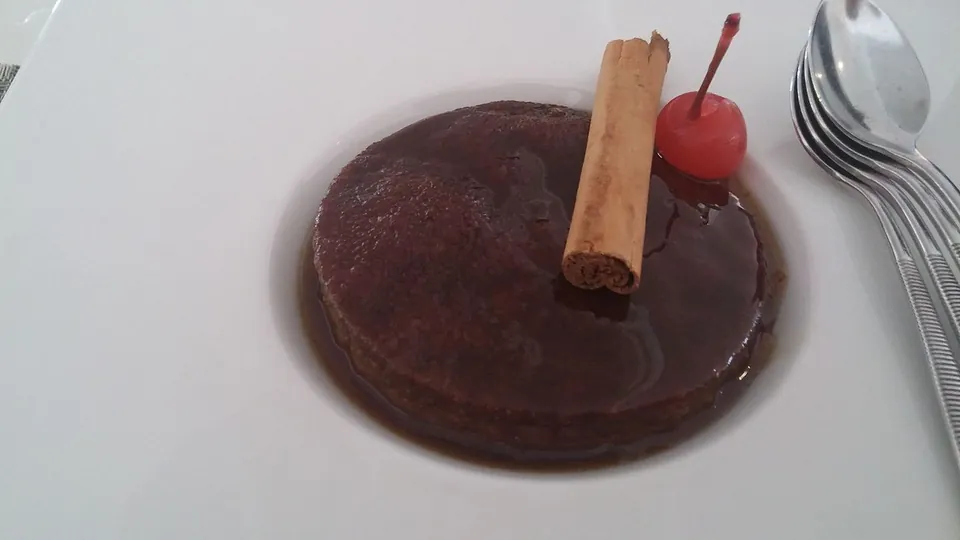
Watalappan is a Sri Lankan steamed pudding dark and fragrant with kithul palm jaggery. That it is a sweet carried across the sea is by now largely settled; what is still told and retold is rather the story of the name the island gave it.
Verification highlight popular claim → verdict → evidence
The dish traces to serikaya, a steamed coconut-and-egg custard brought by Malay settlers from Indonesia during the Dutch colonial period and later adapted with local palm jaggery -- a lineage supported by ethnological scholarship rather than any single inventor's story; the name has a separate, compatible history of its own, most likely a local rendering of the Dutch word for custard, 'vla.'
The three gates
- Ingredient-supply gate
- Coconut, kithul palm jaggery, and eggs are all native ingredients; no single ingredient sets a limiting date for the dish.
- Cooking-technique gate
- A steamed, custard-style technique.
- Venue gate
- A festive sweet of Sri Lanka's Malay community that later spread across the island.
Overview
Watalappan (also spelled Wattalappam) is a custard-like sweet: dark, toasty palm jaggery drawn from the kithul palm is dissolved into coconut milk and egg, scented with cardamom, and steamed until firm. The sticky-sweet palm sugar, the mellow coconut milk, and the eggs were all long-established on this island, ordinary things within easy reach. Poured into a bowl and steamed slowly until set, that plain making yields a rich dish that graces the festive table.
It is cherished in Sri Lankan Muslim society, and especially among the Malay people (the Ja Minissu), as a celebration sweet, indispensable at Eid and at weddings. In time it crossed the boundaries of the community and spread across the island, and today it is known as one of Sri Lanka's signature sweets.
How we know
Watalappan origins have long been spoken of as though disputed. But as for the pedigree of the sweet itself, one view has now settled.
From the late seventeenth to the late eighteenth century, the Dutch East India Company (VOC) transported people from Java and the Malay archipelago to the island of Ceylon as exiles and soldiers. The Sri Lankan Malays (the Ja Minissu) who arrived this way brought with them a sweet from home called serikaya -- egg, coconut milk, and palm sugar steamed until firm. It met the island kithul palm jaggery and turned into a local festive sweet. Asiff Hussein, a longtime scholar of Sri Lankan Muslim society, sets out this pedigree as the accepted account in his ethnography Sarandib.
What lingers as kindling for debate is instead the name. Some read watalappan as inheriting the Tamil vattil (bowl) and appam (a sweet cake); others read it as the Dutch vla, meaning custard, worn down in the mouths of the Moor community. The trail is old. In 1888-89, Louis Nell recorded in the scholarly journal The Orientalist that the Moors expressed the Dutch vla with the local name vattil-appan, which tells us the dish already went by its present name by at least that time. Hussein notes, too, that this sweet was unknown to the Tamils -- the Tamil spelling is the trace of a borrowed name, not a sign that its makers were Tamil.
So the vattil reading and the vla reading are not really fighting over which is the true origin. They are two variants of a single naming history: a Malay-derived steamed custard to which the Moor community of colonial Colombo gave a name in the local tongue. The name watalappam first appears in an English dictionary only in 1956, but that is merely the earliest year it was recorded as an English word, not the year the sweet came into being. The sweet that crossed the sea had been granted its name on this island long before, and only then became Watalappan.
The full set of origin theories and the detailed verification log — traceable all the way to their sources — are available on the Japanese edition.
See the full origin theories and verification log (Japanese) →