All dishes / 北米
Nanaimo bar Period BOrigin theory CVerified
Some fields (dish name, region and gates) are shown from the Japanese-edition data.
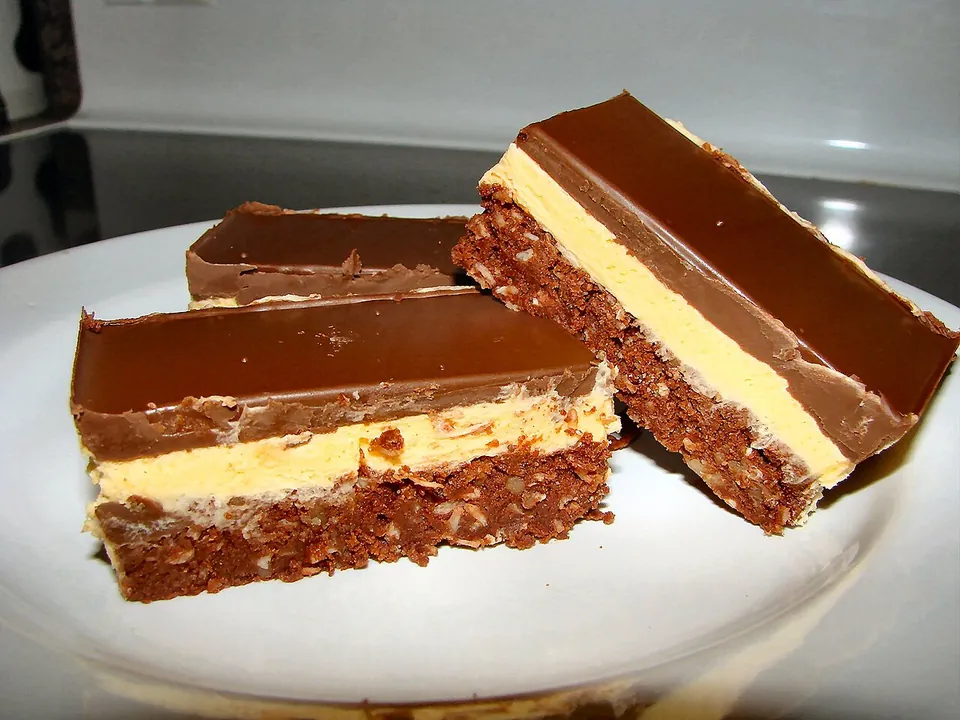
A no-bake chocolate confection built in three layers, it spread across the country under the name of the town of Nanaimo. But no contemporary record survives to support the famous origin tale that "a woman named Mabel in Nanaimo invented it."
Verification highlight popular claim → verdict → evidence
The first recipe matching today's three-layer form appears in a 1952 Nanaimo Hospital Auxiliary cookbook, and the name 'Nanaimo bar' first turns up in print in a 1953 Vancouver Sun column. The dish's tie to the city of Nanaimo solidified in the early 1950s, but no specific inventor is recorded in any source.
The three gates
- Ingredient-supply gate
- Wheat, dairy, and sugar were in ordinary local supply; cocoa and coconut had already arrived through trade.
- Cooking-technique gate
- No-bake layering: a double-boiled cocoa base, then a custard layer, then a chocolate layer.
- Venue gate
- Home and church recipe collections, later commercialized.
Overview
The Nanaimo bar layers three components, none of them cooked: a base of cocoa melted over a water bath and set firm, a smooth custard-style cream, and a chocolate coating over the top. Requiring no oven, just melting over a water bath and chilling to set, it could be made without trouble in a home kitchen or at a church gathering. The crushed biscuit, cocoa, and coconut worked into the base, and the chocolate on top, were all ingredients that households on Canada's west coast had readily on hand, and it called for no special tools or skill.
Behind this confection lies the thriving community-cookbook culture of mid-20th-century British Columbia. Hospital auxiliaries and church women's groups gathered their recipes into a single booklet to raise funds and socialize, and the practice was well established. The no-bake three-layer square itself had circulated in the region for some time. Vancouver newspapers of 1947 and 1948 already carried instructions for a no-bake confection using a coconut-and-graham-cracker base, and similar squares passed from hand to hand under a range of local names: Chocolate Square, Chocolate Slice, London Fog Bar, Mabel's Square, and more.
The turning point came when such squares became tied to the specific place name "Nanaimo." In 1952, a Mrs. E. MacDougall contributed the current three-layer form as two entries, "Chocolate Slice" and "Chocolate Square," to the cookbook of the Nanaimo Hospital Auxiliary. The following year, 1953, the name appears plainly in print when the reader's cooking-advice column run by "Edith Adams" in a Vancouver paper added the line "also called Nanaimo Bars." It appeared that same year in a prize-recipe collection, and the name settled here. A square that had gone by scattered names across the country came to rest on a single name and form through the town of Nanaimo's community booklet and its local paper. As the recipe moved from home kitchens into print and then into widely sold goods, the confection, name and all, became the face of the region.
How we know
The Nanaimo bar carries an origin tale long handed down. In the early 1950s, the story goes, a woman named Mabel Jenkins who lived south of Nanaimo invented the confection. With an inventor's name attached, the anecdote sounds very much like a genuine origin.
Yet no contemporary record supporting that anecdote can be found anywhere. When the food geographer Lenore Newman and others traced the cookbooks of the day, the same three-layer square turned up under different names from place to place: Mabel's Square in Nova Scotia, Victoria Special in Drumheller, New York Slice in Winnipeg. "Mabel" was simply one of these regional names, not a pointer to any particular inventor. Newman states plainly that there are many mysterious tales about where the Nanaimo bar came from, but no evidence for them at all.
So what is certain? Between 1952 and 1953, through the Nanaimo Hospital Auxiliary's cookbook and the local paper, this three-layer square crystallized around a single form under the name "Nanaimo." The name "Nanaimo bar" first appears in print in 1953, and the dictionary of Canadian English usage records that year as its earliest attestation. Who the single inventor might have been, on the other hand, remains unknown in the record to this day. The story that credits the invention to one person's hand recedes, and only the account of a town community giving the confection its name stands as the outline the record preserves.
The full set of origin theories and the detailed verification log — traceable all the way to their sources — are available on the Japanese edition.
See the full origin theories and verification log (Japanese) →