All dishes / 中央アジア
Beshbarmak Period BOrigin theory BVerified
Some fields (dish name, region and gates) are shown from the Japanese-edition data.
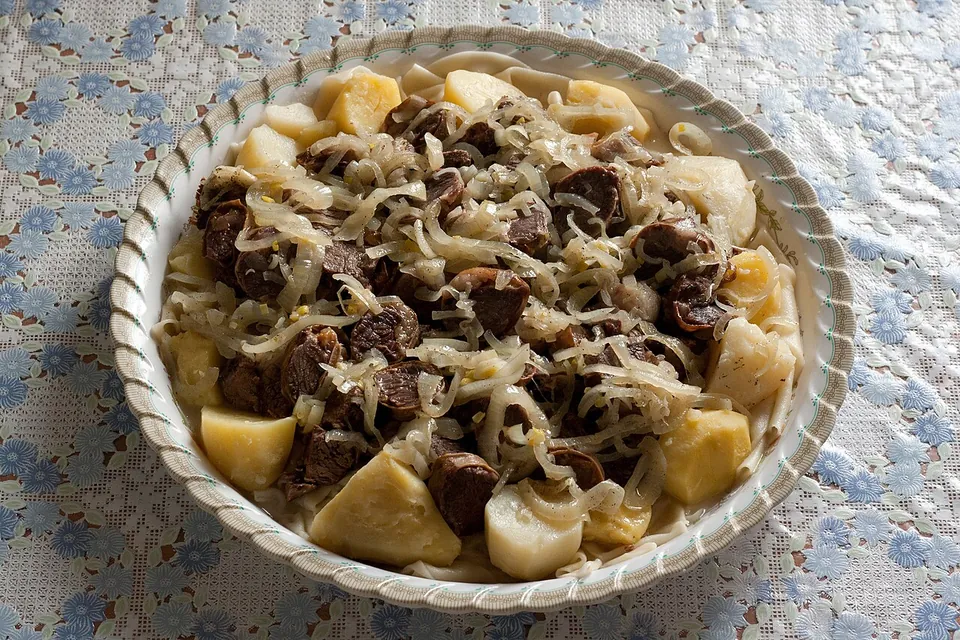
Boiled horse and mutton laid over flat sheets of dough, eaten by hand with five fingers: this is beshbarmak, an old nomadic dish of Central Asia. Yet much of what now frames it as the "national dish" of Kazakhstan or Kyrgyzstan was fixed in modern times, and even the dish's name was a label imperial Russia fastened onto it after the fact.
Verification highlight popular claim → verdict → evidence
Competing claims remain unsettled. The dish itself is not disputed; who created it is. Kazakhs and Kyrgyz each claim beshbarmak as their own, and the historical record does not settle the attribution to either people: a study, "Eating with the Hands" (2025), argues that the name itself was not the name of a dish already on the steppe, but a category that grew out of imperial Russian observation and classification on the Orenburg frontier in the nineteenth century. What is not in question is the dish underneath, boiled horse meat or mutton served over flat sheets of wheat dough and eaten by hand, an old native dish shaped by the constraints of Central Asian nomadic life and later formalized as a national dish during the Soviet era.
The three gates
- Ingredient-supply gate
- Horse meat, mutton, and wheat are all native to the Eurasian steppe pastoral economy; no single ingredient constrained when the dish could take shape, so the material threshold is loose.
- Cooking-technique gate
- Boiled horse or mutton meat served over boiled flat wheat-noodle sheets with the cooking broth (sorpa), eaten by hand (besh = five, barmak = finger).
- Venue gate
- The centerpiece of Kazakh/Kyrgyz nomadic hospitality and festive feasts, later adopted as a national dish.
Overview
Beshbarmak is a feast dish that nomads raised on the steppe stretching from the Kazakhs to the Kyrgyz. Boiled horse meat or mutton is set over flat, boiled sheets of wheat dough and served on a large communal platter with the cooking broth (sorpo). The name means "five fingers," naming the very manner of eating it by hand. It developed within Turkic nomadic culture, an old dish whose deepest layer reaches back roughly to medieval times and after.
The ingredients that sustain it were all long present in the nomadic world. Horse meat, mutton, and wheat were all staples of the Eurasian steppe, close at hand from early on in a life of movement. Beshbarmak gathered these familiar foods into a single dish within the customs of hosting guests and marking festivals.
Boiled meat laid over dough, shared by hand around one platter: this form travels well and sits easily within a mobile, pastoral life. Its place at the center of steppe hospitality shaped what beshbarmak is, a dish everyone reaches into from a common dish. It appears clearly in writing in the nineteenth century. Aleksey Levshin's Description of the Kirghiz-Kaisak Hordes and Steppes (1832) recorded it as the most celebrated dish of the steppe, meat cut fine and combined with fat, taken up and eaten with five fingers.
How we know
Two questions follow beshbarmak everywhere: which people created it, and since when has it been a national dish?
The first has no resolution. Kazakhs and Kyrgyz each claim the dish as their own, and the dispute over ownership continues to this day. There are regional differences, such as whether the dough is cut into diamonds or into long strips, but these give no handle for assigning the origin to one side. The reason it cannot be settled lies deeper. The study "Eating with the Hands" (2025) argues that the very name "beshbarmak" was not the name of a dish already on the steppe, but a product of the observation, administration, and classification that imperial Russia carried out on the Orenburg frontier in the nineteenth century. What the earliest records captured was a visible act, eating salted meat by hand, not a fixed recipe or a native name of its own. Through that descriptive naming, the dish was afterward tied to particular groups such as the Kazakhs, Bashkirs, and Tatars. So the question of "who created it" is, from the order of the naming itself, built so that it cannot return an answer to either side.
The second question admits a firmer answer. The dish itself is old, but the present framing of it as "the national dish of Kazakhstan" or "of Kyrgyzstan" was consolidated in modern times. Alymbaeva's research (2020) shows how state-compiled cookbooks such as The Book of Tasty and Healthy Food (1939) and National Cuisines of Our Peoples (1951), together with the very idea of a national cuisine, advanced within a wider move to draw food along lines of ethnicity and border. The antiquity of the dish is not in doubt. But much of the "national dish of so-and-so" signboard is something modernity pasted, after the fact, onto an old feast food of the steppe.
The full set of origin theories and the detailed verification log — traceable all the way to their sources — are available on the Japanese edition.
See the full origin theories and verification log (Japanese) →