All dishes / 北米
Tourtière Period BOrigin theory CVerified
Some fields (dish name, region and gates) are shown from the Japanese-edition data.
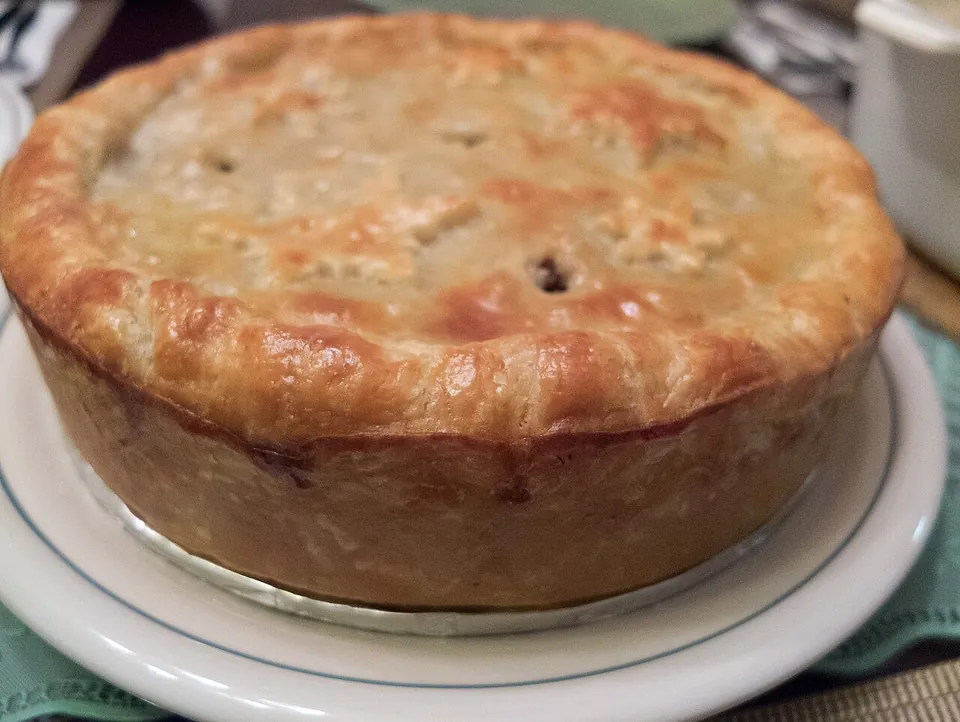
Quebec's essential Christmas meat pie. The popular story that its name comes from an extinct migratory bird is a case of mistaking where a word comes from for where a dish comes from, and linguists reject it.
Verification highlight popular claim → verdict → evidence
Myth: the name comes from the passenger pigeon (French tourte), once abundant and easy to catch in North America. Verdict: refuted by linguists—the word tourtière is first attested in French in 1573 (J.-A. de Baïf), referring to the pie tin itself, more than two centuries before any pigeon connection could apply. The name follows the utensil, not the filling, the same way 'casserole' names a dish after its cooking vessel. Key sources: Wiktionary and CNRTL/TLFi etymology entries; La cuisinière canadienne (1840), the earliest cookbook attestation of the dish itself.
The three gates
- Ingredient-supply gate
- Pork and wheat were brought by French settlers and became locally established.
- Cooking-technique gate
- A pastry-baked meat pie.
- Venue gate
- A Québécois household dish, a fixture of the Christmas Eve réveillon meal.
Overview
Tourtière is a French-Canadian meat pie of pork wrapped in pastry, long cherished in Quebec and above all at Réveillon, the late-night feast on Christmas Eve.
Both pork and wheat came to the New World with French settlers who established them locally, and the technique of baking them into a meat pie belongs to the same French culinary line. A dish of the same name already existed across seventeenth-century France, and it took root at Quebec tables from the settlement period as a continuation carried across the Atlantic.
Oral tradition traces its beginnings to the Réveillon tables of the 1600s. Its earliest written form is a recipe using three meats—pork, mutton, and veal—printed in La Cuisinière canadienne (Montreal, 1840), Canada's first French-language cookbook. That date marks only the point by which the dish demonstrably existed, not the year it was created. Recipes varied from household to household and region to region, and the pie sank deep roots into Quebec's winter and its festive table.
How we know
Tourtière comes with a memorable origin story. The name, it is said, comes from the passenger pigeon—tourte in French—which numbered in the billions across North America into the early nineteenth century and was easy to catch. That bird went extinct at the century's end. It is a dramatic, easy-to-remember tale.
But the etymology is not history. Linguists and food historians reject it, holding that the dish's name does not come from its filling.
The real source of the name is a tool, not a bird. The shallow pan used to bake a tourte (a pie) is called a tourtière in French. Just as the name of a pot can pass to the dish cooked in it, the Quebec dish took the name of the vessel.
The decisive point is chronology. The word tourtière for the baking pan already appears in French in 1573, in the poet Jean-Antoine de Baïf's Les Passetems—more than two centuries before the passenger pigeon was ever tied to the Quebec table. Together with the fact that a dish of the same name already existed in seventeenth-century France, this means the name reached the dish from the vessel before the bird. Etymological dictionaries such as CNRTL/TLFi, and Wiktionary as well, state plainly that the resemblance to the bird's name is coincidental and that the name does not derive from the filling. The Canadian Encyclopedia and Britannica likewise support the vessel origin.
The tale of an extinct migratory bird spread widely because it is easy to remember. Put the sequence in order, though, and the settled view is clear: the dish's name came from the baking pan, not the bird.
The full set of origin theories and the detailed verification log — traceable all the way to their sources — are available on the Japanese edition.
See the full origin theories and verification log (Japanese) →