All dishes / ラテンアメリカ
Ceviche Period AOrigin theory CVerified
Some fields (dish name, region and gates) are shown from the Japanese-edition data.
Ceviche is often said to reach back to the Inca, or further still. But the ceviche we know, in which lime cures the fish, could not have come into being before the 16th century, when that citrus crossed to the New World with the Spanish.
Verification highlight popular claim → verdict → evidence
This entry covers the current lime-based form. Citrus reached the Peruvian coast via Spain in the 16th century (recorded 1535-1600), and that arrival fixes the earliest possible date for this style, so the dating is nearly certain. An acid-marinated forebear predating citrus is treated separately (#36). Both the acid source of that forebear and the word's etymology remain unsettled, so the origin account is presented as competing theories.
The three gates
- Ingredient-supply gate
- Native white fish plus acid (citrus); lime arrived via Spain in the 16th century, fixing the earliest possible date.
- Cooking-technique gate
- Curing raw fish in acid, coastal fishing, and native chili peppers.
- Venue gate
- Markets and home kitchens in the coastal ports, where it was everyday food for ordinary people.
Overview
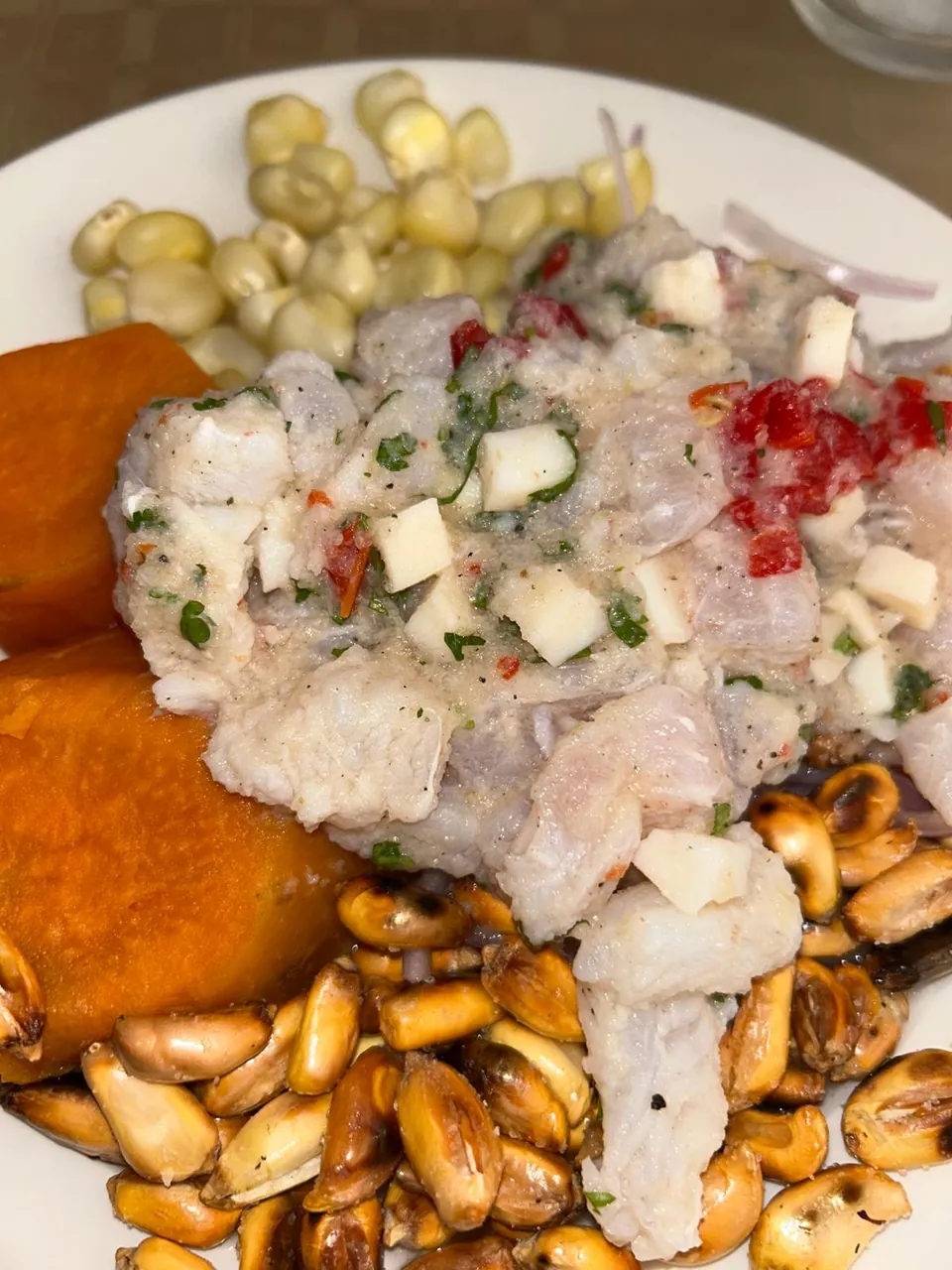
Ceviche is a dish of the Peruvian Pacific coast: white fish cured in acid and eaten raw. Today the acid is citrus, lime or lemon. Yet these fruits did not originally grow in South America. After Columbus reached the Americas in 1492, it was the Spanish who brought them across, beginning with the bitter orange. Lime took root along the Peruvian coast around the 16th century.
For that reason, the modern way of turning fish white with the acid of lime cannot, on the most generous reckoning, predate the 16th century. Only once citrus had arrived did the outline of today's ceviche settle into place.
The knack of briefly curing fish in acid, the abundant fishing of the Pacific coast, and the native chili came together to give the dish its form. What spread it was not the court but the seaside fishing villages and markets. In the coastal ports, people cured the day's catch quickly and ate it, and that food of the common people grew in time into a dish that stands for Peru.
There was, to be sure, an older custom of curing fish in a different acid before citrus arrived. But that belongs to another age and another source of sourness, and it has to be kept apart from today's lime style.
How we know
The telling that ceviche was eaten in Inca times, or even before, runs deep, and the view has real support. The archaeologist Ruth Shady and the historian Juan Jose Vega see a prehistory of curing fish in acid within the ancient coastal cultures of Caral, Moche, and the Inca. The food historian Maricel Presilla reports that at a pre-Inca site on Peru's northern coast, seeds of the tumbo, the banana passionfruit, were found together with the seeds of native chili and with shells and fish bones. It is a trace showing that acid, fish, and chili were all present at an old coastal table.
There is one awkward point, though: what served as the source of acid back then is not clear. Against Shady and Vega, who name the tumbo, Presilla, while writing, tried curing fish with tumbo herself and judged that it took too long and the acid was too weak. Noting that some chilies carry a sourness of their own, she suggests that before lime arrived, seaweed and chili may have played the role of the acid. Within this older layer the views remain divided.
Here the single line of citrus makes itself felt. The ceviche of today, which transforms the fish with lime or lemon, cannot exist before the 16th century, when those fruits came across with the Spanish. The age of the dish as a category and the moment its present method took shape are two separate matters. So the pre-citrus acid-curing has to be set apart as a prehistory of a different age from today's ceviche.
In writing, the word sebiche first appears in 1820, in the patriotic song La chicha. That the dish is named in this song, by the independence-era poet Jose de la Torre Ugarte and the composer Jose Bernardo Alcedo, shows that ceviche had already taken hold as a dish through the colonial period. It is firm evidence that after citrus arrived, the dish was indeed on Peruvian tables.
The origin of the name has likewise not been decided. The Spanish Royal Academy traces the Moorish escabeche, meaning a pickle, back to a line reaching the Arabic sakbaj, meat cooked in vinegar. The geographer Javier Pulgar Vidal, on the other hand, derived it from the Quechua siwichi, fresh fish. Juan de Arona's Diccionario de peruanismos of 1884 set down the word form seviche early on. The origin of the word and the origin of the dish are separate questions, and here too the accounts stand side by side, unresolved.
The full set of origin theories and the detailed verification log — traceable all the way to their sources — are available on the Japanese edition.
See the full origin theories and verification log (Japanese) →