All dishes / 西欧
Cheese fondue Period BOrigin theory CVerified
Some fields (dish name, region and gates) are shown from the Japanese-edition data.
Cheese melted in white wine and shared straight from a communal pot: cheese fondue. The common notion that Alpine peasants ate it for centuries as a humble country dish is the reverse of the record—it began as a dish of lowland city dwellers.
Verification highlight popular claim → verdict → evidence
The popular image of fondue as an age-old rustic dish eaten by Alpine peasants for centuries is a myth: hard cheeses like Gruyère were an expensive export good peasants could not afford, and the earliest recorded recipe (1699, Zurich) comes from an urban, French-speaking lowland household, not a mountain farm. Its status as Switzerland's 'national dish' was deliberately built by the Swiss Cheese Union's marketing campaigns from the 1930s onward to boost surplus cheese consumption — a genuine case of an 'invented tradition.'
The three gates
- Ingredient-supply gate
- Alpine hard cheese, white wine, and wheat bread are all locally available, so no single ingredient's arrival sets the limiting constraint.
- Cooking-technique gate
- Melting cheese with white wine into an emulsion, served from a shared pot.
- Venue gate
- Began as home cooking in Alpine households, then became a national dish promoted through 20th-century restaurants and tourism.
Overview
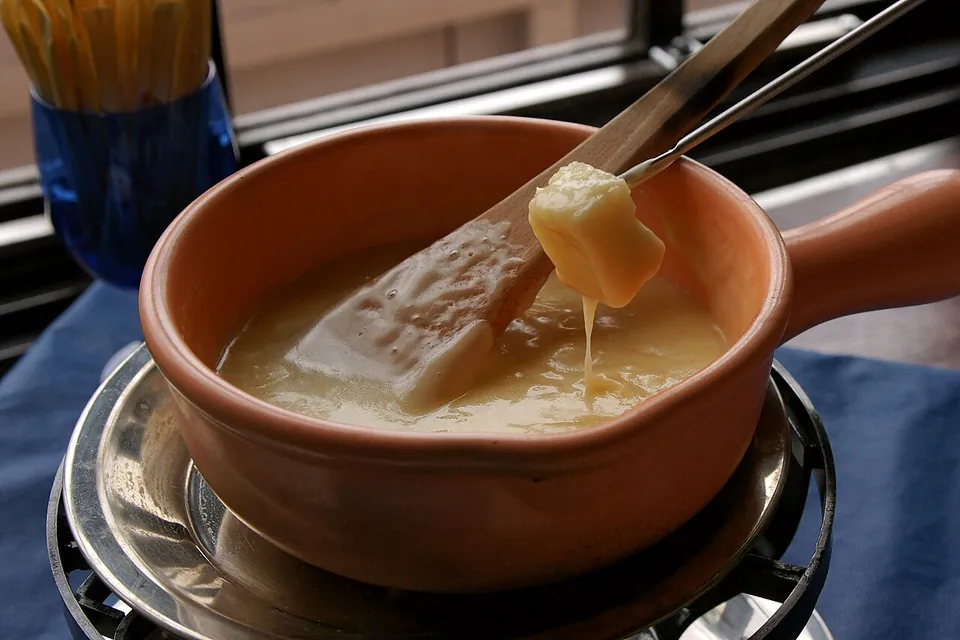
Cheese fondue is a dish in which hard Alpine cheeses such as Gruyere are heated with white wine until they emulsify, melted smooth in a single shared pot, and eaten with bread dipped into it. Widely known as a signature Swiss dish, it is a fixture at mountain chalets and in tourist towns.
The ingredients are all obtainable around the Alps—hard cheese, white wine, and wheat bread are enough to make it. The heart of the dish lies in the skill of melting the cheese smoothly in white wine without letting it separate, and setting it out as a shared pot.
Its first appearance in writing is a dish called "cooking cheese in wine," in a handwritten cookbook set down in Zurich in 1699. The dish is traced to the French-speaking west, and to lowland city dwellers rather than the mountains. By the nineteenth century a modern recipe had taken shape, and as early as 1875 it was being presented as a "Swiss national dish." What began as a household pot spread in time to restaurants and to tourism.
How we know
Fondue carries a beloved image: a humble traditional food that Alpine peasants have eaten for centuries. It is a story bound to mountain life, the flavor of the countryside.
That premise, however, does not hold. Hard cheeses like Gruyere were an expensive export product, slow to reach the rural poor and urban laborers well into the early twentieth century. The 1699 Zurich cookbook in which the dish first appears depicts not a mountain village but the table of lowland city dwellers. The starting point of a humble peasant tradition is itself an image arranged after the fact. The ethnologist Isabelle Raboud-Schule, former director of the Musee gruerien, has said that until around 1930 fondue was known only in the French-speaking region.
Its standing as a "Swiss national dish" is likewise a modern product. From the 1930s onward, the Swiss Cheese Union (Schweizerische Kaseunion) heavily promoted fondue as a national dish in order to move surplus domestic cheese. Through a showing at the 1939 New York World's Fair and distribution to the army, fondue was raised into a symbol of national unity, and plausible-looking country recipes were even devised for it. This course of events is told alike by public records—the official blog of the Swiss National Museum and the Swiss federal foreign ministry's official site (aboutswitzerland)—and by American reporting (NPR's Planet Money, "The Fondue Conspiracy"). The age of the dish as a category is not denied, but the "ancient Swiss national dish fondue" now imagined is a tradition made up after the fact, built by twentieth-century marketing. It was originally a dish of lowland city dwellers, and the picture of an ancient Alpine peasant food is one that twentieth-century promotion spread only later.
The full set of origin theories and the detailed verification log — traceable all the way to their sources — are available on the Japanese edition.
See the full origin theories and verification log (Japanese) →