All dishes / 西欧
Bouillabaisse Period BOrigin theory CVerified
Some fields (dish name, region and gates) are shown from the Japanese-edition data.
A pot of unsellable rockfish, simmered on the shore by Marseille fishermen, climbed its way into a celebrated soup glowing gold with saffron. A grand tale traces it back to ancient Greece, but the golden soup on the table today descends from something much nearer in time: the fishermen's own hand-pot.
Verification highlight popular claim → verdict → evidence
Leading account: a Marseille fishermen's soup of unsellable rockfish, first recorded as a recipe in 1768 and later refined with saffron into the celebrated "golden soup" of the 19th century. A rival claim traces bouillabaisse directly to the ancient Greek fish stew kakavia from Marseille's founding as Massalia; this is treated as an unproven parallel rather than a confirmed lineage, since no source shows continuity between the two.
The three gates
- Ingredient-supply gate
- Mediterranean rockfish and shellfish were native to the coast; saffron arrived through Old World trade.
- Cooking-technique gate
- A fishermen's stew of seafood simmered in water or wine, served with rouille and bread.
- Venue gate
- Began as a beachside dish of Marseille fishermen, became a regional specialty of Provence, and was later elevated to haute cuisine.
Overview
When and where it took shape
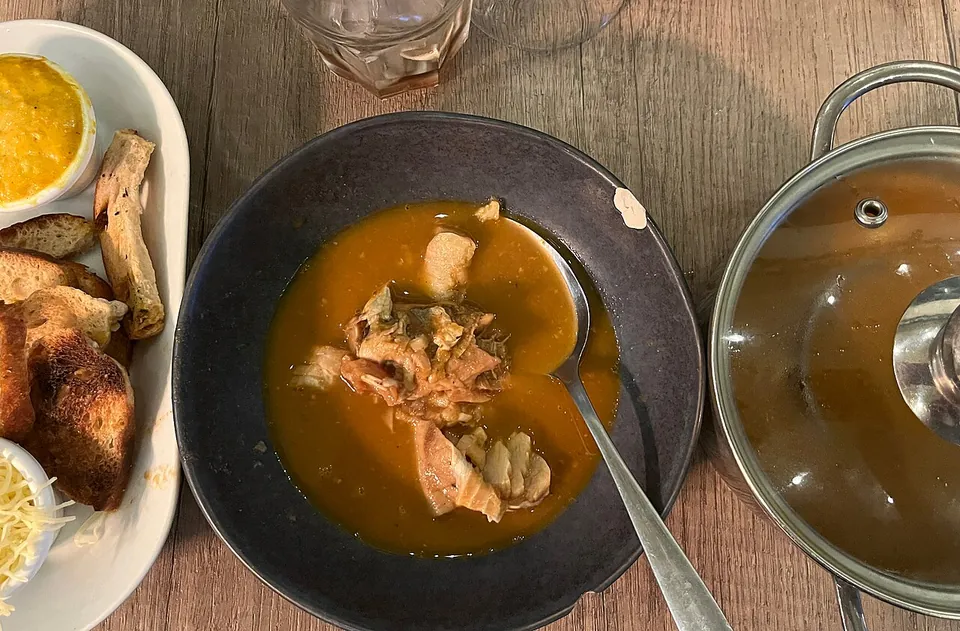
Bouillabaisse is a southern French fish soup of assorted Mediterranean fish and shellfish simmered in water or wine. A regional dish of Marseille and the rest of Provence, it is served with bread spread with rouille, a garlicky sauce.
The star is the humble fish and shellfish long found along the Mediterranean coast, the bony rockfish that were hard to sell at market. These were local ingredients, on hand in quantity, with no need to send away for them. The saffron that scents the soup came along old-world trade routes.
What made the dish was the fishermen's own way of simmering. Between the catches, they would boil the leftover fish in seawater in a great pot and share it out on the spot: that shore-life knack was the prototype of bouillabaisse. In time the restaurants of Marseille refined it, adding saffron for color and aroma and serving it with rouille and bread, working it into the dish we know today.
From shore-pot to specialty
The oldest recipe on record dates to 1768, still plain in form, using garlic, parsley, bay, olive oil, and onion. The dish first appears in a book of regional cookery in Charles Durand's Le Cuisinier Durand (Nimes, 1830), which carries two recipes titled bouil-abaisse. In the early nineteenth century the restaurants of Marseille added saffron and polished it into la soupe d'or, the golden soup, lifting it into a local specialty. In 1980 a Bouillabaisse Charter was drawn up, setting out agreed rules for the fish and the method. From a fishermen's shore dish to a regional specialty and then to fine dining: this is the road bouillabaisse traveled.
How we know
Bouillabaisse comes trailing a grand story about its origins. When the Phocaeans founded Massalia, the forerunner of Marseille, around 600 BC, so the telling goes, they brought a fish soup called kakavia, and that is the direct ancestor of bouillabaisse: a dish carrying twenty-six centuries of history.
That the genre of fish soup itself is old is beyond doubt. Mediterranean people have boiled humble fish in a pot since antiquity. But kakavia has neither saffron nor rouille, and its contents differ from what we now call bouillabaisse. The word bouillabaisse, too, only surfaces in the record in the nineteenth century. According to the CNRTL, which tracks the history of French words, the form bouille baisse appears around 1835 (in Pons de L'Herault), and Flaubert wrote the present spelling bouillabaisse in 1845. No source shows the word or the dish passing unbroken from an ancient Greek ship to the modern table. It can be told as part of the old lineage of boiled fish soups, but that is better kept separate from the beginning of bouillabaisse itself.
So where does the bouillabaisse on the table today come from? What can be traced is the shore-pot in which Marseille fishermen boiled the fish they could not sell. The oldest recipe on record is from 1768, plain in form, using garlic, parsley, bay, olive oil, and onion. The dish enters a book of regional cookery with Charles Durand's Le Cuisinier Durand (Nimes, 1830), whose two recipes titled bouil-abaisse are taken as its first appearance there (the original survives in the BnF's Gallica). It was in the early nineteenth century that saffron came in and it became the showy specialty called the golden soup. The food historian Barbara Santich describes this road as the elevation of a poor fishermen's pot into a standardized fine dish.
The romance of twenty-six centuries from an ancient Greek ship thus lands on the early-modern shore of Marseille. Its history has not grown any shallower for it. If anything, the tale of a poor fishermen's pot rising to a specialty suits this dish better.
The full set of origin theories and the detailed verification log — traceable all the way to their sources — are available on the Japanese edition.
See the full origin theories and verification log (Japanese) →