All dishes / 東南アジア
Chili crab Period AOrigin theory AVerified
Some fields (dish name, region and gates) are shown from the Japanese-edition data.
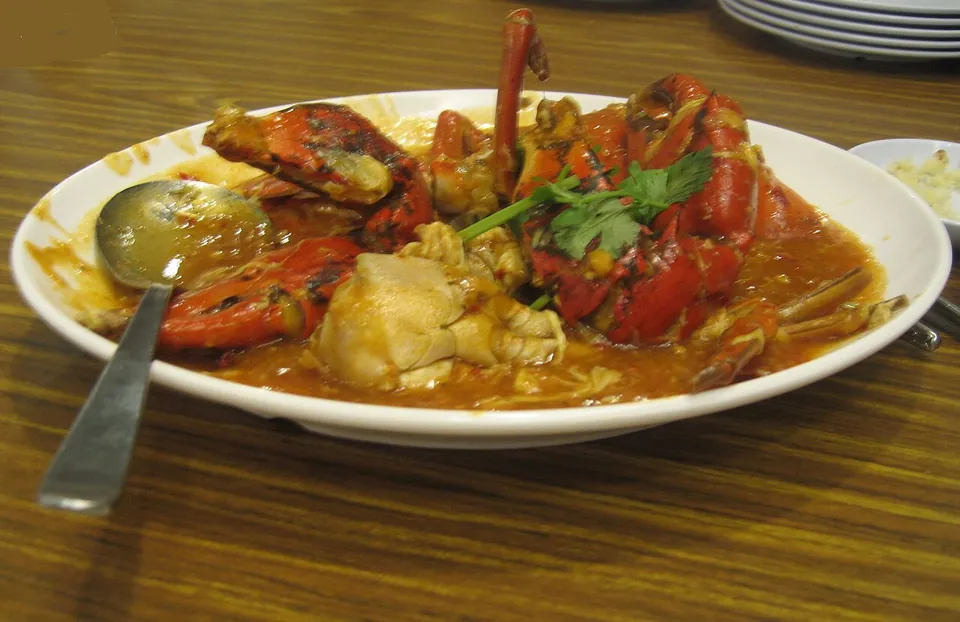
Chilli crab is Singapore's signature dish of mud crab tossed in a sweet, spicy tomato-and-chilli sauce. It began at a single roadside stall, and the name of its inventor, her family business, and the public records all survive: a modern dish with a well-documented pedigree.
Verification highlight popular claim → verdict → evidence
Popular claim: chili crab is a Malaysian dish, as declared by Malaysia's tourism minister in 2009. Verdict: unsubstantiated -- the claim cites no supporting record, while Singapore's tomato-chili version has a well-documented lineage: hawker Cher Yam Tian and her husband began selling it at a stall by the Kallang River around 1956, later opening the Palm Beach restaurant in 1962. Singapore's National Heritage Board inscribed it as Intangible Cultural Heritage (ICH-067) in 2019, corroborated by National Archives oral history and family testimony. Key sources: Singapore Infopedia (NLB); Roots.gov.sg (NHB).
The three gates
- Ingredient-supply gate
- The main ingredient, mud crab, was locally available and is the limiting factor. The sauce's tomato and chili are New World crops but had already become established locally by the time of the dish's creation.
- Cooking-technique gate
- Stir-fried and braised in a thick, sweet-and-spicy tomato-chili sauce, a Chinese-style wok technique.
- Venue gate
- Originated at street food stalls and seafood restaurants, later becoming a Singapore signature dish.
Overview
Chilli crab is mud crab, shell and all, stir-braised in a thick, sweet-and-spicy sauce built on tomato and chilli. The mud crab at its center is a native creature of Southeast Asian waters, long caught around Singapore and a familiar catch in local kitchens. The tomato and chilli that dissolve into the sauce came from the New World, but they had settled into the region early. The dish took shape where the Chinese wok technique of stir-braising crab in a heavy sauce met the riverside stalls and seafood restaurants that served it.
Its beginnings are placed in 1950s Singapore. At a stall by the Kallang River, cooks paired stir-fried crab with a bottled chilli-and-tomato sauce, a ready-to-hand improvisation, and the dish grew into a specialty served at dedicated seafood restaurants. The present sauce, thickened and given its tang, was worked out in the 1960s, and chilli crab is now one of the faces of the nation.
How we know
The start of chilli crab is, unusually for a dish, recorded down to the names. Around 1956, Cher Yam Tian and her husband Lim Choon Ngee began selling stir-fried crab dressed with a bottled chilli-and-tomato sauce at a stall by the Kallang River. In 1962 they opened Palm Beach on the East Coast and carried the business on as a family trade. The tangy, thickened version now standard, enriched with lemon, vinegar, egg white, and tomato paste, is credited to Hooi Kok Wai of Dragon Phoenix, who reworked it in 1963. Singapore's National Library Board Infopedia, the oral-history holdings of the National Archives, the account given by the inventor's son, and the National Heritage Board's inscription of the dish as intangible cultural heritage (ICH-067) in 2019 all set down this course of events in layers.
The dish also carries a cross-border quarrel over ownership. In 2009, Malaysia's tourism minister Ng Yen Yen claimed chilli crab as Malaysian, and the argument flared. It is true that in Langkawi, Malaysia, Weng Fung Seafood has served a "chilli crab" since the 1950s. But its sauce uses no tomato ketchup, no vinegar, and no egg; it is built on a spice paste (rempah), a dish of a different line from the Singapore tomato-and-chilli version. The sambal crab (kepiting balado) of Minangkabau in West Sumatra runs in yet another current. That crab dishes called "chilli crab" arose side by side across Southeast Asia is clear, and that overlap has not been untangled. The origin of the Singapore version, built on tomato and chilli, is not shaken by the 2009 claim: the records of inventor, restaurant, and public institution support it many times over.
The full set of origin theories and the detailed verification log — traceable all the way to their sources — are available on the Japanese edition.
See the full origin theories and verification log (Japanese) →