All dishes / 東アジア
Napolitan Period BOrigin theory CVerified
Some fields (dish name, region and gates) are shown from the Japanese-edition data.
Spaghetti Napolitan, a staple of the Japanese coffee shop, is often taken for a postwar invention—yet the name 'Napolitan' was already on prewar Western-food menus in Yokohama and Tokyo. That earlier dish, however, was a tomato-sauce side, not the ancestor of the ketchup-dressed plate now known as a national comfort food.
Verification highlight popular claim → verdict → evidence
The postwar, US-influenced origin is well established; the specific originating restaurant remains disputed (Hotel New Grand's tomato-based original vs. Center Grill's ketchup-based version that became the national standard).
The three gates
- Ingredient-supply gate
- Pasta plus ketchup
- Cooking-technique gate
- US-supplied ketchup available during the Allied Occupation
- Venue gate
- Hotel dining rooms and kissaten (coffee shops)
Overview
Napolitan took shape in Japan after the war, roughly between 1945 and 1955. Its date of emergence is nearly firm in the scholarship, and the underlying frame—the American influence of the postwar years—does not move.
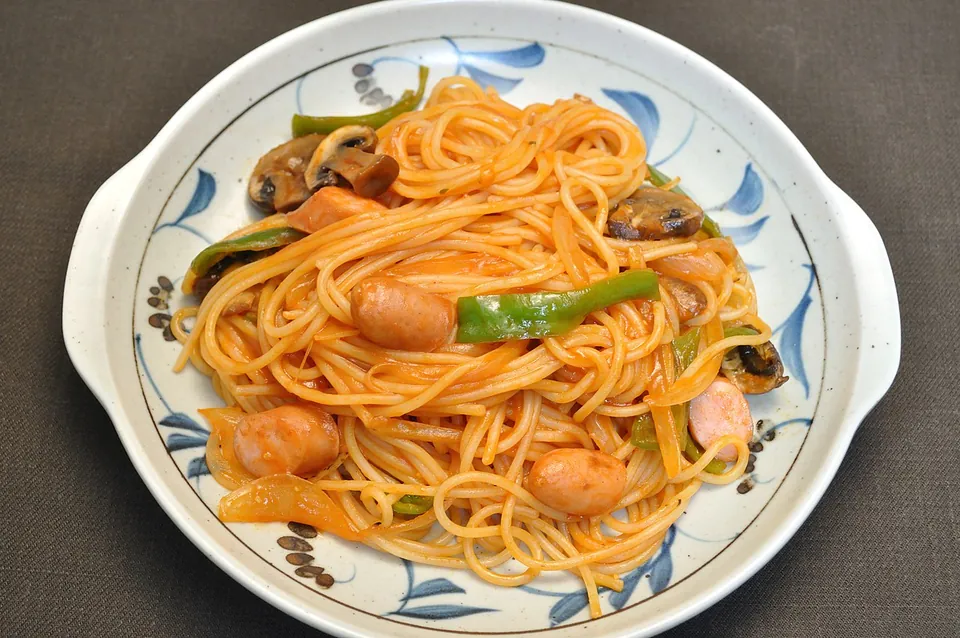
What makes today's coffee-shop Napolitan what it is has less to do with the starring pasta than with the ketchup generously tossed through it. Pasta had been available since before the war, but the way of making a dish simply by dressing boiled, unsimmered noodles with ketchup spread only once the American foodstuffs the occupation forces brought in by the ton were on hand. Ketchup became cheap and easy to get, and in the setting of hotels and coffee shops serving Western food, the dish took hold as something cheap and quick.
Yet 'Napolitan' is really two styles that need to be told apart. One is the prototype of the Hotel New Grand in Yokohama, which used fresh tomatoes and tomato purée rather than cheap ketchup—a refined version fit for a hotel. The other is the cheap version widely known today as a national comfort food, made with ketchup used liberally. The two differ in ingredients and in price, and though they go by the same name, as food they wear quite different faces.
How we know
The origins of Napolitan tangle two questions together: since when did the name exist, and where was today's taste born?
The name was no postwar invention. As a side dish introduced by Saly Weil, the first head chef of the Hotel New Grand in Yokohama, 'Spaghetti Napolitaine' already appears on the à la carte menu of 27 January 1934 (Yokohama Board of Education, 'The Food Culture of Yokohama'). The 1935 menu of the Tokyo New Grand carries the name in katakana as well, and the comic actor Roppa Furukawa recorded in his diary that on 22 December 1934 he ate 'Napolitan' at the Mitsukoshi special dining room ('The Showa Diary of Roppa Furukawa'). Roppa's aside that it felt 'a little short of drained of moisture' suggests something dressed in tomato sauce rather than fried with ketchup. The name, then, existed by 1934 at the latest—but it belonged to a tomato-sauce side or single dish, a thing apart from the ketchup-flavored plate that spread during the occupation. That the name came early does not pull the birth of the taste back before the war.
So where was today's taste born? Here two shops stand side by side. At the Hotel New Grand, the second head chef, Shigetada Irie, is said to have taken his idea from the sight of American soldiers dressing boiled spaghetti with ketchup during the occupation, and to have devised a refined version using fresh tomatoes and tomato purée (Hotel New Grand's official account; the government's HIGHLIGHTING Japan; Santatsu, and others). This was around the lifting of requisition in 1952, in the late 1940s and early 1950s. Its standing as the founding shop is firm. The cheap, ketchup-flavored version that spread as a national comfort food, meanwhile, is often traced to the version served by Toyokichi Ishibashi, founder of the Center Grill in Noge (opened 1946), who used the ketchup readily available after the war liberally. There is a record that Ishibashi received advice from Irie, so the two accounts are less a conflict than a lineage—from the fresh-tomato prototype to the ketchup-based popular form.
Which to call the 'birthplace' remains a matter on which views still divide. The refined prototype is credited to the Hotel New Grand, the popularized taste of today to the Center Grill; because the single word 'birthplace' points to different things depending on the style, the relation between the two shops can be drawn as a lineage, but the starting point is not fixed to one.
The full set of origin theories and the detailed verification log — traceable all the way to their sources — are available on the Japanese edition.
See the full origin theories and verification log (Japanese) →