All dishes / 東アジア
Takoyaki Period AOrigin theory BVerified
Some fields (dish name, region and gates) are shown from the Japanese-edition data.
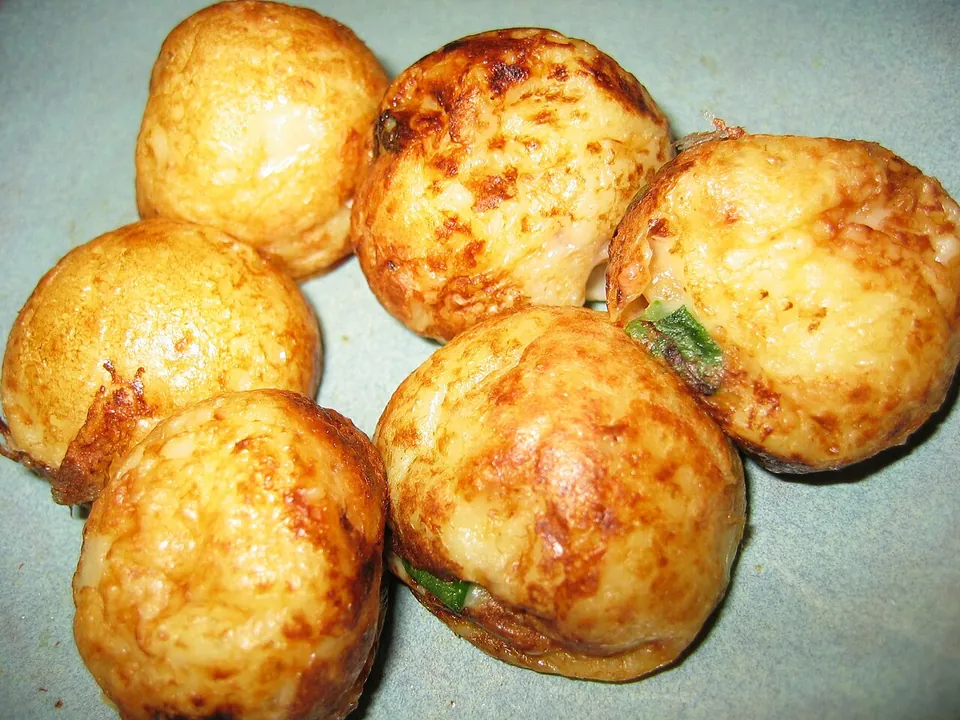
Takoyaki is cooked in the rows of half-round hollows cut into an iron plate. This little round savory ball was born at an Osaka street stall in 1935, not so old a food after all, and another half-century passed before you could buy one anywhere in Japan.
Verification highlight popular claim → verdict → evidence
Takoyaki was invented in 1935 by Tomekichi Endo at his Aiduya stall in Osaka, adapting his earlier dish radioyaki (1933) after customers pointed him to Akashi's egg-and-octopus dish, akashiyaki. Both octopus and wheat flour were already available locally, so what actually limited the dish was the tool: the purpose-built hemispherical cast-iron griddle first developed for radioyaki. Aiduya's own timeline places the 1933 start in Osaka's Imazato neighborhood -- the Nishinari-ward address often cited today reflects only the shop's postwar moves (1949, then 1993), not where takoyaki began.
The three gates
- Ingredient-supply gate
- Both the octopus and the wheat flour were domestically sourced in Japan, so ingredient supply was not the limiting factor (octopus from the Seto Inland Sea/Akashi area, native wheat flour).
- Cooking-technique gate
- The limiting factor was the technique of continuously cooking hemispherical shapes on a purpose-built cast-iron griddle (the takoyaki/rajioyaki pan). The tool and technique had already been established with the earlier rajioyaki (1933), and the dish took its current form in 1935 when the filling was switched to octopus.
- Venue gate
- A street stall in Imazato, Osaka called Aiduya. Aiduya's own timeline records that it began as a rajioyaki stall in Imazato in 1933, moved to Tengachaya in 1949, and relocated to Tamade, Nishinari-ku in 1993 (its current main shop) - so the stall's location during the founding period (1933-35) was Imazato, and Nishinari-ku reflects only the postwar shop location (no source confirms exactly where the stall stood in 1935 itself). It belongs to the street-food culture of flour-based snacks, such as rajioyaki, that spread through Osaka in the Taisho era.
Overview
Takoyaki is an Osaka flour snack: a batter of wheat flour poured into the rows of hemispherical hollows on a dedicated cast-iron plate, a piece of octopus dropped in, and each ball cooked through in turn. The octopus comes from the Seto Inland Sea, off Akashi, and the wheat flour was already at hand; the ingredients themselves had long been on Japanese tables.
What was new was the way of cooking. To set batter into round half-spheres, you need an iron plate lined with those hollows. Only once that tool and technique had come together at an Osaka stall did the round takoyaki of today take its form. In 1933 the stall Aizuya, in the Imazato area of Osaka, sold a ball called radio-yaki, filled with beef tendon and konjac; this was the forerunner of the round-cast cooking.
Aizuya was run by Endo Tomekichi, who came from Aizu in Fukushima. In 1935 he swapped the filling for octopus and named the result takoyaki. The idea of using octopus is said to have come from a customer who told him that Akashi's tamago-yaki (akashiyaki) used it. The dish was born in the middle of the flour-snack stall culture that had spread through Osaka in the Taisho years, a street food of ordinary people.
From an Osaka stall to the rest of Japan
1935 is the year the dish was made, not the year it spread. The encyclopedia Nihon Dai-Hyakka Zensho (Encyclopedia Nipponica) describes takoyaki as stall food sold at the fairs of Osaka's Tenma Tenjin shrine and in the city's entertainment districts, and goes on to say that after the Second World War, as goods began to circulate again, takoyaki sellers appeared in Tokyo and other cities as well. It left Osaka after the war, and it left first as a stall trade.
In Osaka itself, Umaiya and Kanta opened as fixed shops in 1953, and in 1960 Otafuku Sauce put a sauce made for takoyaki on the market—both from a timeline compiled by the Japan Konamon Association. In 1975 the Asahi Journal, a national weekly published in Tokyo, gathered a serial into a book called "Tako-yaki no uta: gendai seikatsu fukei" (The Song of Takoyaki: Scenes of Modern Life). Whether the book was about the food at all is unclear, but the word had become current enough for a Tokyo publisher to put it on a cover.
Home kitchens came in the 1980s. Hacchando, a firm in Fukuoka, started selling takoyaki from a van in 1977 and brought out a frozen version in 1982—a company outside Osaka, making a frozen product that could travel to shops and households across the country. In 1983 the Tokyo publisher Fujin Seikatsusha issued a home cookbook, "Okonomiyaki, Takoyaki, Teppanyaki: Professional Flavors You Can Make at Home," and books of the same stripe followed in 1985, 1986, 1991 and 1992. From the early 1980s on, takoyaki turns up in the titles of cookbooks distributed nationally. The same association timeline records that Nisshin Foods launched a takoyaki flour mix in 1986, and that the third edition of the Kojien dictionary, published in 1983, gave takoyaki an entry.
Shops competing in Tokyo came later again. The association's timeline marks the "Shibuya takoyaki war" of 1993 as the first boom and the opening of Tsukiji Gindako's first Tokyo shop, in Nakano in 1998, as the second. The state took longer still to start counting the trade. Only with the 2007 revision did the Japan Standard Industrial Classification set up a subcategory for okonomiyaki, yakisoba and takoyaki shops, and the 2021 Economic Census, counting within that subcategory, found 12,283 of them nationwide. The figure lumps okonomiyaki, yakisoba and monjayaki shops in with takoyaki, so shops selling takoyaki cannot be told apart in it.
More than half a century passed between the one snack at an Osaka stall and the shopping streets and home kitchens of the whole country.
How we know
Takoyaki is loved as a homely local taste, yet its birth is recorded with surprising clarity. The man who devised it was Endo Tomekichi of Aizuya; the year was 1935. Aizuya's own official account of the dish's beginning is matched independently by press reports such as the Nihon Shokuryo Shimbun, by the researcher Mana Kumagai in her book on Japan's flour foods, and by the Ministry of Agriculture, Forestry and Fisheries in its record of local dishes—and on the person, the year, and the place they scarcely differ. Several records from different sources tell the same line; that is how firm it is.
The story has a prehistory. The radio-yaki of 1933 was filled with beef tendon and konjac. Told by a customer that Akashi's tamago-yaki used octopus, Endo changed the filling, and two years later came takoyaki. The lineage of round-cast savories itself reaches back to akashiyaki, dated to the Tenpo era.
From here on, though, the texture of the record changes. How akashiyaki came about—that leftover egg yolk from making artificial coral beads was mixed with octopus—is qualified even in the Ministry's account with "it is said." The origin of akashiyaki stays in the realm of tradition, not confirmed in documents the way takoyaki's birth is.
The phrase "an old Osaka taste" is right enough as atmosphere, but the outline of this one round snack was drawn by a single stall owner in a Showa-era street. The age of the ingredients and the year one dish was born are two different matters.
The year of its birth can be followed this closely; the road by which it spread cannot. A full-text search of Aozora Bunko—the online library of modern Japanese writing whose copyright has lapsed—returns nothing for either of the two spellings searched, たこ焼 and 蛸焼. Within that body of writing, at least, no one who lived through those decades left a line saying that the snack was in fashion or that it was everywhere.
What can be counted instead is how often takoyaki appears in print. The National Diet Library catalogue lists 309 items with takoyaki in the title of a book or article. The earliest in its periodical index is from 1997; the count jumps to nine in 1999, and from the 2000s onward settles at a few to a dozen or so a year. These are titles as catalogued rather than full texts, so the word may well have been in print earlier than the curve suggests.
The headlines that Tokyo-published national magazines gave takoyaki between 1999 and 2001 show where it stood at the time: "Thirteen choice Tokyo takoyaki shops that can hold their own against Osaka" (Shukan Bunshun, 1999), "The takoyaki shop out of Kanto with a queue that never ends" (Nikkei Venture, 2000), "Food: the riddle of takoyaki's conquest of Japan" (AERA, 2001). Holding its own against Osaka, coming out of Kanto, the riddle of the conquest—takoyaki going national was still being written up as news, as something to puzzle over. More than sixty years after it was first made, Tokyo magazines still found it startling.
This was not a food that swept the country the moment the war ended. From an Osaka stall in 1935 to everyday life across Japan took more than half a century.
The full set of origin theories and the detailed verification log — traceable all the way to their sources — are available on the Japanese edition.
See the full origin theories and verification log (Japanese) →