All dishes / 南アジア
Gulab jamun Period COrigin theory CVerified
Some fields (dish name, region and gates) are shown from the Japanese-edition data.
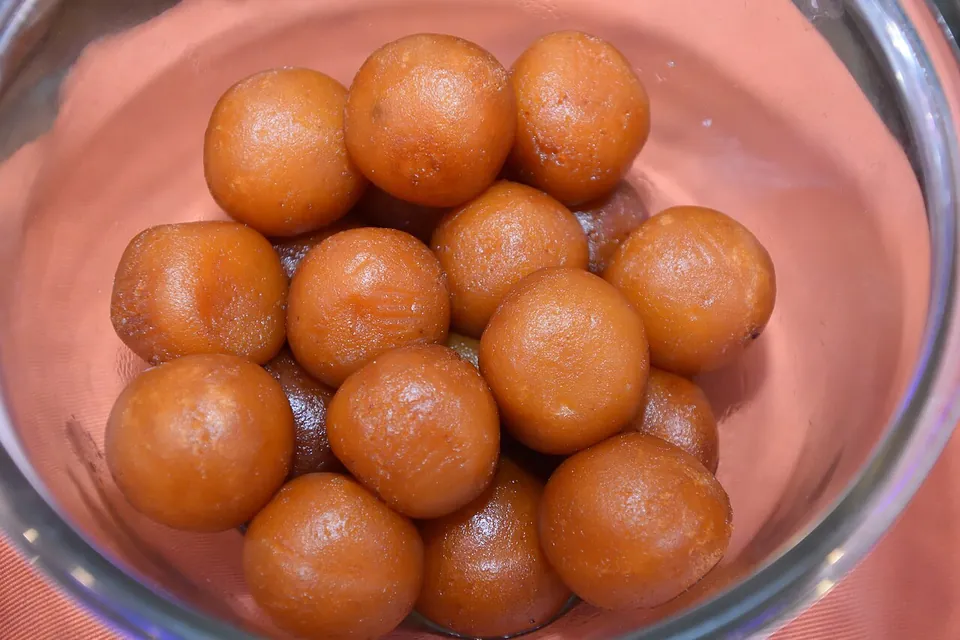
A South Asian sweet of khoya (milk reduced to solids) rolled, deep-fried, and steeped in rose-scented syrup. The famous tale that a cook of the Mughal emperor Shah Jahan invented it by accident is a later fabrication, with no trace in the court chronicles of its own time.
Verification highlight popular claim → verdict → evidence
The popular legend that Mughal emperor Shah Jahan's court cooks accidentally invented gulab jamun is unsubstantiated: it appears nowhere in contemporary Mughal chronicles such as the Ain-i-Akbari, and food historian Colleen Taylor Sen does not mention it either -- rejected as an unsupported origin myth. The real, still-debated question is narrower: whether the dish descends from the 13th-century Persian/Arab fried sweet luqmat al-qadi, or whether the koya-based form was an independent Mughal-era Indian invention.
The three gates
- Ingredient-supply gate
- Milk solids (koya), sugar, and rosewater are all Old World staples; no limiting ingredient constrains the earliest possible date.
- Cooking-technique gate
- Milk is reduced to koya, rolled into balls, fried, then soaked in sugar syrup.
- Venue gate
- Royal courts, festivals, and sweet shops (halwai).
Overview
Gulab jamun is one of the defining sweets of the Indian subcontinent's festivals and sweet shops. Milk is simmered patiently until its water cooks away and it thickens into khoya, which is then rolled into balls, fried to a deep gold, and dropped into a syrup of sugar and rose water so that the sweetness soaks all the way to the center. The pleasure of it lies in the meeting of two textures in a single bite: the fragrant, faintly crisp skin outside and the yielding, almost melting crumb within.
Behind this form lies a long South Asian familiarity with handling milk. Holding milk over a low flame for a long time and reducing it toward a near-solid was ordinary craft here, passed down as everyday kitchen work. Khoya sits at the end of that line, and gulab jamun is built around milk-reduction at its core: fry the khoya, steep it in a sweet bath. Sugar and rose water, too, were materials long at hand across this region and its neighbors.
The name itself is a clue to the sweet's parentage. Gulab is Persian for the water of flowers, that is, rose water, and jamun echoes the name of a dark purple fruit. The habit of steeping the sweet in rose-scented syrup carries a shadow of Persian confectionery. From the medieval into the early-modern centuries, passing through courts, festivals, and the halwais (sweet-makers) of the streets, gulab jamun settled in as a fixture of South Asian sweets.
How we know
One tale has long been told as the beginning of gulab jamun: that a cook of the Mughal emperor Shah Jahan, working with khoya dough, stumbled upon the sweet by chance. An invention born in the imperial kitchen makes a fine picture, but no record from the same period holds it up. The chronicles that set down Mughal court life and food in fine detail — the Ain-i-Akbari among them — say nothing of the anecdote, and Colleen Taylor Sen, a food historian who writes at length on Mughal cuisine, does not touch it either. An invention out of the emperor's kitchen would have left marks in many contemporary records; that there are none makes the story best read as an origin myth added later. The real spread was more modest: halwais across the land gradually swapping the ingredients of Persian and Arab fried sweets for what lay to hand.
Set the palace-invention legend aside, and two more plausible accounts remain.
One looks to the Persian and Arab world. Medieval Arab kitchens made a sweet in which fried dough was steeped in rose-water syrup, luqmat al-qadi ("the judge's morsel"), whose oldest surviving recipe is recorded in the thirteenth-century Baghdad cookbook Kitab al-Tabikh (1226). The close resemblance in the scenting and the steeping in sweet liquid has led to the view that this was the prototype, carried into Mughal-era India. The Persian name for rose water supports the reading.
The other holds that the present form took shape in India itself. However alike the rose-water syrup looks on the surface, the body of the two sweets differs completely. Where the Arab fried sweet fries a wheat dough, the inside of gulab jamun is khoya, milk cooked down to solids. With the makeup of the dough this different, calling one the descendant of the other on the strength of the syrup alone overreaches; on this reading the present khoya-fried form was assembled in Mughal-era kitchens against the background of South Asia's milk-working tradition.
Food-history scholarship keeps both faces in view — a Persian fried-sweet prototype, and a reworking through India's milk craft — without discarding either. A sweet dressed in the shared coat of rose water and sweet syrup: whether it carries a Persian memory or is where South Asia's own milk craft arrived on its own, that line has not yet been firmly drawn.
The full set of origin theories and the detailed verification log — traceable all the way to their sources — are available on the Japanese edition.
See the full origin theories and verification log (Japanese) →