All dishes / 東アジア
Budae jjigae Period AOrigin theory CVerified
Some fields (dish name, region and gates) are shown from the Japanese-edition data.
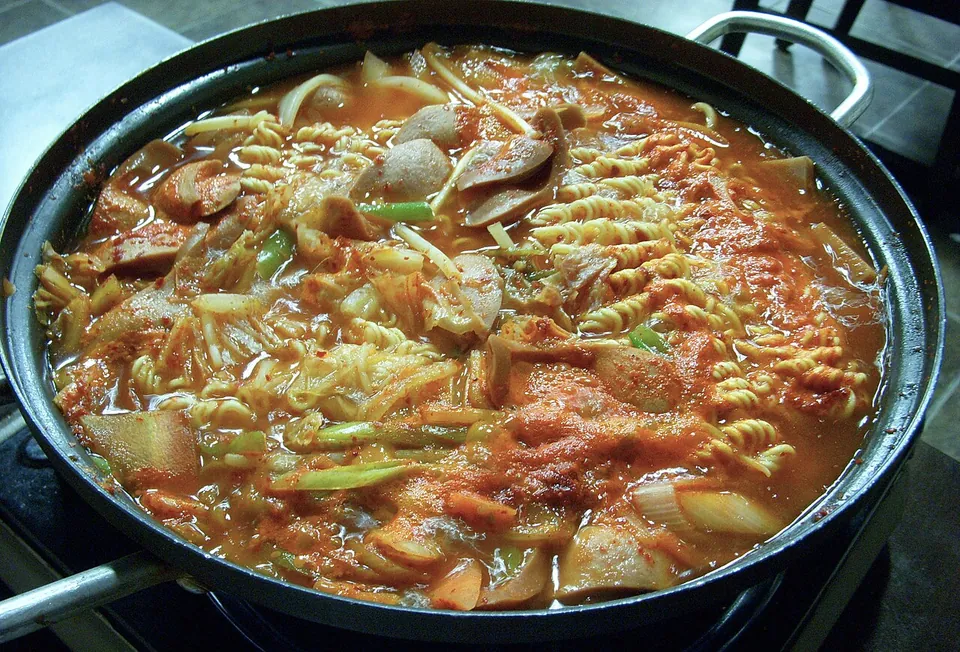
Spam and sausage from the U.S. military, simmered in a pot with kimchi and gochujang: budae-jjigae is a stew born of the hardship after the Korean War, yet who first made it, and where, remains unsettled to this day.
Verification highlight popular claim → verdict → evidence
A hot-pot born of postwar scarcity: American processed meat like Spam and sausage, diverted from U.S. military bases such as Uijeongbu, simmered together with kimchi and instant noodles. No single restaurant or city can be credited as the true birthplace — the dish likely emerged independently at several bases across South Korea under the same conditions.
The three gates
- Ingredient-supply gate
- The limiting factor is the circulation of American processed meats such as Spam and sausage after the Korean War, sourced from U.S. military bases (such as Uijeongbu).
- Cooking-technique gate
- A mixed hot-pot (jjigae) style of simmering ingredients together.
- Venue gate
- From black markets around U.S. military bases, to popular eateries, to nationwide chains.
Overview
Budae-jjigae, the 'army base stew', is a hotpot in which canned Spam, sausage and other processed meats of American military origin are simmered together with kimchi, instant noodles and gochujang. As the name 'army' suggests, its ingredients came out of the U.S. military bases.
In the 1950s, when the Korean War reached its armistice, Korea was in the grip of severe food shortage. Around the American bases, surplus meat and canned goods left over from the bases passed into people's hands through black markets and pilfering, and it was on this flow of Spam and sausage out of the bases that a stew of such scraps first took shape. Its reputed forerunner is kkulkkul-i-juk (꿀꿀이죽, 'pig slop'), a porridge boiled from leftovers and surplus meat gathered from the bases. From there, joined with local tastes of cabbage, kimchi and gochujang and set upon the Korean technique of the combination hotpot, it took on today's form of budae-jjigae. The memory of war and the base economy are simmered together in a single pot.
How we know
Budae-jjigae carries a stubborn dispute over its birthplace: made in Uijeongbu, some say, or in Yongsan in Seoul. But follow the record and the question yields no verdict, and that lack of a verdict is itself the conclusion.
Several cities and eateries have each claimed the origin. In Uijeongbu, Heo Gi-suk, a refugee from the North, is said to have turned base meat into a stew and opened the Oden Restaurant around 1960. The Uijeongbu style, rich and thick with barley gochujang, is known to this day, and a 'Budae-jjigae Street' took shape there by the late 1990s. In Yongsan, Seoul, on the other hand, the stew is called Johnson-tang (존슨탕). The name, 'Johnson soup', is said to come from the visit of U.S. President Lyndon Johnson to Korea in 1966, after an anecdote that he praised the stew.
These names and regional differences of style, however, do not point to a single origin. Even the naming anecdote of 1966 does not mean the dish was born that year; it means only that the stew already existed by then, a first mention rather than a birth. Scholarship (Grace M. Cho, 2014, among others) treats budae-jjigae not as any one person's invention but as a product of the Korean War and the base economy, and as competing narratives of memory over its origin. Under the shared condition of hardship, different places arrived at the same pot independently. The individual claims of origin cannot be verified, and even when folk tales are set aside, the true origin remains open.
The full set of origin theories and the detailed verification log — traceable all the way to their sources — are available on the Japanese edition.
See the full origin theories and verification log (Japanese) →