All dishes / 東南アジア
Khao Soi Period BOrigin theory BVerified
Some fields (dish name, region and gates) are shown from the Japanese-edition data.
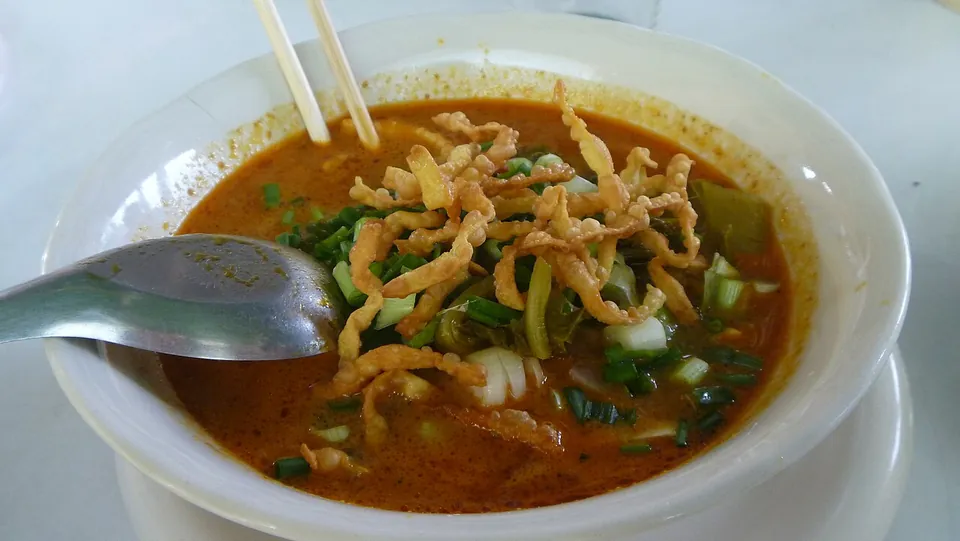
A Northern Thai bowl from Chiang Mai: soft egg noodles bathed in a coconut-rich curry broth, crowned with a nest of the same noodles fried crisp. It is a curry-noodle tradition that traveled from Yunnan across Burma and settled into Northern Thailand in the nineteenth century. The Lao dish of the same name (rice noodles in a tomato-and-pork sauce) is a separate lineage entirely.
Verification highlight popular claim → verdict → evidence
Myth: the dish's identity is sometimes pinned to the arrival of chili peppers. Verdict: chili had arrived long before the dish itself took shape, so it does not set the earliest possible date; Khao Soi's origin instead lies in nineteenth-century cultural transmission along the Yunnan-Burma-northern Thailand caravan trade carried by Chin Haw (Yunnanese Muslim) traders. Main sources: Kyoto Review of Southeast Asia; Wang Liulan (2006).
The three gates
- Ingredient-supply gate
- Egg noodles, coconut, and curry spices were all Old World ingredients at hand locally, and none of them had to be traded or imported in. Chili peppers came from the New World, but they had reached northern Thailand by around the sixteenth century, well before the dish took shape, so no ingredient sets its earliest possible date. That was set instead by the nineteenth-century arrival of a curry-noodle food culture from Burma and Yunnan.
- Cooking-technique gate
- Making egg noodles combined with a simmered curry and a topping of crispy fried noodles.
- Venue gate
- Eaten out at the noodle shops and street stalls of the north, it was everyday food for ordinary people, and it took root among the Chin Haw, the Yunnanese Muslim community settled in northern Thailand.
Overview
Northern Thai Khao Soi sinks supple egg noodles into a broth of curry and coconut milk, then piles a tangle of the same noodles, fried until crisp, on top. Its present form took shape across Northern Thailand, and Chiang Mai in particular, during the nineteenth century.
The people who carried this dish into Northern Thailand were the Yunnanese Muslim traders known as the Chin Haw. From their homeland in Yunnan they organized mule caravans over the mountains, moving goods and food into the towns of the north along a route that ran from Yunnan through Burma. The curry-based noodle dish they brought closely resembled Burmese ohn no khao swe, and was originally served, in keeping with their dietary law, with chicken or beef. In the noodle shops and street stalls of the north it settled among ordinary people, mingled with local tastes, and became the egg-noodle, curry, and coconut-milk bowl eaten today. That the Chin Haw put down roots in Chiang Mai can still be seen in the Ban Haw Mosque they built there in 1905, which stands in the city to this day.
The broth carries a heavy load of spices, chili among them. Chili came from the New World, yet it had already taken hold in Northern Thailand by around the sixteenth century and was an everyday ingredient in the local kitchen well before this dish existed. What gave Khao Soi its form came later: a curry-noodle food culture, grown in Yunnan and Burma, that crossed the mountains with the caravans and arrived in this land. Out of that arrival, the bowl of today rose into being.
How we know
There is, in fact, a second dish that answers to the name Khao Soi. It comes from Luang Prabang in Laos: hand-cut rice noodles dressed with a sauce of tomato and minced pork. The name is shared, but the Northern Thai version is a coconut-and-curry egg-noodle bowl while the Lao one is a tomato-and-pork rice-noodle bowl, and neither the main ingredients nor the method overlap. No source lets us trace the two back to a single common ancestor. To fold their origins into one just because the name is shared would be a mistake.
The lineage of the Northern Thai version itself is now fairly clear. The view that the Chin Haw, moving along the trade road that ran from Yunnan through Burma into Northern Thailand, brought this noodle dish has become the settled account in food history. What began as one guess among several took its place as the account that most naturally explains the dish once scholarship on Southeast Asia based in Kyoto (Wang Liulan) traced the history of the caravan trade and the migrations that came with it.
In recent years a further refinement has been added to this account. To say flatly 'Yunnanese origin,' the argument runs, risks confusing the people who carried the dish with the land that gave birth to it. Present-day Yunnan has no dish in the Khao Soi mold, with yellow egg noodles, a crown of fried noodles, and a spiced coconut broth. That form matches Burmese ohn no khao swe instead. The long stretch during which the Lanna kingdom of Northern Thailand lay under Burmese rule (1558 to 1775) also points to a Burmese layer. The Chin Haw look less like the ones who created the dish than like the carriers who moved it along a road passing through the Shan State of Burma. The first to carry a dish and the first place to make it are not always the same.
One question, meanwhile, remains unsettled: where the name 'Khao Soi' came from. Read by its literal sense, it joins khao (rice) to soi (to cut or slice), reading as 'cut rice,' and several sources consistently connect it to a hand-cut noodle made by spreading turmeric-tinted rice flour over cloth, steaming it into a thin sheet over water, and cutting it into strips. Others hold that the Thai name was borrowed, as a sound-transcription, from Burmese or Shan. The lineage of the dish has come into view, but the origin of its name is still an open question.
The full set of origin theories and the detailed verification log — traceable all the way to their sources — are available on the Japanese edition.
See the full origin theories and verification log (Japanese) →
Related dishes
Cross-links Sister dishes & same-name dishes (separate lineage)
- Same name, different dish (separate lineage)Khao SoiB
- Sister dish (shared ancestor)Ohn no khao swèMyanmarC