All dishes / ラテンアメリカ
Ackee and saltfish Period BOrigin theory CVerified
Some fields (dish name, region and gates) are shown from the Japanese-edition data.
Jamaica's national dish. The story of its beginnings as a poor colonial substitute food is broadly sound. But no source pins down who first paired the two ingredients, and the title of national dish was earned more than a century after the dish itself was born.
Verification highlight popular claim → verdict → evidence
The limiting ingredient is not the shipping of salt cod but ackee's arrival itself: introduced from West Africa via the slave trade (Dr. Thomas Clarke, 1778; taken to Kew by Bligh in 1793), while cheap imported salt cod -- the low-grade 'West India cure' shipped in bulk from Newfoundland -- became a staple protein for the enslaved. No source can pin down the exact moment the two ingredients were first combined by enslaved or freed Jamaicans, so that founding-moment story stays an open, unresolved account rather than settled fact. Its status as Jamaica's national dish is a separate, later development, tied to independence-era identity in the 20th century.
The three gates
- Ingredient-supply gate
- Ackee, native to West Africa, was brought to Jamaica through the slave trade (around 1778); salt cod was an imported provision
- Cooking-technique gate
- Salting and drying for preservation
- Venue gate
- Household and street-food staple; popular, everyday fare across Jamaican society
Overview
When and where it took shape
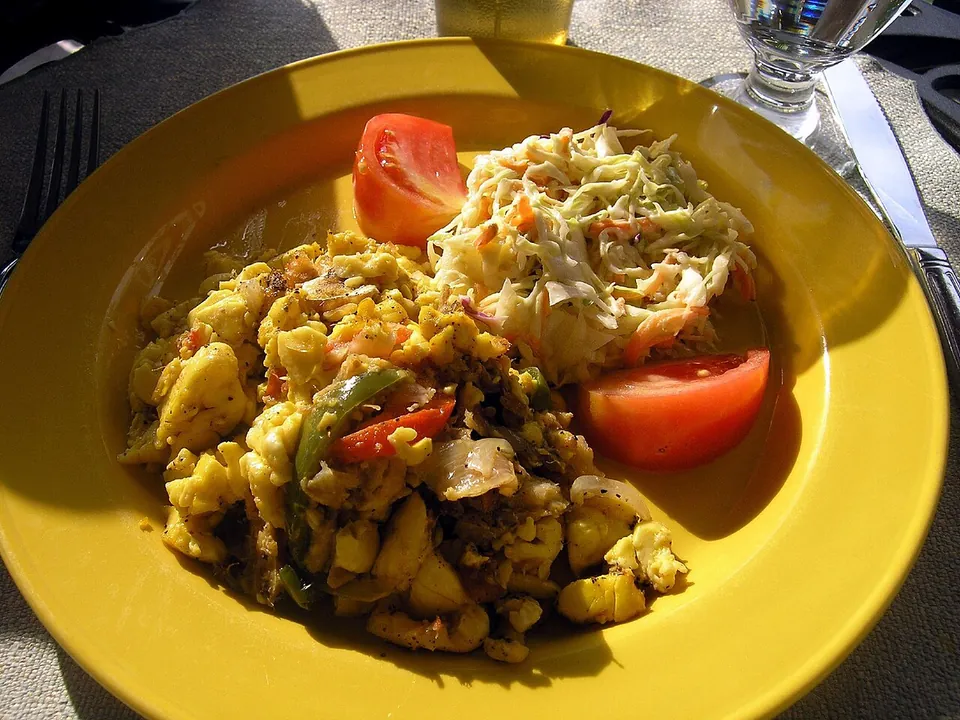
Ackee and saltfish brings together ackee, a fruit from West Africa, and salt cod, carried across the Atlantic, into a dish of ordinary Jamaicans. It took shape in Jamaica across the late eighteenth and nineteenth centuries. Under the colonial economy, two cheap ingredients met on everyday tables, and that meeting is where the dish begins.
The salt cod came from the fishing grounds of Newfoundland, split, salted and dried. It was the lowest grade of the trade, the so-called West India cure, shipped in bulk to the British West Indies as a cheap keeping protein for the enslaved. The colonies received it steadily and at low cost.
Ackee, the other half of the pairing, began as a West African fruit. It was carried to Jamaica through the slave trade in the late eighteenth century, around 1778, and took root on the island. The record leaves a trail: Dr. Thomas Clarke is credited with introducing it into the eastern parishes, and in 1793 the navigator William Bligh brought it to the notice of science. A cheap imported fish set against a newly rooted local fruit; once that combination was at hand, the dish had begun. Those who made it were the enslaved and the freed, and it was eaten day after day in homes and at street stalls, in the ordinary places of daily life.
How we know
There is no tall tale to knock down here. Under the colonial economy, two cheap ingredients were brought together on everyday tables by the enslaved and the freed. That account of the dish as a substitute food is broadly accepted.
The received story has just one gap that no one can reach. Nowhere in the sources is there a single moment naming who first paired the two, or when. Several accounts say in the same breath that the exact moment the two were joined has never been pinned down. The origin story, then, is not a recorded event but a reconstruction after the fact, built from the reasonable line that cheap things would naturally have met in the settings of daily life. The earliest firm sign of the dish as food is a printed one: in 1811 Titford's Sketches Towards a Hortus Botanicus Americanus describes ackee as a delicious vegetable that tastes like marrow, which fixes ackee as an eaten food in print. A well-known cultural reference comes later still, in Harry Belafonte's 1956 Jamaica Farewell. Because the founding story is not a documented event, this account of the dish's beginnings stands as the most reasonable reading rather than settled fact.
A second gap in time lies in the name national dish. The dish did not receive that standing at birth. That came much later, in the twentieth century, assembled as a separate matter. Ackee was made Jamaica's national fruit around the time of independence, and the dish, tied to that symbol, took its place as national food. As the Dictionary of Jamaican English shows through four centuries of recorded usage, a plate that ordinary people ate in the colonial period was later chosen again as the face of an independent nation's table.
To call this a national dish from colonial times, then, folds two different times into one. It was born in the colonial period; it became a national dish around independence. And the founding moment itself still sits in the dark of the record. The gap between its making as a cheap substitute food and its later construction as a national symbol, and the quiet fact that no one wrote down its beginning, is the key to reading this plate.
The full set of origin theories and the detailed verification log — traceable all the way to their sources — are available on the Japanese edition.
See the full origin theories and verification log (Japanese) →