All dishes / 西欧
Bagna càuda Period COrigin theory CVerified
Some fields (dish name, region and gates) are shown from the Japanese-edition data.
In the sealess winters of Piedmont, a hot dip of anchovies and garlic melted in oil. Its main ingredient has long been cast as the fruit of a salt-tax smuggling scheme, but that story falls apart in front of a medieval ledger.
Verification highlight popular claim → verdict → evidence
A colorful legend holds that anchovy peddlers (acciugai) smuggled salt past the tax collectors by hiding it under a single layer of salted anchovies in their barrels, and that this is how anchovy reached the inland Piedmontese table. The story does not hold up: Piedmont's old-regime salt tax was a fixed levy unrelated to quantity consumed, giving no motive to disguise a barrel, and salted anchovy was itself a valuable good, an implausible decoy for cheap salt -- indeed a 1377 Asti customs tariff records salted anchovy as an ordinary, inexpensive commodity, not a good worth smuggling. The better-supported account is regular trade along the historic 'salt roads' (vie del sale) linking Provence's saltworks to Asti from the 12th century onward, which carried both salt and salted anchovy inland as legitimate goods.
The three gates
- Ingredient-supply gate
- Anchovy, garlic and olive oil were all native to the Mediterranean; what mattered was getting salted anchovy inland to Piedmont.
- Cooking-technique gate
- A warm dip, gently melted over low heat and served from a heated fojot pot.
- Venue gate
- Piedmontese peasant harvest festivals and shared meals.
Overview
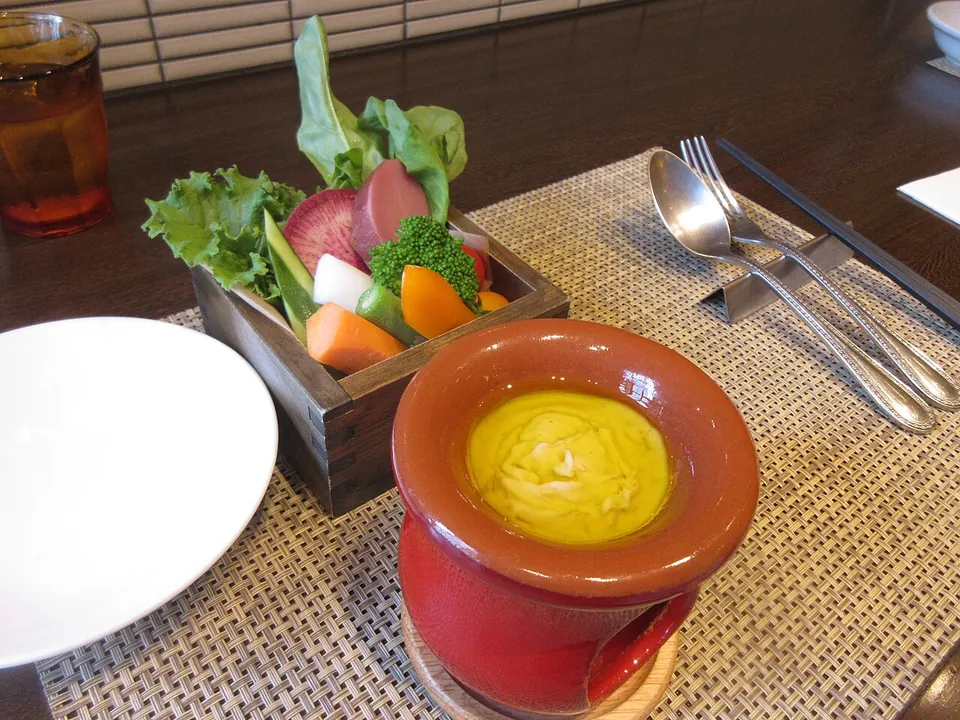
Bagna cauda is a warm winter dip from landlocked Piedmont, in Italy's northwest. Garlic and salt-cured anchovies are melted gently into olive oil, and the mixture is kept hot at the table in a small earthenware warmer called a fojot. It was food for the shared table of farming families once the harvest was in, who dipped raw cardoons and vegetables into it together.
Garlic and olive oil were long rooted in the Mediterranean world, and both were on Piedmontese tables from early on. These two, which carry the sauce's aroma and richness, were familiar staples of local life.
What sets this dish apart is that anchovies had become a pantry staple in a place with no coast. Salt-cured, the anchovies kept for a long time and travelled inland without spoiling. Their supply rested on the 'salt roads' (vie del sale) that, from the 12th century onward, linked the salt pans of Provence with Nice and Asti. Merchants from Asti moved salt by mule train, and salt-cured anchovies travelled the same road. A customs tariff from Asti dated 1377 records these salt-cured anchovies as a cheap, everyday foodstuff.
The idea itself of a rich, warm sauce of garlic, oil and anchovies is older still. A Provençal-style garlic sauce described by the physician Guainerio at the end of the 14th century is regarded as its prototype. The bagna cauda we know today, a hot dip served in a warmer, first appears in detailed description in Roberto Sacchetti's Vecchio guscio of 1875-76. From its medieval prototype to the 19th-century record, the dish slowly settled into its present form.
How we know
Bagna cauda comes with a smuggling tale that has been retold for generations. Travelling salt sellers known as acciugai are said to have laid a single top layer of salt-cured anchovies over a barrel packed with salt, fooling the tax collectors and smuggling the salt beneath. The anchovies carried as this cover, the story goes, are how the fish spread into sealess inland Piedmont.
But the plot loses its footing in front of the sources. Under the old regime, Piedmont's salt tax was a compulsory levy that did not track how much a household consumed. In a system where understating your purchases won you nothing, there was no motive in the first place to disguise a barrel to hide salt. And the salt-cured anchovies supposedly used as cover were themselves a far dearer commodity than salt. Hiding the cheap thing behind the expensive one gets the order backwards.
The decisive piece is a single ledger. The 1377 customs tariff of Asti lists salt-cured anchovies as a cheap, everyday consumer good. Far from being a smuggler's decoy, they were taxed openly as a legitimate item of trade and flowed to market as such. The smuggling legend rested on the origin anecdote alone and lacked any independent record to support it, an explanation added after the fact.
What remains instead is a plainer and more solid route. Along with Provençal salt, salt-cured anchovies travelled the salt roads as a legitimate commodity and became a pantry staple of the inland table. That trade route survives in contemporary records. The tale of daring smuggling gives way, and the modest commerce recorded in a single tariff is what remains to explain how anchovies took root in a land without a sea. This was examined in the English Wikipedia account and in the historical study by Gianluigi Bera, which traces the dish from the Middle Ages through Provence.
The full set of origin theories and the detailed verification log — traceable all the way to their sources — are available on the Japanese edition.
See the full origin theories and verification log (Japanese) →