All dishes / 西欧
Osso buco Period COrigin theory CVerified
Some fields (dish name, region and gates) are shown from the Japanese-edition data.
A Milanese braise in which marrow glistens from the middle of the bone. It has long been said that its first appearance in a cookbook was in Artusi, yet a book twelve years older survives.
Verification highlight popular claim → verdict → evidence
The dish is often said to first appear in Artusi's 1891 La scienza in cucina, but Giuseppe Sorbiatti's Il Memoriale della Cuoca (Milan, 1879) predates it by twelve years and already includes the traditional gremolata. A further correction: the common narrative of an old white (tomato-free) version being displaced by a later tomato version is too simple -- Sorbiatti's 1879 text already gives both a tomato and a tomato-free version side by side, so the two coexisted from the earliest record rather than one supplanting the other. The now-standard lemon-zest gremolata itself traces to Artusi (1891); Sorbiatti's 1879 version used parsley, garlic and anchovy instead.
The three gates
- Ingredient-supply gate
- Veal shank and vegetables were native ingredients.
- Cooking-technique gate
- Braising a bone-in shank slowly, keeping the marrow intact.
- Venue gate
- A home and regional dish of Lombardy.
Overview
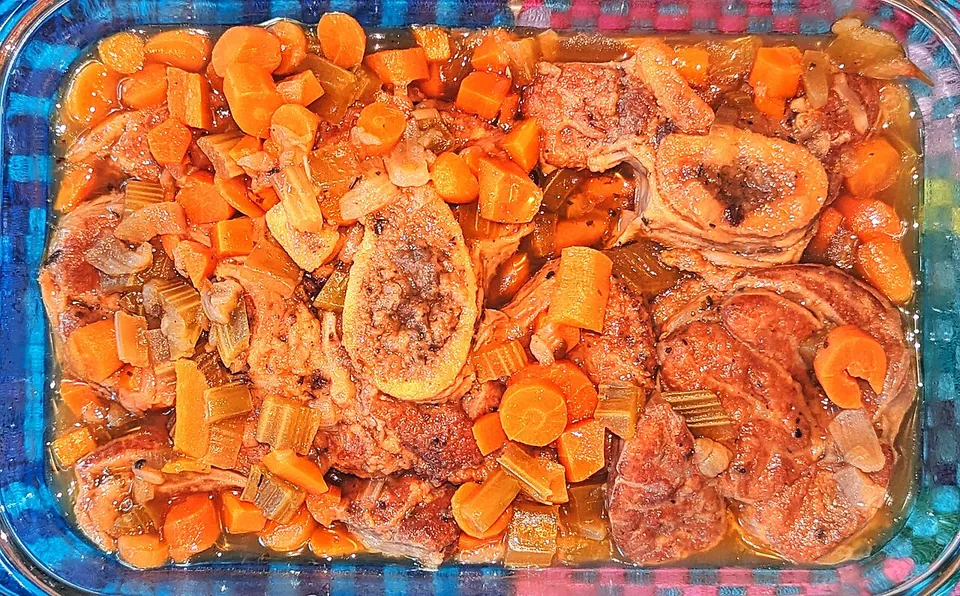
Ossobuco is a Milanese home dish in which a veal shank is cut crosswise, bone and all, and gently braised with white wine and vegetables. The name means "bone with a hole" in Italian, and the marrow that stays in the center of the cooked bone is the real star of the plate. The heart of the dish is the way the shank is cooked around its bone without falling apart, so the marrow stays soft and intact when it comes to the table. It is finished with gremolata, a scattering of chopped parsley, garlic, and the like, to lift the aroma.
Veal and vegetables were both well established in Lombardy and had long been close at hand in its kitchens. A bone-in shank, cooked slowly so the marrow does not run out, was a knack handed down in Milanese homes, and once it was written into cookbooks the dish settled into a fixed form. It appears clearly in the written record in the later 19th century, and its formation is placed there as well.
There is a version with tomatoes and a version without, called in bianco (white), and people often say "white first, tomato later." But as the story below shows, the two already existed side by side at the moment of the earliest record. Tomatoes came from the Americas and only became widely used at the Italian table in the 19th century. That means the tomato version cannot reach back before this period, but the white version belongs to a separate, older line of braising.
How we know
Two fixed ideas have clung to this dish for a long time.
The first concerns its first appearance. Ossobuco alla milanese, it has been said again and again, first appeared in a cookbook in Pellegrino Artusi's celebrated La scienza in cucina e l'arte di mangiar bene (1891). But Il Memoriale della Cuoca (Milan, 1879) by the Milanese Giuseppe Sorbiatti already records a Milanese ossobuco served with gremolata, twelve years earlier than Artusi. This is the oldest surviving text, which means the dish existed by 1879 at the latest. The received wisdom that Artusi came first yields to an older book (from the study by the Museo della Cucina in Milan, and a collation of Artusi's first edition against Sorbiatti). Even so, the first text is not the birth. A record is not the moment a dish was born but only proof that people were already making it.
The second concerns the gremolata. Today "chopped lemon zest, parsley, and garlic" is the standard, but this was not always its form. Sorbiatti's gremolata of 1879 combined parsley and garlic with half a chopped anchovy, and had no lemon. It was the later Artusi of 1891 who brought chopped lemon zest into the garnish. So the lemon-style gremolata we now take for granted traces to Artusi, and before that it was a different aroma, sharpened with anchovy. The assumption of "today's form all along" is overturned once the two cookbooks are set side by side.
Then the white version and the tomato version. The tidy, linear story that "an old white version came first and a tomato version later replaced it" is also unlike the real picture. Sorbiatti in 1879 set down both a tomato-sauce version and a white version within the same book. So at the moment of the earliest record, the two versions already stood shoulder to shoulder. Tomatoes took root at the Italian table in the 19th century, and the tomato version is no older than that. But none of this denies the old line of braising that the white version belongs to. Not which is authentic, but that both stood side by side: that is the true picture of this plate.
The full set of origin theories and the detailed verification log — traceable all the way to their sources — are available on the Japanese edition.
See the full origin theories and verification log (Japanese) →