All dishes / 西欧
Bitterballen Period COrigin theory CVerified
Some fields (dish name, region and gates) are shown from the Japanese-edition data.
Spanish occupation troops brought it in as tapas—a neat story, but one no independent source supports. The bitterbal is a French croquette that turned round in the Netherlands and grew up as a snack served alongside a drink before dinner.
Verification highlight popular claim → verdict → evidence
A popular story traces bitterballen to Spanish occupying troops applying tapas custom to Dutch leftover-meat ragout during the Eighty Years' War (from 1568), but this lacks independent early evidence and sits awkwardly with the word's actual documented history: the earliest known use of the word is from a 1923 newspaper (Algemeen Handelsblad), and the Dutch croquette itself only becomes established in the 19th century. The name in fact comes from the bittertje, the strong pre-dinner drink (jenever and the like) the snack accompanies, not from any bitter taste -- and the dish itself descends from the French croquette (first recorded by Massialot, 1691/1705), adapted in the Netherlands into a round shape.
The three gates
- Ingredient-supply gate
- Meat, wheat and dairy were all native; the dish reuses leftover ragout, an Old-World, waste-saving preparation.
- Cooking-technique gate
- Ragout is set firm, shaped into balls, breaded, and deep-fried -- a round version of croquette technique.
- Venue gate
- A café and bar snack served during bittertijd, the pre-dinner drinks hour.
Overview
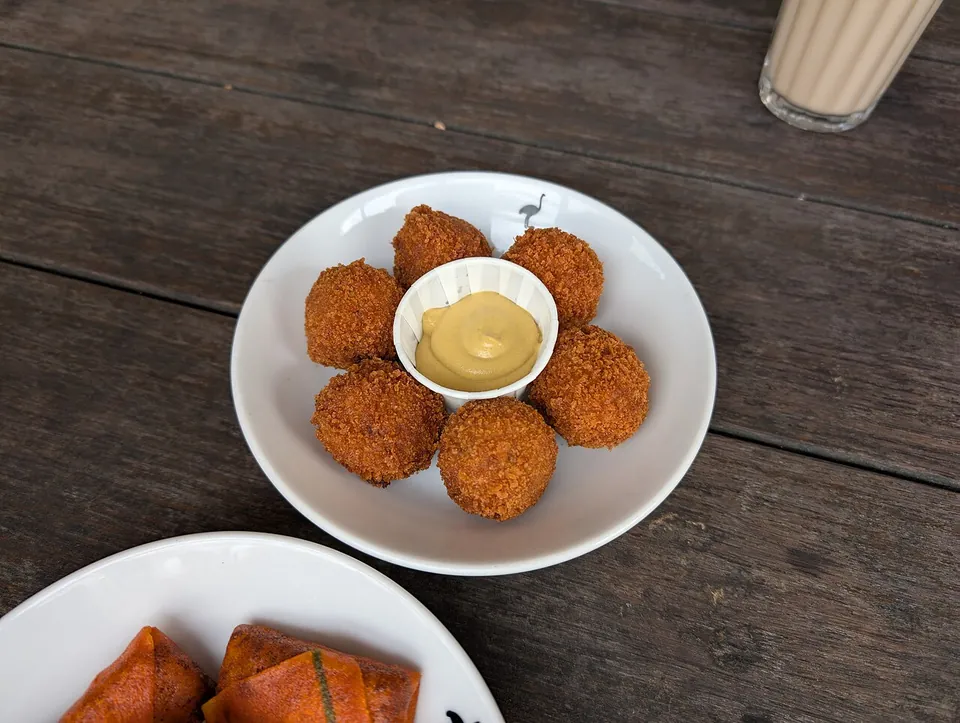
A bitterbal is a bite-sized round snack: a soft beef ragout chilled and set firm, coated in flour and breadcrumbs, and deep-fried. Bite in and the outside is crisp while a hot, creamy filling spills out. Served in cafés and bars with genever or beer, it is a staple of the Dutch pub.
The backbone of the dish is the French croquette (croquet). This technique—a rich ragout bound with butter and flour, chilled to set, then coated and fried—appears under the name croquets in Massialot's cookbook of the late seventeenth century, and reaches the Netherlands in the nineteenth. The first Dutch recipe for a kroket appears around 1830. The bitterbal is the round variant of that stick- or log-shaped croquette. It comes together only once the sequence is in place—set the ragout, roll it, wrap it in coating, and fry—a thrifty dish complete within the Old World, made possible by frying oil and a crumb coat. Leftover meat, not thrown away but recast into a rich sauce, rolled small and fried: there lies the real bitterbal.
The bitter in the name does not mean a bitter taste. Strong spirits like genever were once called a bittertje and enjoyed before dinner. The ball served alongside that glass is the bitterbal. This snack is inseparable from the Dutch culture of the borrel, the time spent over a pre-dinner drink. Less to eat for its own sake than to grace the hour of drinking, the little ball exists.
How we know
A fittingly colorful origin tale clings to the bitterbal. During the Eighty Years' War, so it goes, Spanish troops occupying the Netherlands brought the custom of tapas from home, coated leftover-meat ragout, and fried it into a ball that became the bitterbal's beginning. Often told in guidebook pieces, it makes for an appealing pedigree reaching back to the sixteenth century.
But no contemporary record supports this story. It is an origin legend without independent primary sourcing, and the dates do not fit. The croquette took root in the Netherlands in the nineteenth century, and the word bitterbal appears in writing only in the twentieth. Its first known print appearance is in the Algemeen Handelsblad of 17 February 1923, with a dictionary entry in 1946—more than three centuries removed from the age of the occupying troops. That said, the first appearance of a word is not the birth of the dish itself; the balls were surely eaten before the name reached print.
The naming, too, points nowhere near Spain. Onze Taal, the authority on Dutch etymology, explains that bitter derives from the pre-dinner bittertje, meaning neither a bitter taste nor a Spanish import. Who invented it and the exact year remain unrecorded—that much stays unresolved—but the path back to the French croquette and the naming after the ball served with a pre-dinner drink are firmly established. The alluring tapas-origin theory retires quietly to the side, a product of tradition rather than of the record.
The full set of origin theories and the detailed verification log — traceable all the way to their sources — are available on the Japanese edition.
See the full origin theories and verification log (Japanese) →