All dishes / ラテンアメリカ
Moqueca Period BOrigin theory CVerified
Some fields (dish name, region and gates) are shown from the Japanese-edition data.
Moqueca, the seafood stew of Bahia in Brazil, carries a name whose origin is still contested: a Tupi-language derivation and a West African Kimbundu one stand side by side, neither yet winning out.
Verification highlight popular claim → verdict → evidence
Myth: dendê-oil cooking in Bahia represents an unbroken ancient continuity carried directly from West Africa. Verdict: refuted as overstated — historian Case Watkins argues the Bahian dendê landscape and cuisine were actively reconstructed in diaspora rather than passed down unchanged from Africa; still, the arrival of dendê oil and coconut during the slave-trade era genuinely sets the material bottleneck for the current baiana style. Key source: Case Watkins, Landscapes and resistance in the African diaspora: Five centuries of palm oil on Bahia's Dendê Coast, Journal of Rural Studies.
The three gates
- Ingredient-supply gate
- The base is an Indigenous fish stew; the arrival of dendê (African oil palm) oil and coconut sets the lower bound for the current Bahian style.
- Cooking-technique gate
- Simmered in a clay pot.
- Venue gate
- Home cooking of Afro-Bahian communities, later a regional specialty.
Overview
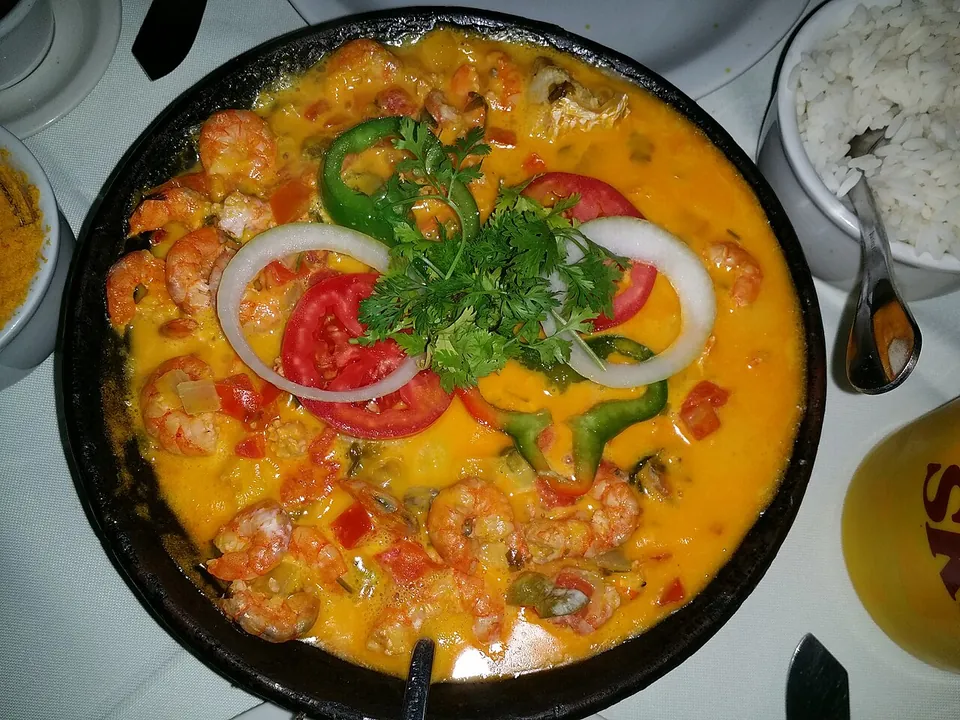
Moqueca is a stew of white fish and shellfish simmered slowly in an earthenware pot, a signature dish of the state of Bahia in Brazil. The best-known version, moqueca baiana, brings together the deep red of dendê oil pressed from the oil palm, the roundness of coconut milk, and the bite of chili, and it is rooted in the table of Salvador as an essential regional taste.
At the base of the dish lies the fish cookery of the indigenous Tupi-Guarani. The moquém technique — roasting or steaming caught fish over a frame of embers — is old, and it appears in the record left by the Jesuit Fernão Cardim around 1584 as 'peixinhos de moquém' (little fish done on the moquém). Onto that was laid the Portuguese method of the vegetable stew, the cozido.
Then ingredients that had crossed the Atlantic entered the kitchens of Bahia. Through the slave trade, dendê oil from the West African oil palm was brought over and had taken root on the Bahian coast within the seventeenth century; coconut, too, was carried to Brazil by way of Cape Verde in the mid-sixteenth century. These met the indigenous seafood stew, chili was added, and around the seventeenth and eighteenth centuries of the colonial period, the moqueca baiana of today took shape as a home dish of Afro-Brazilian communities. That the history folds together three food cultures — indigenous, Portuguese, and West African — is agreed on by several works, foremost the book by Câmara Cascudo regarded as the standard of Brazilian food history.
Yet the baiana we picture today does not reach back quite as far as one might think. The earliest systematic primary record of Bahian cooking is Manuel Querino's 'A Arte Culinária na Bahia' (1928), which gives a fish moqueca dressed in dendê oil with a sauce of salt, chili, coriander, lime, tomato, and onion. Tellingly, that 1928 recipe has no coconut milk yet. The coconut milk now thought indispensable enters moqueca baiana only around 1940 — a comparatively recent element of the preparation. The base technique may reach into deep antiquity, but the style itself has been rewritten with the times.
How we know
Over the broad outline — that three food cultures met here — there is little dispute among scholars. What refuses, surprisingly, to be settled is where the name 'moqueca' itself comes from.
One account derives it from the indigenous Tupi language: from pokeka, meaning 'to wrap,' or from moquém, the frame for roasting over embers. Câmara Cascudo, who gave shape to the study of Brazilian food history, held to this view. The word moquém already appears in sixteenth-century records, and that the cooking technique itself springs from the indigenous peoples is clear from the sources.
The other account derives it from the West African Kimbundu language. The Angolan Kimbundu word mu'keka means 'a stew of fish,' which sits closer to the sense of moqueca as the name of a dish. Yeda Pessoa de Castro, a scholar of Afro-Brazilian language, argued for this line in a 2001 work.
The name of the technique from the indigenous peoples, the name of the stew as a dish from the African tongue — of late some have come to read it this blended way. Yet there is no sign of it coming to rest on one side or the other. Just as the dish itself was born from the mingling of indigenous, Portuguese, and African, its name too may have been born in a place where several tongues overlapped.
There is one more thing worth setting straight. Of Bahia's dendê oil, some speak as of an unbroken, ancient continuity carried over intact from West Africa — the African oil culture crossing the sea just as it was and running on unchanged into the present. It is a romantic reading, but the sources do not support it. Trace the history of palm oil and Afro-Brazilian culture and Bahia's dendê landscape and foodways turn out to have been actively remade within the diaspora, reconstructed as a practice of resistance, not the homeland frozen and preserved. The myth of continuity falls away; what stands firm is the material fact that dendê and coconut arrived from abroad during the era of the slave trade and became the core of this style.
Moqueca, moreover, is not a single dish. The baiana style of Bahia told of here turns on dendê oil and coconut, while the capixaba style of neighboring Espírito Santo uses no dendê, tinting its lighter preparation red with olive oil and annatto instead. Neither is the parent of the other: from a shared indigenous Tupi base of fish simmered in an earthenware pot, each branched off in parallel by taking up a different oil — sister styles of equal standing. Under one name stand two lines that differ from the very oil up.
The full set of origin theories and the detailed verification log — traceable all the way to their sources — are available on the Japanese edition.
See the full origin theories and verification log (Japanese) →