All dishes / ラテンアメリカ
Pão de queijo Period COrigin theory CVerified
Some fields (dish name, region and gates) are shown from the Japanese-edition data.
A wheatless cheese bread from Brazil. The well-known story that enslaved women in an eighteenth-century gold-mining town invented it has no record surfacing in the archives of that era to back it up.
Verification highlight popular claim → verdict → evidence
A widely repeated story credits enslaved women in 18th-century gold-mining Minas Gerais with inventing this bread out of cassava starch. But researchers find no contemporary documentation of the dish anywhere in 18th- or 19th-century sources, suggesting it may be a more recent invention retrofitted with an older legend; the cheese version most likely coalesced later, as Minas Gerais grew into Brazil's dairy heartland in the late 19th century. Key source: a 2024 Estado de Minas article citing historian Monica Chaves Abdala's research on the absence of documentary evidence.
The three gates
- Ingredient-supply gate
- Cassava is native to South America; cheese came after cattle were introduced in the colonial period — both had to be available for this dish to take its current form
- Cooking-technique gate
- Shaping and baking a starch-based dough in an oven
- Venue gate
- From rural Minas Gerais households to urban breakfast and snack food
Overview
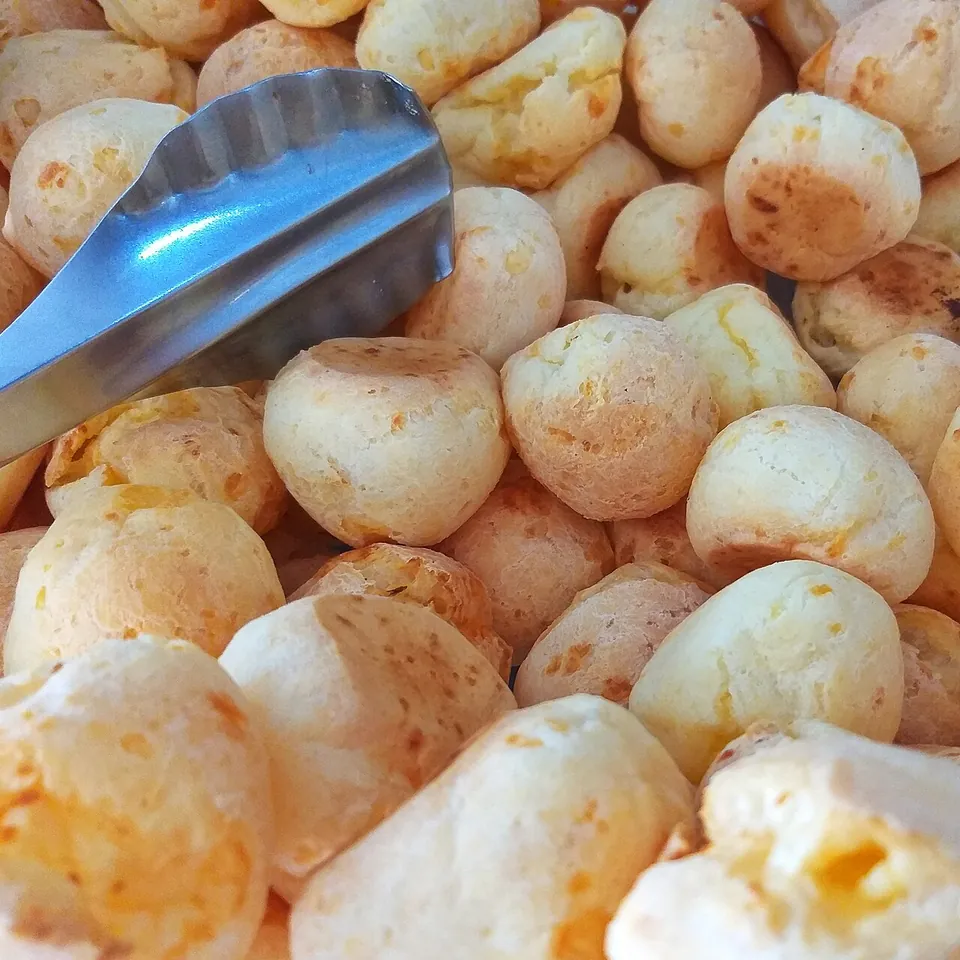
Pão de queijo is a wheatless Brazilian bread made from cassava starch (polvilho) worked into the dough and studded with cheese. Baked into a small, ping-pong-ball-sized round, it has a thin, dry crust and a distinctive elastic chew from the starch. It has long been eaten as a breakfast or afternoon snack, above all in the southeastern state of Minas Gerais.
Cassava, the leading ingredient, is a long-established South American crop that was on Indigenous tables from early on. Its grated, water-washed, dried root starch is polvilho. According to food specialists, polvilho came into culinary use around the middle of the eighteenth century, about 1750 (National Geographic Brasil, 2024). At first it was baked plain, more like a biscuit made of starch alone; working in scraps of cheese came later.
The other ingredient, cheese, took root in the hills of Minas along with the cattle-raising the colonial period introduced. Research by Embrapa records that dairying and the cheese trade in Minas began in the eighteenth century and strengthened through the nineteenth, and that by the 1920 agricultural census Minas accounted for roughly two-thirds of all cheese production in the country. After slavery was abolished in 1888, Minas became the country's dairy heartland and cheese turned into an everyday product of the farmhouse. This abundant Minas cheese meeting the starch dough is how today's pão de queijo is thought to have taken its present shape.
The method itself is plain: polvilho mixed with hot water, fat, egg and grated cheese, shaped by hand, and baked in an oven. Bread once baked in farmhouse kitchens was carried in time to the towns and became part of the urban breakfast table. The name and the method first appear clearly in writing only in the twentieth century — in a home cookbook of the 1940s, then spreading as a shop-bought item through the 1950s and 60s. It reached the whole of Brazil only later still, in the 1970s.
Just when it was born stays open, somewhere between the close of the nineteenth century, when dairying flourished, and the first half of the twentieth, when the record turns solid. For now, what can be said is only that it dates from around when cattle filled the Minas hills and cassava starch had become a kitchen staple.
How we know
Ask in Brazil where this small bread comes from, and the answer that comes back is almost always the eighteenth century. In gold-rush Minas Gerais, wheat was hard to come by, and enslaved African women working the kitchens of the great houses are said to have worked cassava starch at hand into a wheatless bread — a well-known origin story bound up with Minas pride.
Yet no record of this episode has surfaced in the archives that document the gold-mining years, nor in the accounts of the nineteenth-century foreign travelers who wrote in detail about the region's food as they passed through. The dish appears too rarely in cookbooks of the nineteenth and twentieth centuries for something said to be a signature food of Minas. Researcher Mônica Chaves Abdala points to this "considerable absence in the historical record" and asks whether it is instead a comparatively recent invention assembled out of later memory and lore — an invented tradition. Studies of nineteenth- and twentieth-century sweets and snacks (quitutes) by Sônia Maria de Magalhães and Maria do Carmo Pires likewise show how rarely the dish turns up (Estado de Minas, Carolina Figueira's column, August 2024).
That the enslaved-invention story lacks documentation had already been noted inside Brazil. Food specialist Vani Fonseca of Senac MG has likewise said the origin of this dish was never set down in writing and remains shrouded in mystery (National Geographic Brasil, 2024).
Still, an absence of record does not by itself pin down a birth year. What the silence of the sources shows is only that the eighteenth-century story has no footing to stand on — it does not positively point to a later date of origin either. Only two things can be said with confidence: that polvilho came into culinary use around 1750, and that the dish's name and method appear clearly in writing only in the twentieth century — a home cookbook of the 1940s, then commercial spread through the 1950s and 60s.
The view that today's cheese-laden form settled at the end of the nineteenth century, meanwhile, rests on evidence from the cheese side. Research by Embrapa tracing the growth of Minas dairying and the cheese trade, and the region's rise to national dairy center after the 1888 abolition of slavery, explains well enough the conditions under which abundant cheese could have been worked into the starch bread. But that is a story about surrounding conditions — no document from nineteenth-century Minas has been found stating that the dish itself was being baked then.
So the eighteenth-century origin story and the late-nineteenth-century dairy account stand side by side, and into that stands the further point that neither is accompanied by a contemporary record. Nothing here is settled, and the date of origin stays open within a span running from the close of the nineteenth century to the first half of the twentieth. The people of Minas who say they have "always" eaten this bread have, for now, no source that can say just when that "always" begins.
The full set of origin theories and the detailed verification log — traceable all the way to their sources — are available on the Japanese edition.
See the full origin theories and verification log (Japanese) →