All dishes / 西欧
Smørrebrød Period BOrigin theory CVerified
Some fields (dish name, region and gates) are shown from the Japanese-edition data.
Smørrebrød, the Danish open sandwich with its toppings piled up in three dimensions, is a refined plate today, but it began as the plain packed lunch that workers carried to the job. And the well-known tale that one restaurateur "devised 178 kinds all at once in 1888" has some exaggeration folded into it.
Verification highlight popular claim → verdict → evidence
Competing accounts remain unsettled. The leading narrative holds that today's urban open-faced sandwich, topped with cold cuts and pickled fish, took shape in 19th-century Copenhagen as industrialization made home lunches impractical, building on the older rural klemmer (buttered rye bread, a practice dating to the 1600s) that workers carried to their jobs. The word Smørre-Brød itself is attested as early as c.1731 (Holberg, per ODS), though that only documents the older, simpler 'buttered bread' genre, not the modern urban style.
The three gates
- Ingredient-supply gate
- Rye and butter were locally available; a range of toppings depended on market distribution.
- Cooking-technique gate
- Buttering dense rye bread and assembling it with toppings.
- Venue gate
- Originated as a laborer's packed lunch, later refined at specialist restaurants.
Overview
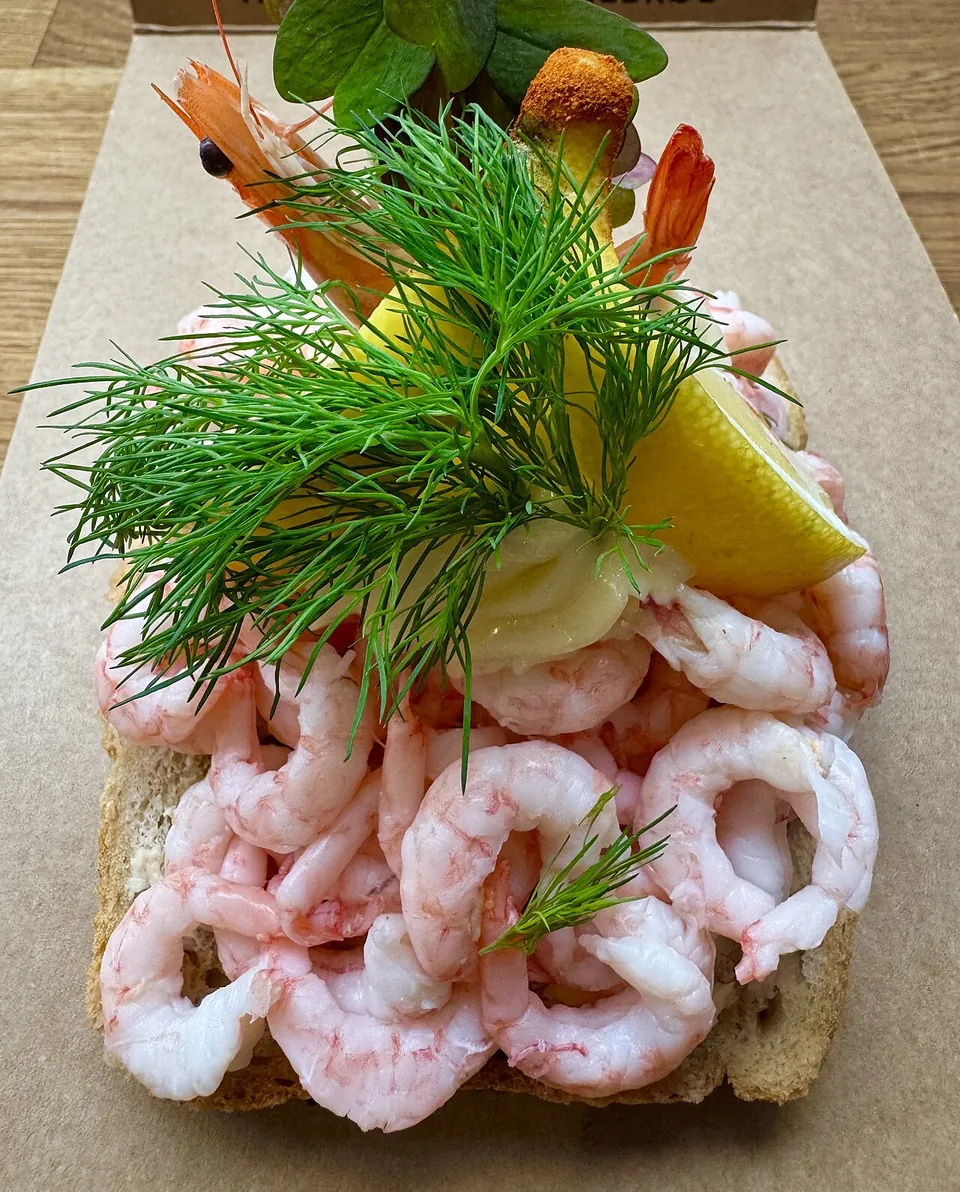
Smørrebrød is an open sandwich that became an everyday food in nineteenth-century Denmark, above all in the capital, Copenhagen. Dark rye bread is spread with butter, and a range of toppings is arranged on top.
On the side of ingredients, this dish met no great barrier. Rye and butter were long-established Danish foods, on everyday tables from early on, and the toppings could be had through the market. Since the Middle Ages, Danish eating had been built around bread.
In fact, the very term "buttered bread" is old. The word smørrebrød already appears in the works of the playwright Ludvig Holberg, around 1731. Go back further and the klemmer, two slices of rye bread with butter between them, was eaten in the countryside of the 1600s as a lunch to take out to the fields. In other words, the genre of "buttered bread" has a long prehistory of its own.
Even so, the urban open sandwich we know now, with cold cuts and pickled fish stacked up in three dimensions, took its present shape in the nineteenth century. What drove this shift was a change in the setting where it was served. Through the nineteenth century, against the backdrop of Copenhagen's urbanization and factory work, the rural custom of the packed lunch was carried into the city as the workers' midday meal. Leftovers laid on rye bread and taken to the job, eaten as a snack in the taverns, took hold as an everyday food. In time it was brought into dedicated restaurants and reworked into a refined plate.
How we know
Smørrebrød's history holds two overlapping stages: the stage in which it became an everyday food as a plain packed lunch, and the stage in which specialist restaurants polished it into an artful plate. These are not rival theories but the first and second halves of one continuous movement, from the people's lunch to commercial refinement.
First, the plain beginning. Against the urbanization and factory work that grew in Copenhagen from the 1850s on, the rural custom of the packed lunch became an everyday food as the city workers' midday meal, an adaptation of the bread-centered eating of the Middle Ages to city life.
The other stage belongs to the restaurant that carried the refinement. Here sits a much-repeated anecdote: that at the establishment the wine merchant Oskar Davidsen opened in 1888, more than 170 kinds of smørrebrød were devised all at once. But the telling has exaggeration folded into it. The year 1888 was only when the restaurant opened, and it was his wife, Petra Davidsen, who actually made the smørrebrød for customers. The famous list of 178 kinds was not drawn up in 1888 but around 1900, the first year of the new century, according to the Davidsen family's own record. Pinning the invention on the proprietor Oskar as an individual, and the year of devising to the 1888 opening, is something that swelled in later retelling.
Even so, the role of the Davidsen family's restaurant in pushing a plain packed lunch up into a refined dish, stacked in three dimensions, is not in doubt. The practical line of the plain packed lunch, and the culinary line polished by the specialist restaurant: these two overlap to give smørrebrød its two faces.
The full set of origin theories and the detailed verification log — traceable all the way to their sources — are available on the Japanese edition.
See the full origin theories and verification log (Japanese) →