All dishes / 中東・北アフリカ
Molokhia Period BOrigin theory CVerified
Some fields (dish name, region and gates) are shown from the Japanese-edition data.
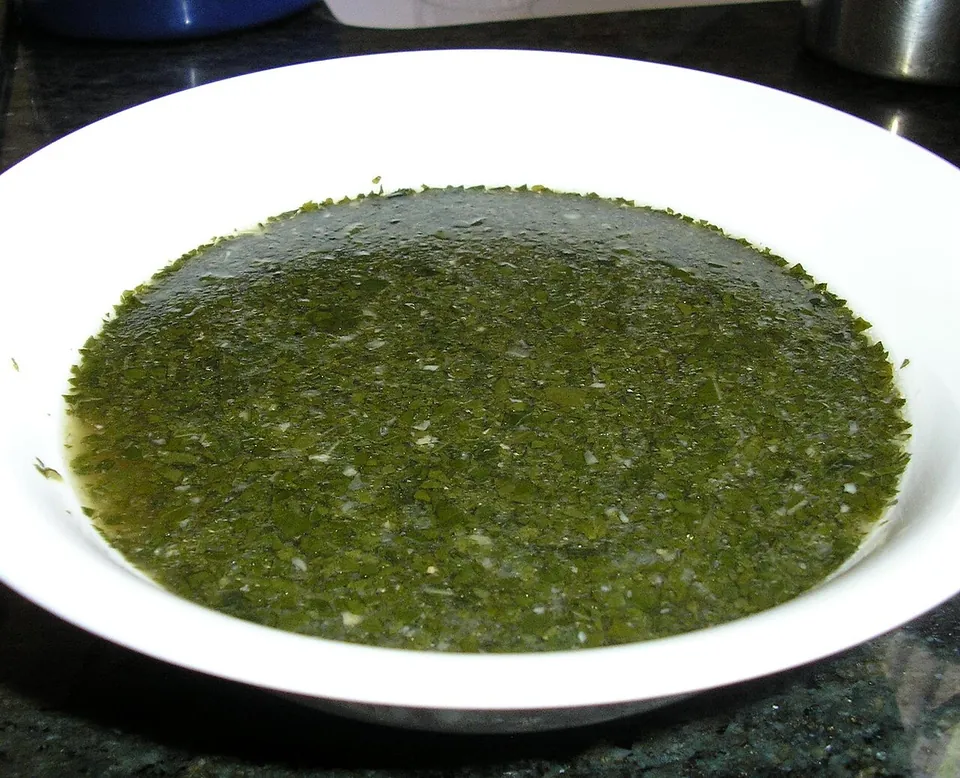
Molokhia is an Egyptian home dish whose finely chopped leaves are simmered into a distinctively slippery, mucilaginous soup. The popular claim that its name comes from the Arabic for kings (muluk), that it was the pharaohs' restorative vegetable of kings, reads royalty into the name after the fact on a chance resemblance of sound.
Verification highlight popular claim → verdict → evidence
Many scholars trace molokhia's use as food back to ancient Egypt, since the jute mallow plant is native to the Nile valley and its name appears in ancient Mediterranean languages, though solid primary evidence for ancient-period consumption is scarce. The earliest secure documentary records of it as a dish cluster in the medieval Islamic period: the historian al-Maqrizi (d. 1442) reports that the 7th-century Umayyad caliph Muawiya was fond of it, the Fatimid caliph al-Hakim banned it by decree in 1005 as a supposed aphrodisiac, and recipes for it appear in 13th-14th century Arabic cookbooks. A separate popular legend claims the name derives from Arabic 'muluk' (kings), linking the dish to a supposed royal or pharaonic health food -- but this is a false etymology; the name actually derives from an ancient Mediterranean plant name (Greek 'malache'/'molokhe,' related to mallow) that merely resembles 'muluk' by coincidence.
The three gates
- Ingredient-supply gate
- Jute mallow (molokhia) is native to the Nile valley, so the limiting ingredient is a local native plant and the ingredient side of the constraint is old.
- Cooking-technique gate
- Finely chopping the leaves and simmering them in broth to bring out their characteristic sliminess, seasoned with a garlic-and-coriander tempering (taqliya).
- Venue gate
- An everyday household dish since ancient Egypt.
Overview
Molokhia is a soup-like dish in which the leaves of jute mallow (Corchorus) are finely chopped and simmered in chicken or rabbit stock until they turn distinctively slippery. It is finished with taqliya, an aromatic of garlic and coriander bloomed in oil. The main ingredient, jute mallow, is a plant long native to the Nile valley, growing there of old and used both as food and for fiber. The ingredients were at hand in this land, and the dish has been part of the everyday table of ordinary Nile-valley households for a very long time.
The plant name for jute mallow appears in the ancient languages of the Mediterranean, among them ancient Egyptian and Greek. Simmering and eating the leaves is thought to be an old practice, and the dish has a deep history. Even so, it is hard to fix in precise dates just when it was eaten in something like its present form, and its beginnings have to be understood within a wide span.
How we know
The name molokhia, the story goes, comes from the Arabic muluk (kings), and the dish was the vegetable of kings that pharaohs prized as a restorative after illness. This account circulates widely on recipe sites and in general encyclopedias.
But the name owes nothing to kings; the likeness is only a chance resemblance of sound. The plant name molokhia goes back not to muluk but to an ancient Mediterranean plant name. It belongs with the Greek malache/moloche (of the mallow family) and cognate words of Egyptian origin, and the Arabic spelling mulukhiyya only happens to look like muluk (kings) by coincidence of sound. What a word sounds like it comes from is not where the dish comes from. As for the specific tale of a post-illness food for pharaohs, no contemporary source records anything of the kind; the account has no footing in the writings of the age it claims.
So how far back can the dish itself be reliably traced? The records cluster instead in the medieval Islamic period. The historian al-Maqrizi (d. 1442) reports that the Umayyad caliph Muawiya (r. 661-680) was fond of molokhia. In 1005 the Fatimid caliph al-Hakim, regarding it as an aphrodisiac, issued a decree banning its consumption, which his successor al-Zahir later lifted. The oldest surviving direct record of the dish is a thirteenth-century Syrian cookbook, the al-Wusla ila al-Habib (Ibn al-Adim, d. 1262), which sets down several ways of preparing it. Written records reach back this far; anything earlier, any ancient origin, stays in the realm of tradition and circumstantial evidence.
That the plant itself was long present in the Nile valley is one thing; the naming tale of a courtly vegetable of kings is another. This is a home stew of deep history, and the royal story attached to its name was a garment draped over it by later generations.
The full set of origin theories and the detailed verification log — traceable all the way to their sources — are available on the Japanese edition.
See the full origin theories and verification log (Japanese) →