All dishes / ラテンアメリカ
Anticucho Period BOrigin theory CVerified
Some fields (dish name, region and gates) are shown from the Japanese-edition data.
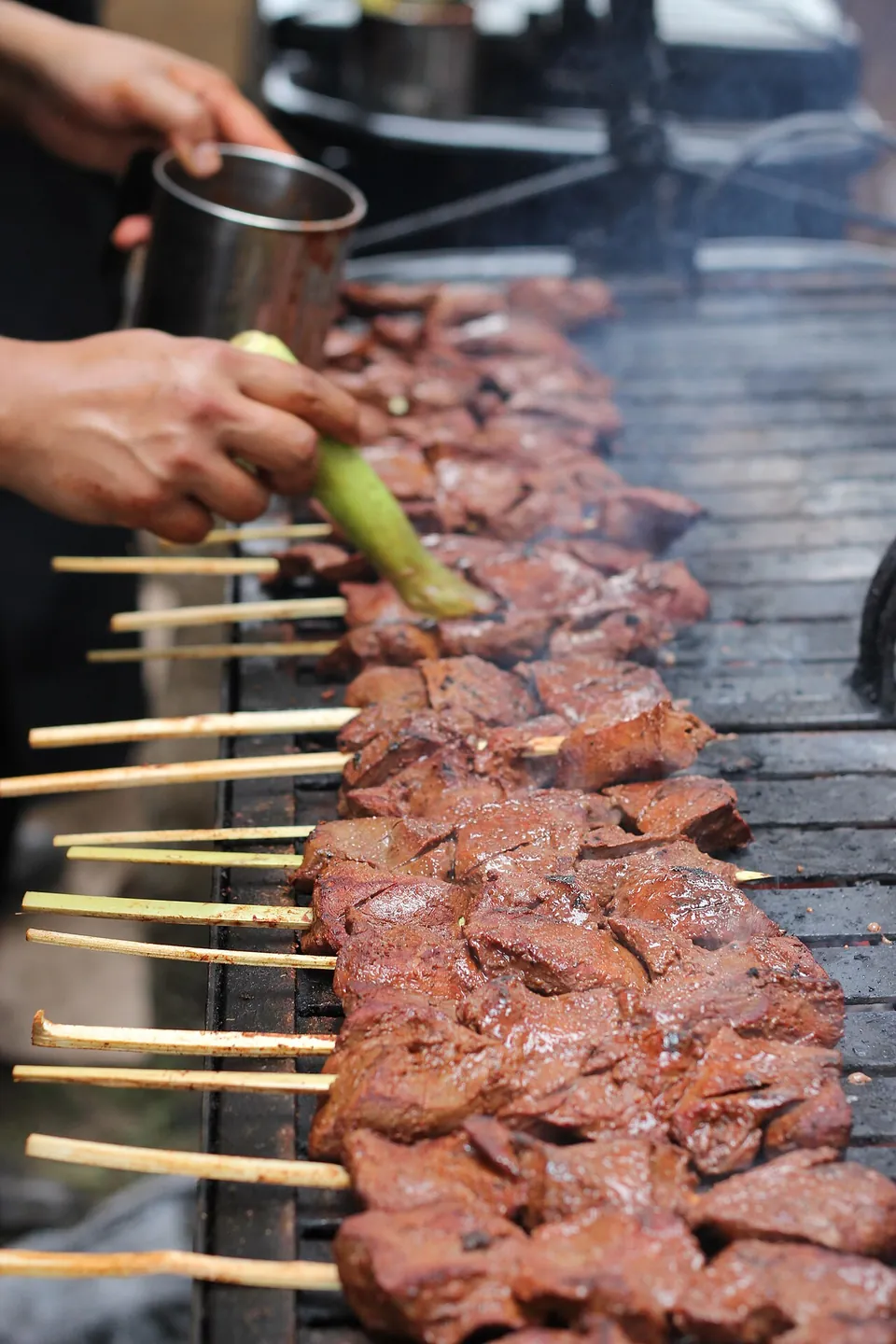
Anticucho, the skewered and grilled meat of Peru. Threading meat onto sticks to cook over open flame reaches back into the Andes long before the Inca, but the beef-heart anticucho now sizzling at street stalls could not come into being until cattle crossed the ocean with the Spanish. It is a dish of the colonial era.
Verification highlight popular claim → verdict → evidence
Myth: the pre-Inca/Inca tradition of grilling skewered meat is itself the current beef-heart anticucho. Debunked — cattle only reached Peru after the Columbian Exchange (from 1532), so the old skewer-grilling genre used native animals, not beef. The current beef-heart version instead took shape in the colonial era, when enslaved Afro-Peruvians on coastal estates were given offal cuts and marinated and grilled them with native aji pepper and Spanish garlic and cumin.
The three gates
- Ingredient-supply gate
- Pre-Inca ritual skewer-grilling used native animals; cattle arrived after the Columbian Exchange (from 1532), and the current version using beef heart took shape during the colonial era, making cattle the limiting ingredient.
- Cooking-technique gate
- Open-fire skewer grilling with an aji-pepper marinade, a native technique.
- Venue gate
- From ritual sacrifice to a cheap-cut street and market food that spread widely among commoners in the colonial era.
Overview
Anticucho is a Peruvian dish of marinated meat threaded onto skewers and grilled over an open fire. The standard version today uses beef heart, cut into bite-sized pieces and steeped in a marinade of aji panca chili with garlic, cumin, and vinegar before grilling. Skewering and grilling meat is itself old, already present in the Andes before the Inca. The name is usually traced to the Quechua Anti Kuchu (a cut of meat from the eastern Andes), though this etymology is not decisive. The meat grilled on those early skewers was llama, native deer, and other animals of the land.
What sets the beef-heart version apart is the beef itself. Cattle were not a native American animal; they were brought to Peru by the Spanish conquest, from 1532 onward. Only after cattle had taken root and offal such as heart began to appear on the streets as cheap fare could the beef-heart anticucho emerge. So the anticucho of today is a colonial-era dish. Its flavor is built from the meeting of old and new: the native aji panca chili on one side, and the garlic, cumin, and vinegar the Spanish brought on the other.
How we know
Anticucho is dogged by the telling that a pre-Inca grill has carried on unbroken to the present day. The antiquity of the grilling is real, and its early ingredients are rooted in the native cultures of the Andes. But what turned on those old skewers was llama and deer, not cattle. Cattle were a foreign animal that arrived in the New World, and a version built around beef heart can only come after them.
The current anticucho de corazon (beef heart) is often told as a dish created in the coastal plantations of the colonial period, where enslaved Afro-Peruvians took the discarded offal and steeped it in native aji panca with the Spanish garlic, cumin, and vinegar. That enslaved people marinated the offal in native chili is not in doubt. But the story of the discarded offal is also a simplification. The researcher Tulio Frasson (Infobae Peru, 2024) points out that eating offal was widespread in the Mediterranean food cultures of Italy, Spain, and Portugal, and that Spanish settlers may well have brought the practice with them.
The date, too, has lost a fixed point long repeated. The account of Lima street stalls in Ricardo Palma's Tradiciones Peruanas has often been cited as a record from 1833. But 1833 is the year Palma was born, not the year of the event. Tradiciones Peruanas appeared between 1872 and 1910, and the tradicion is a genre that blends historical fact with literary embellishment; Palma was not a historian. The emergence of the current form can be placed in the colonial era, but the precise year of its first appearance is still not pinned down by firm sources.
The full set of origin theories and the detailed verification log — traceable all the way to their sources — are available on the Japanese edition.
See the full origin theories and verification log (Japanese) →